


For decades, biotech companies have chased the same target: disease-causing proteins inside cells. The standard playbook? Develop drugs that bind to these proteins and shut them down. Take cancer-causing kinase proteins, for example – drugs typically block their ATP-binding sites to stop them from functioning. But here’s the problem: blocking a protein isn’t the same as getting rid of it.
That’s why the industry shifted toward targeted protein degradation (TPD) – technologies that actually destroy harmful proteins using the body’s built-in disposal system. The most famous example is PROTAC (PROteolysis TArgeting Chimera), which works like a molecular tag team. Ubiquitin molecules attach to defective proteins like sticky notes marked “destroy me,” and the proteasome – think of it as the cell’s shredder – does the rest.
But PROTAC has its own baggage. The technology relies on E3 ligase enzymes to stick those ubiquitin tags onto target proteins. Problem is, we’ve only figured out how to use about two types of E3 enzymes out of roughly 600 that exist in cells. Plus, the whole tagging-and-shuttling process burns through energy and time, and there’s no guarantee it’ll work.
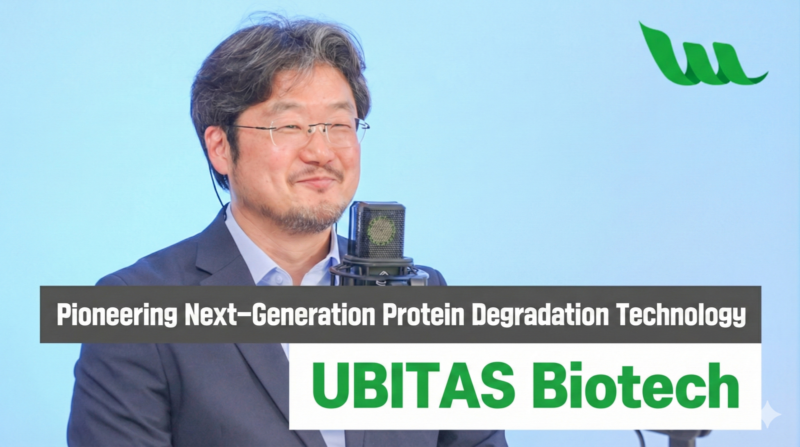
That’s where Seoul-based UBITAS Biotech comes in. Founded in 2025 by Professor Min-Jae Lee from Seoul National University’s College of Medicine, UBITAS has cracked a code that’s eluded the industry: how to destroy proteins without the ubiquitin middleman.
Professor Lee isn’t new to this game. After earning his chemistry degree from Seoul National University and doing postdoctoral work at Harvard Medical School, he’s spent 20 years studying how cells break down proteins. With over 80 international papers to his name, he knows this field inside out. And what he’s built is genuinely different.
UBITAS’s breakthrough – called Protea-Tac – cuts straight to the chase. Instead of using ubiquitin as a go-between, it directly connects target proteins to the proteasome using intracellular antibodies like scFv and nanobodies. These antibodies grab onto the target protein and hand it directly to the proteasome. No tags, no E3 enzymes, no waiting around. Just direct destruction.
Here’s why that matters: by skipping ubiquitin and E3 enzymes – two components everyone thought were essential – Protea-Tac offers a much faster, cleaner path to destroying disease proteins. It’s a paradigm shift, and globally, the field remains largely unexplored.
The lab results back it up. In animal studies, Protea-Tac slashed levels of c-fos protein, which cancer cells produce in abundance. When c-fos dropped, cancer cells lost their ability to divide endlessly – arguably cancer’s most dangerous trait – and tumors shrank significantly. Professor Lee published these findings and filed patents in Korea, the US, China, and Europe. “Since we published, we’ve been hearing from global biotech companies,” he says. “PROTAC researchers in China and Japan are taking notice too.”
What about scalability? “Just swap out the antibody component – the scFv or nanobody – and you can target different proteins,” Professor Lee explains. That means Protea-Tac isn’t locked into cancer treatment. It could work for neurodegenerative diseases, metabolic disorders, muscle diseases – pretty much anywhere a protein needs eliminating. Since no one else has registered this technology internationally, UBITAS is going for “First-in-class” regulatory approval.
Of course, challenges remain. UBITAS needs to work with antibody developers to boost expression levels inside cells. They’ve validated the technology with c-Fos protein, but expanding to other targets and confirming it works in human cells are still open questions. And there’s the reality every biotech startup faces: bringing a new drug to market typically takes close to a decade. Compressing that timeline is no small feat.
That’s why UBITAS is actively fundraising. In 2026, the company plans to secure investment while joining the TIPS (Tech Incubator Program for Startup) program to accelerate growth. After Yuhan Corporation’s Leclaza, Korea is hungry for its next global drug success story. Could UBITAS be it?
What problem is UBITAS tackling?
We’re building a new game-changer in targeted protein degradation – a field where pharmaceutical companies are pouring billions. TPD drugs don’t just block disease-causing proteins; they eliminate them entirely. It’s a completely new drug modality, and everyone from Big Pharma to Korean drugmakers is racing to crack it.
But here’s the thing: existing technologies have biochemical limitations that lead to disappointing efficacy. We’ve developed a first-in-class TPD platform that sidesteps these restrictions. We’ve already demonstrated anti-cancer effects in animal studies, and through continued R&D, we’re aiming to create the world’s first high-efficiency, non-toxic TPD anti-cancer drug.
How does UBITAS solve this problem?
Protea-Tac’s core advantage is simple: it goes straight to the cell’s protein-shredding machinery – the proteasome. By doing this, we overcome the low efficacy that’s plagued existing TPD drugs while creating a platform that’s easy to adapt for new therapeutics. We developed this technology as a global first, with patents filed in Korea, the US, Europe, and China.
We’ve presented the detailed methodology at international conferences and published it in scientific journals. As a first-in-class technology, nothing like it exists anywhere else. We’re confident UBITAS can lead the global market.
What makes UBITAS competitive?
Protea-Tac isn’t just another anti-cancer drug – it’s a platform. Our TPD drug has two modules: one that targets disease proteins and another that targets the proteasome.
Swap out the disease protein-targeting module, and suddenly you can eliminate proteins behind neurodegenerative diseases, metabolic disorders, you name it. Because this modular swapping uses simple cloning procedures, new drug development becomes significantly faster and more precise than small molecule-based TPD approaches.
This differentiation lets us avoid going head-to-head with global pharma giants while carving out our own technological edge.
What does UBITAS offer, and where are you now?
We’re not just another bioventure making anti-cancer drugs. UBITAS is a TPD platform company that can eliminate disease-causing proteins at their source. By offering platform services, we can build valuable R&D references before launching our own drugs while generating early revenue. We’re also pursuing partnerships with global pharma companies and domestic ventures for collaborative drug development.
First-generation Protea-Tac technology is already protected by intellectual property, and we’re actively developing second-generation tech. We expect to have technology that’ll turn heads globally by 2026.
Who are your customers, and how big is the market?
The TPD anti-cancer drug market alone is projected to hit $68 billion USD (100 trillion KRW) by 2035. That’s huge, but we think Protea-Tac can punch into the hundreds-of-billions-dollar global anti-cancer market through combination therapies with existing treatments.
Over the past decade, TPD-related technology transfers totaled over 50 deals worth more than $8.2 billion USD (12 trillion KRW). UBITAS plans to maintain R&D momentum through diverse business models – building our own pipeline and licensing platform technology.
Global pharma companies and Korean firms developing new drugs are all potential customers. We’re focused on maintaining close partnerships for technology transfers and integration opportunities.
What’s your business model?
UBITAS’s TPD platform runs on two tracks. Long-term, we’re developing proprietary anti-cancer drugs and treatments for neurodegenerative diseases like dementia. We’ve got drugs in preclinical trials now, with second-generation drugs in development.
Medium to short-term, revenue will come from platform technology transfers, licensing, licensing-out pipeline intermediates, technology fees, and licensing agreements.
What has UBITAS achieved so far?
Around our 2025 launch, we secured over $68,000 USD (100 million KRW) in government grants from the Ministry of SMEs and Startups’ Preliminary Startup Package and the Ministry of Science and ICT’s Innovation Startup Lab program. Through this, we’ve refined our technology and expanded IP protection from Korea and the US to China and Europe. We’ve filed domestic patents for second-generation tech and shared core findings through papers and academic presentations.
Since then, pharmaceutical companies and university researchers have been reaching out for research collaboration and resource sharing. We take this as validation that UBITAS’s technology is gaining global recognition. Right now, we’re continuing R&D while preparing to bring on additional researchers and secure investment.

What makes your team competitive?
Our research team’s capabilities are our biggest asset. I’ve been researching this field for over 20 years, and I can confidently say we’ve reached world-class academic depth. When I realized our TPD technology had real commercialization potential and international competitiveness, founding UBITAS was the natural next step.
My team brings research experience across chemistry, pharmacy, biology, and medicine, plus practical commercialization experience including successful licensing deals. These technical capabilities, our tangible and intangible research resources, and how they work together – that’s our competitive edge.
Three reasons to invest in UBITAS
First: UBITAS has original technology in the TPD research field, which is currently seeing the most active R&D investment globally. With validated technology and secured IP, we can set the next-generation TPD standard. TPD anti-cancer drugs can create new markets while enabling combination treatments with existing drugs, opening up a hundreds-of-billions-dollar opportunity.
Second: UBITAS has world-class researchers in protein degradation and related fields necessary for new drug development. We’ve already secured innovative technology with all the resources and know-how needed for continued R&D.
Third: UBITAS balances long-term goals – directly developing GLP-level anti-cancer drugs – with medium-to-short-term objectives like platform and pipeline technology transfer. This diversified business model ensures continuous revenue and R&D momentum. Working with Korea’s top experts, we’re building an innovative drug company like Amgen or Moderna, right here.
What’s UBITAS’s vision?
We’re building a new drug development company based on world-class biochemistry that contributes to innovation in university and national research culture. Moderna, Novo Nordisk, Genentech, Amgen – they all started as small professor-founded bioventures. We’ll do everything we can to make UBITAS’s technology lead to the world’s first truly innovative anti-cancer drug in its class. Through that, we want to show young people a new vision and help advance Korea’s pharmaceutical industry.
MORE FROM THE POST
- [Korean Startup Interview] BioArchers: Revolutionizing Oral Drug Delivery with NanoLink™ Platform Technology
- [Korean Startup Interview] Beyondmedicine, Pioneering World’s First Digital Therapeutic for TMJ Disorders
- [Korean Startup Interview] Peptirna Therapeutics Aims for Global siRNA Market with Peptide Delivery Platform
- [Korean Startup Interview] MAI Derma’s Cutting-Edge Skincare Tech: The Power of Painless Microneedles
- [Korean Startup Interview] KINGO Bio Challenges Global Giants with Innovative Clean Up Beads Solution ‘GraBeads’
Share

Most Read
- 1
- 2
- 3
- 4
- 5

Leave a Reply