


Korea’s Venture Investment Surges 14% to $9.6B in 2025


Korea’s Ministry of SMEs and Startups reported that venture investment in the country jumped to $9.6 billion USD (13.6 trillion KRW) in 2025, a 14% increase from the previous year. The figure marks the second-highest annual total on record, trailing only 2021’s peak performance.
Deal volume hit an all-time high of 8,542 transactions, while the average deal size grew 12.3% to $1.12 million USD (1.59 billion KRW). The data represents the first comprehensive annual report since the new government took office in June 2025.
The second half of 2025 showed particularly strong momentum, accounting for $5.6 billion USD (7.9 trillion KRW) of the annual total compared to $4 billion USD (5.7 trillion KRW) in the first six months. Nearly 80% of the year-over-year growth—about $990 million USD (1.4 trillion KRW)—came in the latter half of the year.
New venture fund formations jumped 34.1% to $10.1 billion USD (14.3 trillion KRW), with second-half activity up 45% from the same period in 2024. What’s particularly striking is that private capital drove this expansion, contributing $8.1 billion USD (11.5 trillion KRW)—about 80% of the total and a 40.5% increase from 2024.
Pension funds and mutual aid associations more than doubled their commitments with a 165% increase, while general corporations grew their investments by 61.5% and financial institutions by 28.6%. Policy financing added $1.9 billion USD (2.7 trillion KRW) to the mix.
Market analysts attribute the second-half surge to domestic and international interest rate cuts combined with investor optimism about the new government’s pro-venture investment stance.
ICT services led all sectors with a 20.8% share of total investment, followed by bio and healthcare at 17.4% and electrical machinery and equipment at 14.6%. Together, these three sectors captured just over half of all venture dollars, though their dominance has been gradually declining over the past five years as investment spreads more evenly across industries.
Bio and healthcare saw the biggest dollar increase at $377 million USD (534 billion KRW), while gaming posted the fastest growth rate at 69.4%. The ministry pointed out that ICT services investment declined as capital that poured into platforms and software during the COVID-19 pandemic has been shifting toward hardware sectors like ICT manufacturing and electrical machinery.
Companies in their first seven years captured 45.6% of total investment at $4.4 billion USD (6.2 trillion KRW), up 11.3% from 2024’s $3.5 billion USD (5 trillion KRW). Even the earliest-stage companies—those less than three years old—saw investment grow 1.9%.
But later-stage companies beyond their seventh year drew the bigger share at 54.4%, pulling in $5.2 billion USD (7.4 trillion KRW)—more than $700 million USD (1 trillion KRW) above 2024 levels. This tilt toward mature companies reflects investors’ growing appetite for proven businesses over earlier-stage bets.
To counter this trend, the ministry plans to double its Mother Fund allocation for early-stage ventures to over $235 million USD (333.3 billion KRW). This includes a dedicated $35 million USD (50 billion KRW) “startup fever fund” targeting companies selected through the “Startup for Everyone Project.”
The ministry has also revamped its fund investment criteria to favor early-stage investing—giving preference to funds with mandatory early-stage requirements, weighing early-stage track records in evaluations, and paying bonus performance fees based on early-stage results.
Korea now has 27 unicorn companies valued at over $1 billion, with representation across e-commerce (8 companies), cosmetics (3), fintech (3), AI semiconductors (2), data (2), travel and accommodation (2), and cloud services (2). On average, these companies took 7 years and 8 months to reach unicorn status from their founding.
Four new unicorns joined the ranks in 2025: Rebellions and FuriosaAI, both AI chip designers; Benow, a cosmetics manufacturer; and Galaxy Corporation, which operates in AI and entertainment technology.
What’s notable about the new additions is their diversity. While earlier Korean unicorns were largely B2C platform businesses, the 2025 class spans deep tech sectors like AI semiconductors, data infrastructure, fintech, and cloud computing—suggesting the ecosystem is maturing beyond consumer internet companies.
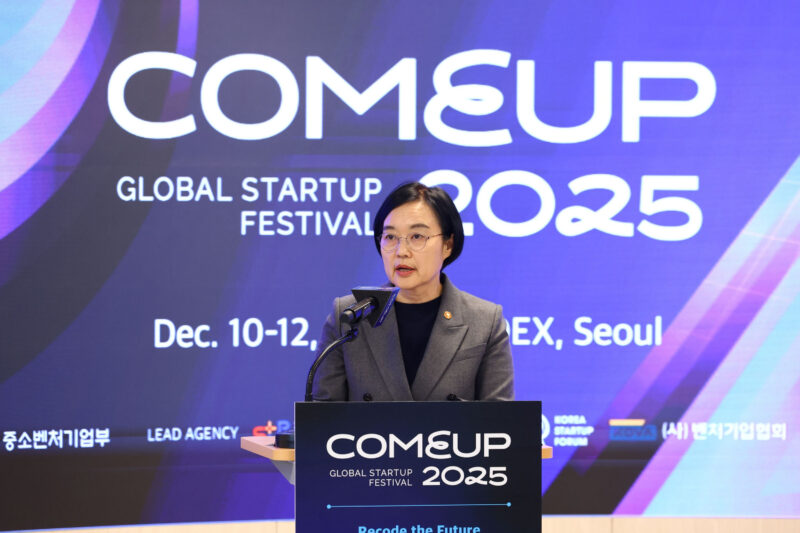
Minister Han Sung-sook welcomed the results, particularly the surge in private capital. “It’s encouraging to see both venture investment and fund formation grow substantially, with private money leading the charge,” she said. “But we’re not stopping at bigger numbers—we want to help these venture companies scale into unicorns and become real drivers of innovation and economic vitality.”
MORE FROM THE POST
- MSS Reports Korea’s Venture Investment Rebound in 2024, Outpacing Global Trends
- Korea’s Venture Investment Market Grows by 11.3%, Reaching KRW 8.6 Trillion in Q3 2024
- South Korea Reports 6% and 42% Growth in Venture Investments and Funds Early in 2024
- South Korea’s Q1 2023 venture investment down 60% year-on-year
- Korea and France Mark a Decade of Startup Ties — With Bigger Plans Ahead
Share

Most Read
- 1
- 2
- 3
- 4
- 5

Leave a Reply