


- AI
- ·
- Government
South Korea Taps Six AI Startups to Bring Public Data to Work for Small Businesses


South Korea’s Ministry of SMEs and Startups has picked six AI startups as the final winners of the OpenData x AI Challenge, a program that unlocks public-sector datasets to help entrepreneurs build tools with direct, practical value for small businesses. The winners gathered at the Global Startup Center in Seoul alongside private-sector AI experts for a roundtable that looked back on the development process and explored how the resulting solutions might find a home in real policy settings.
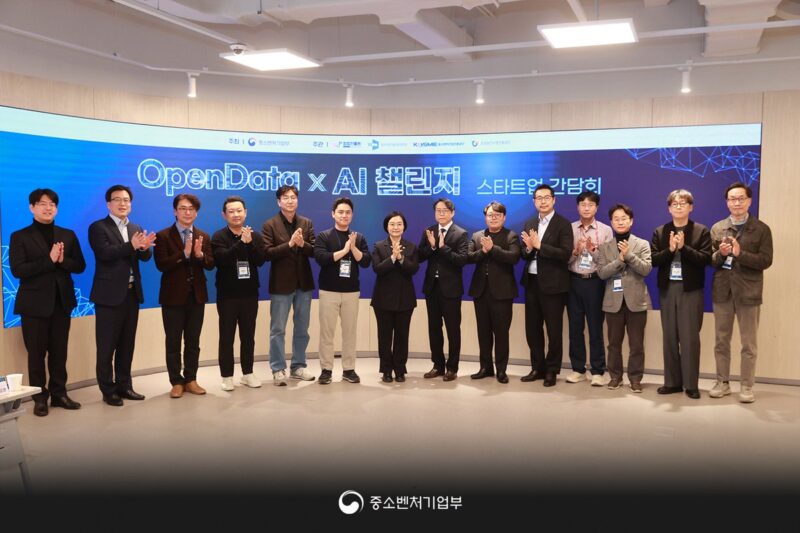
The premise behind the challenge was deliberately hands-on. Rather than commissioning research or funding abstract pilots, the Ministry opened up operational data from public institutions and challenged AI startups to address the everyday pain points that small business owners and sole proprietors actually face. Of the 124 companies that applied, six cleared a multi-stage selection process — document screening, expert review, and user testing — with two finalists emerging from each of three focus areas.
PersonaAI and Lumos stood out for building systems that help small businesses find and navigate government support programs suited to their specific needs. Heum and MyMeta impressed with AI-powered consulting tools tailored to the realities of running a small business. AMBIGEN and Clotho were recognized for their work on growth forecasting and risk assessment tools built around SME data.
Each of the six winners will receive support across commercialization, R&D, and talent recruitment, along with access to policy-based financial instruments such as government-backed loans and credit guarantees.
At the roundtable, founders spoke openly about what it’s actually like to build with real public data — from wrangling messy datasets to figuring out how AI tools can slot into the way government support programs already operate. Minister Han Seong-sook said the challenge had surfaced “a range of AI solutions with strong potential for real-world application,” and made clear that keeping those conversations going with startups would be key to turning innovation into something small businesses can actually feel.
The Ministry intends to feed the lessons from this challenge back into its wider AI startup policy — prioritizing pathways that let companies move past proof-of-concept and rack up real deployment experience. The broader ambition is to weave AI into the fabric of how Korea supports its SME ecosystem, making it less of a buzzword and more of a working tool.
MORE FROM THE POST
- Seoul Unveils Vision to Become Global Physical AI Leader
- MSS Advances AI and Quantum Computing for Drug Development and Biotech Growth
- Korea’s MSS Partners with TÜV Rheinland to Boost SMEs’ Entry into EU AI Medical Market
- MSS of Korea Enhances Support for Super Gap Startups in AI, Quantum and Space Sectors
- Korea Opens Applications for 2026 Program Pairing SMEs with Global Corporations
- AI
- AMBIGEN
- Clotho
- Heum
- Korea
- Korean government
- Korean startup
- Lumos
- Ministry of SMEs and Startups
- MyMeta
- OpenData x AI Challenge
- PersonaAI
Share

Most Read
- 1
- 2
- 3
- 4
- 5

Leave a Reply