





AI chips have a serious heat problem. Today’s GPUs handle heat fluxes of roughly 140 W/cm² — hotter than a space shuttle nose cone re-entering the atmosphere — and each generation runs hotter than the last. It’s a big reason data centers consume so much power and water: they need it to stay cool. How much heat a chip produces and how fast it dissipates both come down to the materials it’s made of, and today’s materials are at their limit. New materials could improve chips by orders of magnitude, but discovering one and getting it into a fab takes years and hundreds of millions of dollars — a “valley of death” where most ideas die between a lab experiment and a fab.
Discovered Materials, a U.S. startup, wants to compress that process with AI. Its AI agents collapse months of interdisciplinary scientific work into days. During its three-month Y Combinator batch, the company says it simulated, synthesized, and tested thermal interface materials matching the performance of products the world’s largest chemical companies have sold and guarded as trade secrets for over 20 years. Alongside its launch, it open-sourced Material Discovery Bench — a benchmark built with experts from IBM, IMEC, Stanford, and Cambridge to test frontier models on real-world semiconductor materials problems.
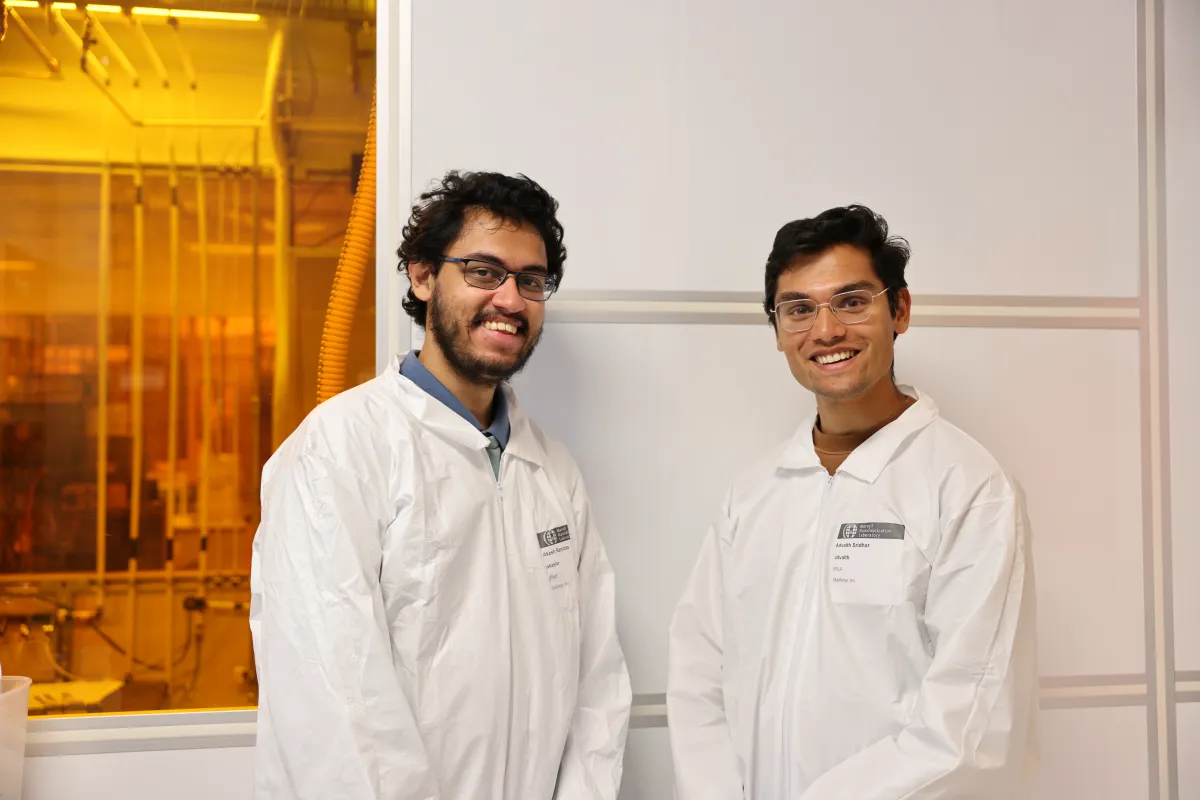
The company was founded by two people who met more than a decade ago at IIT-Madras. Advaith Sridhar studied AI at Carnegie Mellon and was a research engineer building video models and agents at Persona AI (acquired) and Luma Labs. Akash Ramdas earned a PhD in materials science from Stanford and spent 11 years researching new materials for semiconductor chips; his work on nanoscale interconnects was Stanford Engineering’s most-read story of 2025.
Discovered Materials raised a $9 million seed round led by Lightspeed Venture Partners, with participation from Y Combinator and Peak XV, and angels including Paul Graham, Gokul Rajaram, and Thariq Shihipar.
Trying to restart Moore’s law
The ambition is large. Advances in compute drove most technological progress over the last 50 years, the company argues, but that engine stalled in the mid-2010s — and it intends to restart it by accelerating materials discovery. “Chips today are at least 10,000x less power-efficient than the human brain, and our goal is to close that gap,” it says.
Capital is flowing into efforts to accelerate science itself with AI. Periodic Labs, which pitches “real AI scientists,” raised $300 million at seed, and big tech is piling in too — Nvidia and Meta recently joined a global AI materials alliance. Discovered Materials’ differentiator is attacking a concrete bottleneck — semiconductor materials — and open-sourcing a benchmark to measure progress along the way.
MORE FROM THE POST
- Ande Raises $52M Seed and Series A for Corporate Entertainment
- SemiAI Secures Seed Funding to Revolutionize Semiconductor Yield with AI
- Pickle Raises $4.35M Seed Funding to Advance Real-Time AI Avatar Technology
- AXION Garners $1.5M Investment for Global Expansion of AI Semiconductor Innovations
- Dental Robotics Raises Seed Funding for Autonomous Suction Robot
Share

Most Read
- 1
- 2
- 3
- 4
- 5

Leave a Reply