



- AI
- ·
- Tech Giant
From Llama to Muse: Inside Meta’s Rebuilt, Vertically Integrated AI Strategy







Meta has released Muse Glimmer, an open model that runs on a single personal computer. It’s a 30-billion-parameter model with open weights under Apache 2.0, small enough to run on one 24GB consumer GPU, and tuned for agentic tasks — leading comparable open models on the relevant benchmarks, per Meta.
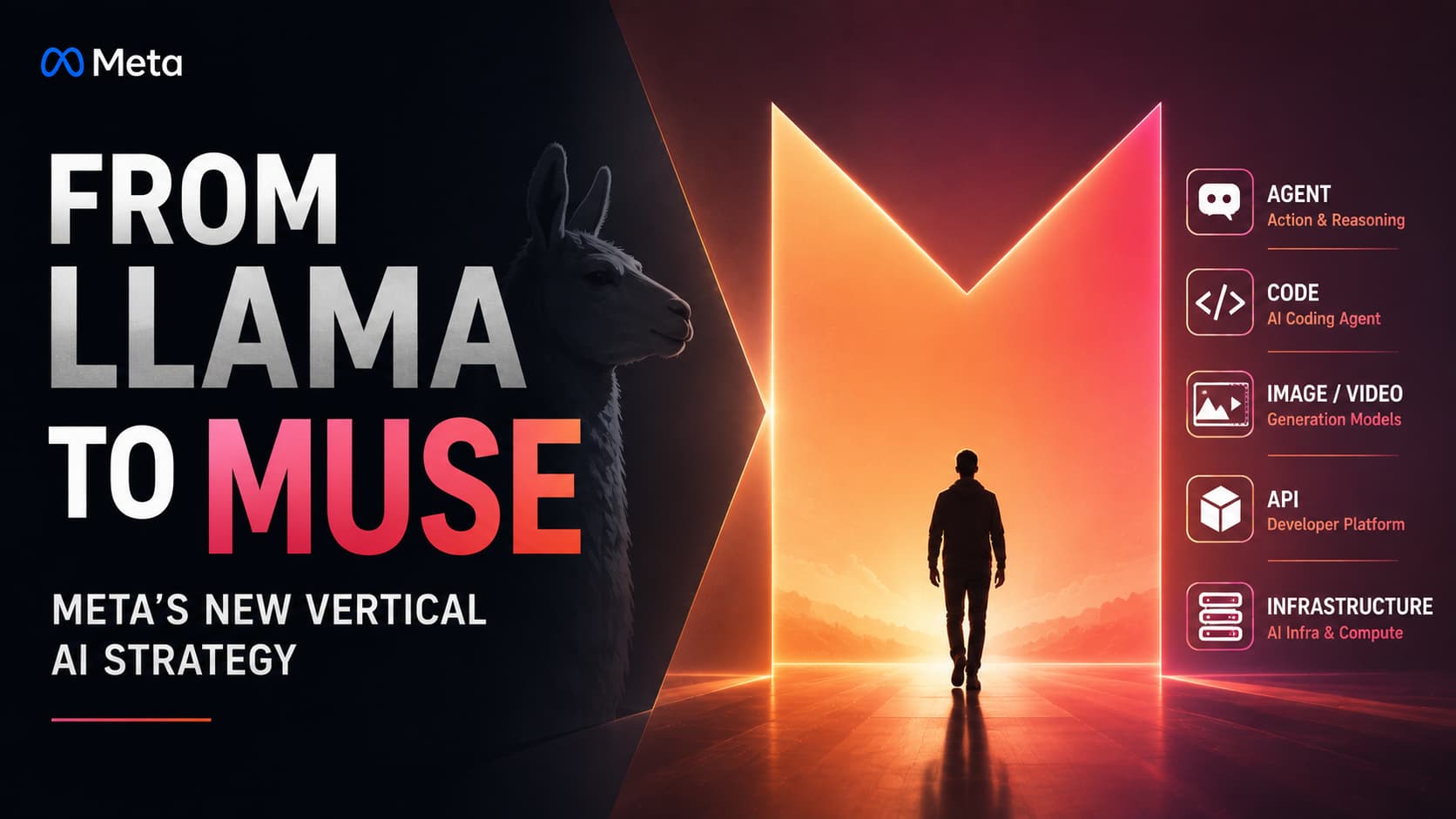
It’s more than a lightweight release. It completes a rapidly expanding stack — frontier models, multimodal generation, a coding agent, consumer agents, developer APIs, and potentially cloud infrastructure — and marks another shift in Meta’s open-model stance. When MSL launched Muse Spark in April, it kept the weights closed, raising doubts about whether Meta was abandoning what Llama stood for. Now it runs two tracks: Spark as its high-performance cloud model, and Glimmer for local use. Meta also plans to open the weights of Muse Spark 1.2, its coding-focused model, according to AP.
From model to product ecosystem in four months
Muse, MSL’s AI brand, splits into “models” and the “products” built on them. Its root is Muse Spark, the flagship frontier model launched in April with multimodal reasoning, tool use, and multi-agent orchestration; it powers the Meta AI app and spread across WhatsApp, Instagram, Facebook, Messenger, Threads, and Meta’s AI glasses. Expansion since has been fast: July brought modality-specific Muse Image and Muse Video; then Muse Spark 1.1 and a developer Model API. This month Meta added Muse Code, a terminal-based coding agent running on the coding-focused Muse Spark 1.2 that coordinates multiple subagents across whole codebases — squaring off against Anthropic’s Claude Code and OpenAI’s Codex. Last month’s agentic Meta AI connects to email and calendars and drafts research and slides — the shift from AI that answers to AI that acts. Muse Glimmer adds the local-and-open layer: a separate on-device model for privacy-, cost-, or speed-sensitive work.
| Layer | Name | Role | Weights |
|---|---|---|---|
| Model | Muse Spark | Cloud flagship frontier model (1.1 tools/coding, 1.2 coding-focused) | Closed (1.2 to open) |
| Model | Muse Image | Agentic image generation | — |
| Model | Muse Video | Video + audio generation (preview) | — |
| Model | Muse Glimmer | Local-only agentic model (30B, one consumer GPU) | Open (Apache 2.0) |
| Product | Muse Code | Terminal coding agent on Spark 1.2 | — |
| Product | Meta AI | Agentic consumer assistant on Spark | — |
| Product | Meta Model API | Developer access to Spark | — |
The superintelligence team starts shipping
At the center is MSL. Meta invested $14.3 billion in Scale AI in 2025, recruited founder Alexandr Wang, and reorganized its research, product, and infrastructure teams around it. The transition was bumpy — costly recruiting wars, researcher departures, and repeated reshuffles, with longtime AI chief Yann LeCun leaving to build world-model startup AMI Labs (which raised $1 billion). Even so, MSL shipped Spark about nine months after the rebuild, then rolled out model upgrades, a Model API, a coding agent, and consumer products within four months. It has also absorbed outside talent — agent network Moltbook and humanoid-control startup ARI joined MSL, and voice-AI deals add speech — pulling text, voice, media, agents, and embodied AI into one organization.
Why ‘selling compute’ rattled the market
Behind the models sits one of the world’s largest infrastructure programs. Meta formed Meta Compute and raised its 2026 capex outlook to $125–145 billion — a bet underwritten by an ad business that posted $56.3 billion in Q1 revenue — and, unable to meet demand from its own data centers alone, signed on for tens of millions of AWS Graviton cores for CPU-heavy agent workloads. So when reports surfaced that Meta might sell AI compute and hosted Muse access, markets read it as overbuilding, pressuring CoreWeave and other neoclouds; it follows xAI into a new “compute monetization” trend. But it needn’t signal weakening demand — it’s a way to monetize spare capacity when internal usage fluctuates and defend the economics of a vast buildout. Meta isn’t about to become a full AWS or Azure rival; early on it would likely offer raw compute and hosted inference. Still, if it sells externally, a company that is neoclouds’ biggest customer could become their competitor.
Meta’s real edge is distribution
Unlike OpenAI, Anthropic, and Google competing on raw model performance and enterprise APIs, Meta doesn’t need to win every benchmark. It already owns consumer platforms used by billions, one of the largest ad businesses, and a growing smart-glasses platform. Its strategy now has four layers: Muse models and products from MSL; Meta AI across its social and messaging apps; smart glasses and future embodied devices; and Meta Compute, with potential external sales.
Open models are the ecosystem lever: Spark, Muse Code, and the Model API monetize directly, while Glimmer pulls developers toward Meta’s stack. What Meta is building isn’t a chatbot or a single foundation model but a vertically integrated platform linking models, infrastructure, consumer distribution, advertising, and hardware. Muse Glimmer signals Meta hasn’t abandoned Llama’s open legacy — but now wields open source as part of a business strategy, not just a research ideal. The open questions are execution and economics: whether Muse can close the gap with the top labs, whether MSL can stay stable, and whether $100 billion-plus in annual capex can turn into durable revenue.
MORE FROM THE POST
- Anthropic Launches Always-On Work Agent ‘Claude Duet’
- Meta Unveils Muse Wonder and Wonder Full Agent Models
- Meta Launches $35B Stock Offerings Despite $82B in Cash, Testing How Far AI Capex Can Stretch
- Google Unveils Gemini Work Agent as Big Tech’s Agent Race Heats Up
- Manus Raises $500M+ as an Independent Company After Meta Deal Collapses
Share

Most Read
- 1
- 2
- 3
- 4
- 5

Leave a Reply