


Airbility, a South Korean counter-unmanned aerial systems (C-UAS) solutions developer, announced on September 1 that it has raised KRW 6.5 billion (USD 4.9 million) in Series A funding led by Silicon Valley-based Sazze Partners.
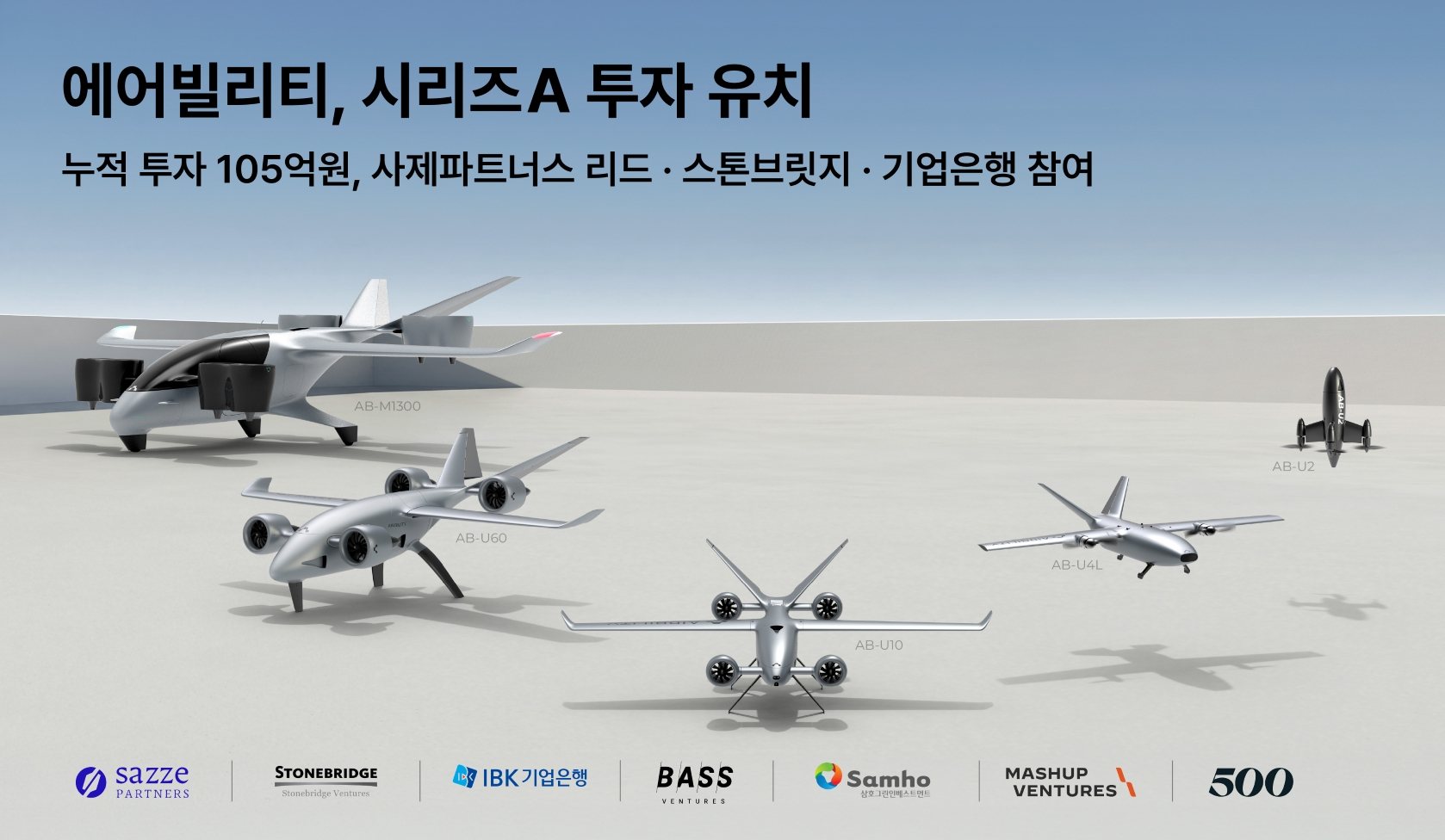
Existing shareholder Stonebridge Ventures participated in the follow-on round, while Industrial Bank of Korea joined as a new investor. The company’s other backers include Samho Green Investment, Mashup Ventures, Bass Ventures, and 500 Global. Airbility has now raised a cumulative KRW 10.5 billion (USD 7.9 million).
The capital will be deployed to refine the company’s air-to-air hard-kill anti-drone kill chain and establish volume production capacity. Building on its existing high-speed eVTOL platform—the net-gun-equipped AB-U10 (capable of 180 km/h) and the carrier aircraft AB-U60—Airbility plans to launch two new interceptor variants: the payload-type strike drone AB-U2, deployed from the carrier, and the fixed-wing launcher AB-U4L (300 km/h). The AB-U10 is scheduled for commercial release this year, with the two new models slated for the first half of 2027 to complete a three-model intercept architecture.
The company is also advancing the onboard artificial intelligence fitted to its interceptors. Enhanced autonomy will enable mission execution in GPS-denied environments, and integration with external detection assets—radar, electro-optical (EO), and infrared (IR) sensors—will unify the kill chain from detection through battle damage assessment into a single system. Airbility will simultaneously build out its production line, leveraging 3D printing and composite airframe manufacturing capabilities.
This investment marks Sazze Partners’ first allocation to the defense sector. Founded in 2018, the Silicon Valley firm has backed more than 100 AI, software, and consumer companies, including Korean AI leader Upstage.
Sazze Partners cited Airbility’s engineering pedigree in indigenous aircraft programs, flight demonstrations within two years of incorporation, localized core-component sourcing, and export competitiveness as key factors.
Airbility was co-founded in November 2023 by veterans of Korea’s Agency for Defense Development (ADD) who led indigenous aircraft programs including KT-1, T-50, and KF-21, along with executives from Hyundai Motor, LG Electronics, and other major corporations. Co-CEO Tae-gyu Ryu, Chief Technology Officer Hyun-soon Kim, and Executive Vice President Kun-woo Kim each served 25 to 31 years at ADD, while co-CEO Jinmo Lee previously worked at Hyundai Motor and MIT Media Lab, Chief Operating Officer Minyoung An at LG Electronics, and Chief Product Officer Jae-hyun Lee in Genesis Design. Eighty percent of the company’s 26 employees are dedicated to research and development.
In December 2025, two years after founding, Airbility successfully demonstrated transition flight of three prototype aircraft, establishing operational-level technology held by a handful of firms worldwide, including U.S.-based Joby. The 4 kg AB-U4 entered commercial service in 2025, and the small-interceptor carrier AB-U60 is targeted for 2027 release. By designing battery packs and flight-control software in-house, Airbility has reduced reliance on Chinese components that dominate much of South Korea’s domestic industry.
This architecture translates into cost and export competitiveness. Real-world engagements have repeatedly used Patriot missiles costing approximately USD 4 million each to intercept Shahed drones worth about USD 35,000. Air-to-air hard-kill engagement costs, by contrast, range from USD 50 to USD 3,000 per intercept.
While leading global C-UAS systems, such as those from U.S. firm Anduril, face country-of-origin restrictions and lengthy procurement timelines, Airbility’s domestically developed AB series offers relatively flexible export eligibility and price points one-tenth of comparable foreign platforms. The company is in discussions with more than nine countries across the Middle East, Southeast Asia, and Latin America, with four memoranda of understanding and two joint ventures under negotiation.
Government backing is expanding. Airbility was selected for Korea AeroSpace Administration’s 2026 Scale-up TIPS program, securing KRW 3 billion (USD 2.3 million) in R&D funding, and is building domestic references through projects with the Republic of Korea Marine Corps and the Defense Acquisition Program Administration.
“We took note of the company’s approach to the cost-asymmetry problem in the counter-drone market—where stopping a single drone can cost hundreds of times the drone’s value—by combining high-speed eVTOL carriers with compact interceptors, the expertise of a team that led indigenous aircraft development, and the rapid product-development track record they have demonstrated to date,” said Kiha Lee, managing partner at Sazze Partners. “If Airbility can convert surging global demand for counter-drone systems into signed contracts, we expect it to emerge as a leading South Korean defense company.”
“This investment will accelerate our execution tempo,” said Jinmo Lee, co-CEO of Airbility. “Our goal is to deploy the first new model this year, complete the three-variant lineup in the first half of 2027, expand the business model from airframe sales to integrated system sales, convert the overseas pipeline into contracts, and achieve cumulative revenue of KRW 50 billion (USD 38 million) by 2028.”
South Korea’s defense industry has entered an era of annual export orders exceeding USD 10 billion, and the government has made becoming a global top-four defense power a national policy priority. Drone interception is among the fastest-growing demand segments. Russia launched 15,800 drones against Ukraine in the first quarter of 2026 alone, and global defense-tech startups raised USD 12.3 billion in venture funding through June 2026—double the prior-year period. Anduril is valued at USD 60 billion, and Shield AI at USD 12.7 billion.
MORE FROM THE POST
- Airbility Secures $2.1 Million in Pre-Series A Funding to Propel Air Mobility Solutions
- Tabular Data AI Startup Nums AI Closes USD 1.5M Second Pre-Seed Round, Selected for TIPS
- Wearable Robot Startup Hurotics Raises Series A Funding Led by Atinum Investment
- Nums AI Secures First Investment of $2.7M to Advance Tabular Foundation Model
- UNASTELLA Closes $22.2M Series B Round to Advance Next-Generation Launch Vehicles
- airbility
- Bass Ventures
- funding
- Industrial Bank of Korea
- mashup ventures
- Samho Green Investment
- Sazze Partners
- Stonebridge Ventures
Share

Most Read
- 1
- 2
- 3
- 4
- 5
Leave a Reply