



Nuance Labs Raises $50M Series A to Build the Foundation Model for Human Conversation and Expression







Voice AI has grown because, faults and all, it’s more useful than what came before. Face-to-face AI hasn’t crossed that same bar, because those systems are assembled from parts: speech gets transcribed, a large language model decides what to say, a voice reads it out, and a face is animated to match. Everything human about a conversation gets lost somewhere in those handoffs, and the delay and choppiness that pile up break the feeling of a live exchange. The result is the uncanny valley — an avatar that sits frozen while you talk, talks over you, or simply can’t keep up.
Lightspeed Venture Partners, which backed Nuance Labs‘s seed round, framed the problem this way in a blog post at the time: as large language models make raw intelligence (IQ) increasingly commoditized, emotional intelligence (EQ) is emerging as AI’s next real battleground. Avatars feel robotic not because of pixel quality, Lightspeed argued, but because they lack the subtle emotional expressiveness that makes a human face compelling — and because they’re nowhere near real-time. Its thesis: just as large language models learned to understand meaning by predicting the next word, AI can learn to understand emotion by learning to predict human emotion and behavior.
Nuance Labs is building that unified model. Rather than stitching parts together, it perceives and responds using a single system that reads the full range of how people communicate — words and tone, but also gaze, gesture, and timing — and answers in kind with facial and vocal expression. The model runs full-duplex, streaming perception in and response out at the same time, so it can show it’s following before the user has even finished speaking.
That capability opens up two directions. One is generating emotion in real time — lifelike avatars that coordinate facial expression, vocal inflection, and body language to produce an appropriate emotional response, the kind of AI therapist that pauses thoughtfully and offers an encouraging expression as it reads a person’s state. The other is reading emotion in real time — a live coaching system that notices the moment a presenter’s confidence wavers, or an interview AI that picks up not just what a candidate says but how they say it.
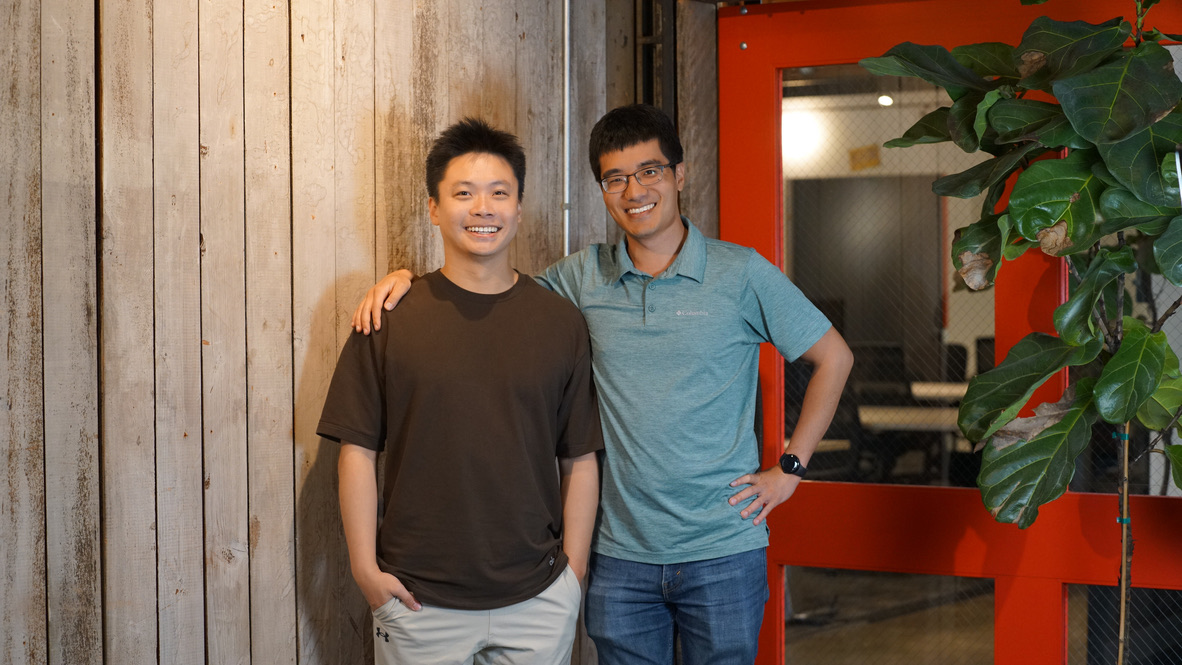
The founders built their expertise studying how machines perceive and reconstruct people. Fangchang Ma, co-founder and CEO, and Edward Zhang met at Apple building the Vision Pro‘s Digital Persona system; their combined work spans computer graphics, robotics, and machine learning, backed by thousands of academic citations. Karren Yang, who studied audio-visual synthesis at MIT before joining Apple’s Seattle research team, joined them to found Nuance Labs. At Apple, the team saw firsthand how hard it is for machines to understand people — faithfully reconstructing someone for telepresence remained difficult enough, let alone following the interplay of verbal and non-verbal cues in a live conversation. That experience pushed them to solve the whole problem — understanding and generating human conversation and expression from audio and video signals — in a single model, rather than stitching together transcription, language, speech, and animation systems that were never designed to work together. The company first tested that direction with a $10 million seed round in September 2025, led by Accel and Lightspeed.
Nuance Labs has now raised $50 million in Series A funding. Returning investor Lightspeed Venture Partners led the round, joined by returning investors Accel and South Park Commons, and new investors NVIDIA and Define Ventures. Define Ventures’ arrival is notable — the firm invests exclusively in digital health, and its participation reads as a signal that technology built to read subtle expression and tone could find a home in healthcare settings such as coaching and therapy, where human trust matters. The company will open a research preview of its model to the public later this year.
“The potential for AI and avatars to enhance our lives will never be achieved while they stare at you blankly or keep interrupting you. They’ve never felt natural because we’ve been contorting ourselves and how we communicate to the machine rather than the machine adapting to us,” said Fangchang Ma. “The most productive collaboration comes from being able to express yourself freely, in words, tone, gesture, and expression, the way you would with a friend or close colleague, with all the nuance in the back-and-forth that turns talking into understanding. That’s what we’re building at Nuance Labs.”
“There’s a massive opportunity to fix the way people interact with these transformative AI tools. Nuance Labs is building that interface, one that can see and respond to a person the way people do,” said Nnamdi Iregbulem, partner at Lightspeed Venture Partners. “The founding team has a rare mix of technical talent and operating excellence, and they’ve turned that into a single model that follows you in real time. We can see this becoming a foundational layer for AI products everywhere.”
The funding will accelerate model development, expand the research team, and support the company’s first public research preview.
Competition to build AI that reads expression and emotion is already intense. Sesame, the conversational AI startup founded by Oculus co-founder Brendan Iribe, raised a $250 million Series B last year built around voice that carries the rhythm and emotion of real conversation — but Sesame is a voice-first interface aimed at wearable smart glasses, and doesn’t handle visual signals like facial expression or gaze. Thinking Machines Lab, led by former OpenAI CTO Mira Murati, released its own “Interaction Models” that process audio, video, and text simultaneously so the system can respond mid-sentence, though that work reads more as a general-purpose research model than a specific product.
On the visual-avatar side, Tavus is pushing video avatars with more than ten controllable emotional states and 134-millisecond response times, while D-ID recently unveiled Expressive Visual Agents offering sub-0.5-second latency and 4K real-time conversational avatars. On the voice side, Hume AI raised a $50 million Series B for its Empathic Voice Interface, which reads emotion from the tone, rhythm, and prosody of a speaker’s voice.
Most of these systems specialize in either voice or video, or split perception and generation across separate models. Nuance Labs is differentiating by unifying voice, video, and verbal and non-verbal signals into a single full-duplex model that perceives and responds at once.
MORE FROM THE POST
- AI Efficiency Lab Flapping Airplanes Raises $1B Series A at $6B Valuation
- AI Dictation Startup Wispr Flow Raises $280M Series B at $2B Valuation
- AI Post-Training Platform Trajectory Raises $45M Series A
- Home-Services AI Broccoli Raises $52M in Series A and B Led by Khosla Ventures
- Fragment Launches With $56M to Have AI Agents Resolve Procurement Exceptions at Large Manufacturers
Share

Most Read
- 1
- 2
- 3
- 4
- 5

Leave a Reply