

ByteDance’s AI Drug Spin-Off Anew Labs Closes $290M Round, Sources Say


Developing a single new drug takes an average of a decade and billions of dollars, and only about 10% of candidates that reach clinical trials ever reach a patient. Capital has been pouring into the bet that AI can flip that equation: venture funding into AI drug discovery topped $11 billion in 2025 alone, up more than 23% from $8.9 billion the year before. An unexpected new name has just joined that list.
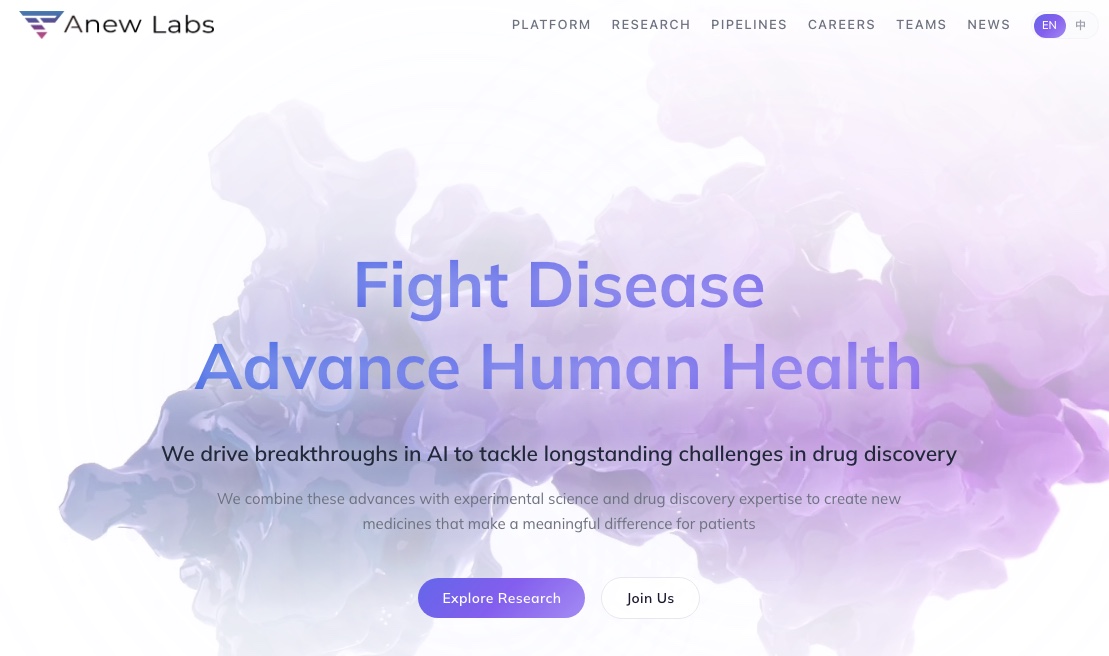
ByteDance’s AI drug discovery unit has closed a $290 million external funding round after spinning off as an independent company called Anew Labs, Reuters reported on Sept. 16, citing two people familiar with the matter. The Straits Times confirmed the same details via the same sources. The round values Anew Labs at $1.5 billion, and ByteDance will retain a 56% stake afterward, one of the sources said. Neither ByteDance nor the participating investors immediately responded to requests for comment — there has been no official announcement. Chinese outlet 36Kr had been tracking the spin-off since June, when the team first began operating under its own brand and courting outside investors; this is the first time the deal has surfaced with concrete numbers.
Headquartered in Shanghai with additional offices in Singapore and San Jose, California, Anew Labs uses AI to discover new drugs. Its open-sourced structure-prediction model, Protenix, released in 2025, reproduces and extends Google DeepMind’s AlphaFold3 and reportedly matches or exceeds it on several benchmarks. Layered on top is PXDesign, which designs protein binders for drug candidates from scratch, and more recently AnewOmni, a generative framework trained on five million biomolecular complexes. The company now has four drug candidates in its pipeline, including an autoimmune-disease program. In April, Anew Labs’ head of biology, Chris Li, presented that candidate at Immunology2026, the American Association of Immunologists’ annual meeting in Boston, according to the South China Morning Post — a small molecule designed to inhibit three IL-17 protein complexes at once, targeting a class of protein-protein interaction the pharmaceutical industry has long considered “undruggable” because the binding surfaces are too large and flat for conventional small molecules. TheNextWeb reports Anew Labs is also registered to exhibit at the BIO International Convention in San Diego this month.
Anew Labs traces back to a ByteDance internal AI4S (AI for Science) team formed in 2021. It’s led by Liu Kai, who joined ByteDance that year after seven years as a venture investor at IDG Capital and Fire Stone Investment, and who has built the team around a mix of AI algorithm specialists and pharma-industry veterans. The company’s website lists 36 core team members alongside a scientific advisory board that includes Liu Yongjun, former president of Innovent Biologics; Ji Ma, a former principal scientist at Amgen; and Hua Zou, scientific director of protein chemistry at Takeda California. One of the sources told Reuters that AI drug discovery follows a different industry logic and management approach than ByteDance’s core business, which is why the unit was spun out.
The round was co-led by HSG (formerly Sequoia China), IDG Capital, and Hillhouse Investment, with 5Y Capital as a co-lead investor, the sources said. Gaorong Ventures, Primavera Venture Partners, and Boyu Capital also participated, alongside strategic investor SBP Group and state-backed Shanghai Future Industries Fund. IDG Capital’s participation is notable given Liu Kai’s own history there before joining ByteDance.
Competition to build the foundational layer for AI drug discovery is already dominated by heavily capitalized players. Isomorphic Labs, spun out of Google DeepMind and led by AlphaFold creator Demis Hassabis, raised a $2.1 billion Series B in May. Like Anew Labs, it builds on AlphaFold-family structure prediction — but Isomorphic has commercialized through multibillion-dollar partnerships with Eli Lilly and Novartis, while Anew Labs is pushing its own candidates, such as the IL-17 small molecule, directly toward the clinic. Xaira Therapeutics launched in April 2024 with $1 billion in hand and Nobel laureates David Baker and Carolyn Bertozzi among its co-founders.
The closest comparison may be Hong Kong-listed Insilico Medicine, whose Pharma.AI platform spans biology, chemistry, and clinical development for its own drug pipeline. Its shares jumped 24.7% on their December 2025 Hong Kong trading debut, valuing the company at $2.1 billion — proof that an AI-designed drug pipeline can make it all the way to a public listing, a path Anew Labs may be positioning to follow. All three ultimately build on the biological foundation model layer that Google DeepMind’s AlphaFold opened up.
Anew Labs began as an internal ByteDance unit in 2021 and spun off as an independent company in 2026, with offices in Shanghai, Singapore, and San Jose.
MORE FROM THE POST
- AI Operating System for Wealth Management Nevis Raises $70M Series B
- Autonomous Construction Startup Bedrock Robotics Raises $600M Series C at $4.1B Valuation
- Physical AI Asset-Health Platform Tractian Raises $130M Series D at $1.4B Valuation
- AI Efficiency Lab Flapping Airplanes Raises $1B Series A at $6B Valuation
- AI Code-Validation Startup Blacksmith Raises $66M Series C at $1B Valuation
Share

Most Read
- 1
- 2
- 3
- 4
- 5

Leave a Reply