










The real bottleneck in the AI data center buildout isn’t chips — it’s people. The cabling required by systems like Nvidia’s GB300 demands a level of skill that’s chronically in short supply, and even Meta has internally acknowledged its robots aren’t yet ready for that intensive cabling work. Compute is only beginning to transform society, but how fast that happens depends on who — or what — can execute on the ground.
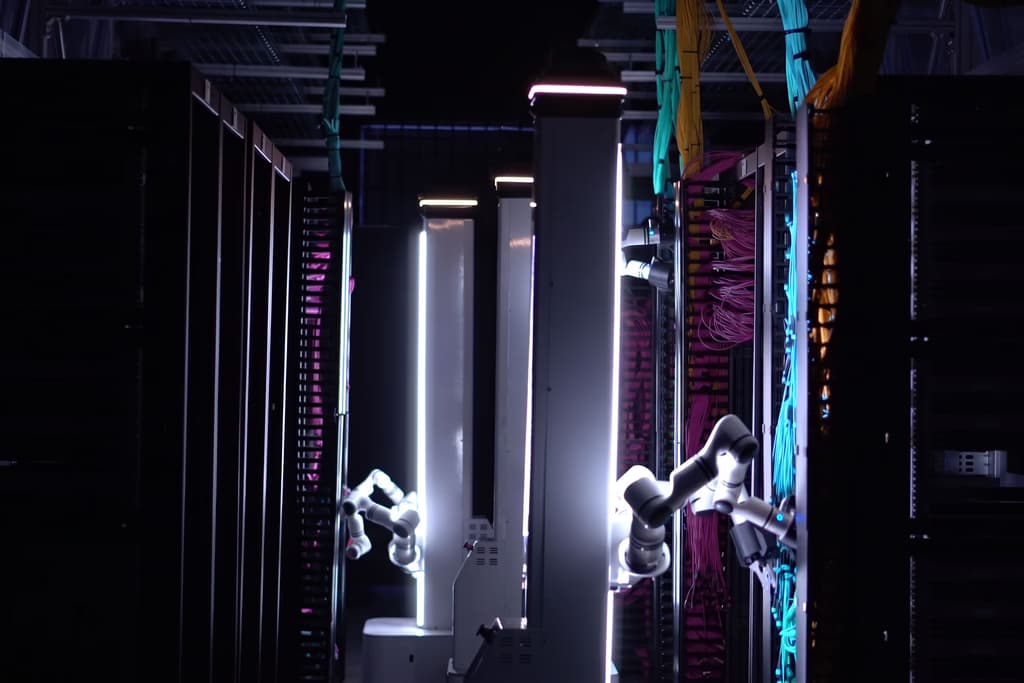
Watney exists to close that execution gap. “A robot will never be as charming as a barista or as personable as a housekeeper, but it can be more exacting than a surgeon,” the company says of its approach — it doesn’t imitate human motion or process, choosing instead only the problems where a robot’s embodiment gives an order-of-magnitude edge in precision, reliability or scale. Since 2025, Watney has served the world’s largest hyperscalers through an end-to-end deployment model, handling tasks like cable swaps and server restarts inside live data center facilities. Across hundreds of thousands of hours in customer facilities, the company says its systems have hit more than four nines (99.99%) of reliability, and it now runs what it calls the largest fleet of dexterous robots operating 24/7/365 across the U.S.
According to WIRED, one of those customers is Meta. Since June of last year, Meta has been testing two dual-armed Watney robots on cabling work at its Altoona, Iowa campus, with related trials also underway at its Prometheus data center in New Albany, Ohio. The robots remain slower than human technicians and still work under supervision, but one Meta worker told WIRED that a mature cable-swapping system could eventually eliminate up to 80% of the workload in some technician roles.
Watney was founded in San Francisco in 2023 by CEO Ryan Gannon and Sean Cheong.
Watney announced an $80 million Series A, co-led by the Valor Atreides AI Fund and Hummingbird Ventures, with continued participation from existing backers Conviction, Abstract and A, plus Grant Gordon. The round brings Watney’s total funding past $100 million, building on a $21 million seed round previously led by Conviction, Abstract and A.
The competitive field
Meta is testing more than one vendor for this work. Alongside Watney, it’s running a Kinova six-axis robotic arm for server power-cycling and ABB machines for component reseating at its Ohio facility. But Kinova and ABB are general-purpose industrial arm makers, not end-to-end operators purpose-built for data center deployment the way Watney is.
The more direct competitors are startups built specifically around data center upkeep. Switzerland’s Exclaim Robotics, founded by ex-Google, Microsoft and NVIDIA roboticist Helen Oleynikova, is building an autonomy-first mobile robot for cleaning and replacing optics, reconnecting copper cables and reseating drives, and emerged from stealth with a $4.95 million pre-seed round. Oleynikova told WIRED the field so far has seen “a lot of pilots and demos, but no provable working solution.” Y Combinator-backed Shepherd Robotics is building a more general-purpose robot foundation model aimed at data center construction and operations as well as cable and wire-harness manufacturing, kitting and factory packaging — a broader scope than Watney’s data-center focus.
MORE FROM THE POST
- Physical AI Simulation Startup Antioch Raises $32M Series A Led by Greylock
- Foundry Robotics Raises $100M Series A to Run Autonomous Assembly Factories
- Physics-First Robotics Startup Eka Robotics Raises $150M Series A
- Warehouse Workstation Robot Maker Ultra Raises $50M Series A
- Fully Autonomous Surgical Robot Maker Aleph Surgical Raises $7.5M Pre-Seed
- A
- Abstract
- AI
- AI Infra
- Conviction
- funding
- Grant Gordon
- Hummingbird Ventures
- Overseas funding
- physical ai
- robotics
- seriesA
- Valor Atreides AI Fund
- Watney
Share

Most Read
- 1
- 2
- 3
- 4
- 5

Leave a Reply