





Dental Robotics, developer of a Physical AI-driven autonomous suction robot for dental clinics, announced on September 21 that it has secured Seed funding from AI Angel Club, CNTTech, People Investment, and Digital Healthcare Partners.
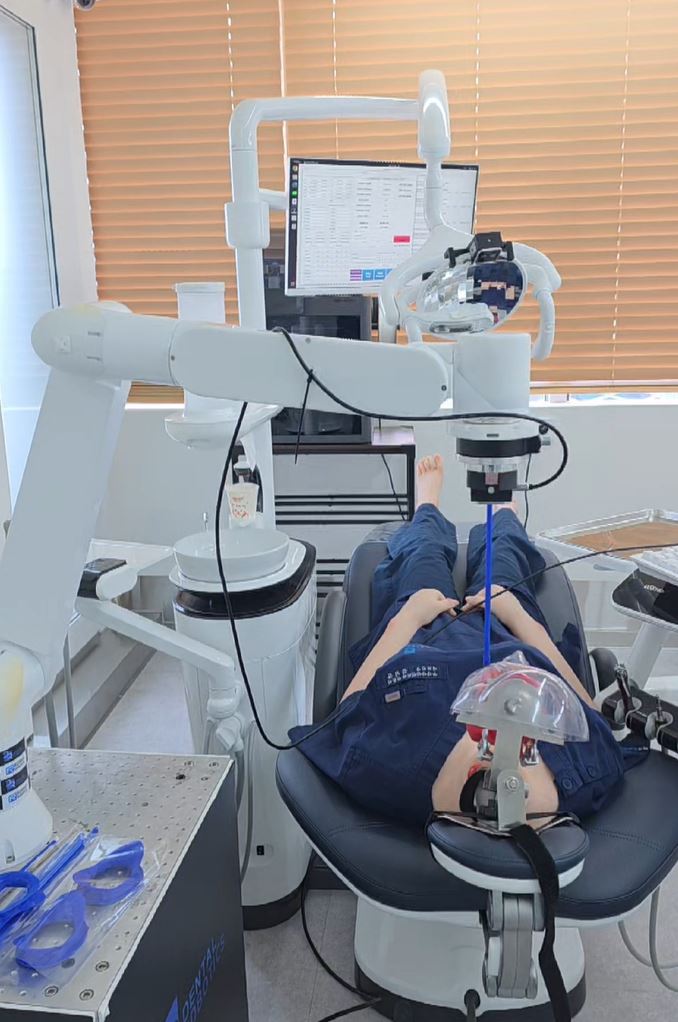
The amount was not disclosed. Dental Robotics plans to use the investment to advance its robot system, accelerate clinical validation and medical device regulatory approvals, and prepare pilot deployments at university hospitals and mid-to-large dental clinics.
The problem Dental Robotics is addressing is a shortage of dental assistant personnel. Only 48.4% of licensed dental hygienists are actively working, and falling birth rates have turned assistant supply imbalances into a structural issue. According to the company’s analysis of treatment workflows, dental hygienists spend an average of 2.5 hours per day on suction work, and about two of those hours involve solo participation in procedures. Suction appears simple but demands skill and delicate movement as a high-intensity repetitive task. While existing medical robots have focused on implant and surgical assistance, Dental Robotics recognized that the real shortage in clinical practice is not physicians but assistant staff, and made treatment-assistance automation the robot’s core objective.
Dental Robotics’ suction robot fuses 3D CBCT (dental CT) and intraoral scanner data to map each patient’s oral cavity with 100 μm accuracy, while vision AI recognizes saliva, blood, teeth, gums, and other oral structures in real time so the six-axis robotic arm autonomously navigates to the correct suction position. The fusion accuracy of 3D CT, scan, and vision camera data is below 0.25 mm, and a 210-case validation achieved a 98.6% fusion success rate.
For safety, the robot’s end-effector incorporates a pressure sensor that detects contact from 50 g upward to decide between avoidance and suction maneuvers, and the system employs a three-layer safety architecture—hardware current cutoff (1 ms), software real-time monitoring (5 ms), and higher-level motion planning—operating independently. The design applies surgical robot standards (IEC 80601-2-77) and personal-care robot standards (ISO 13482) from the ground up. The company is building a dentistry-specialized Vision-Language-Action model called DentVLA on top of a robot foundation model, integrating perception, decision-making, and action to evolve toward fully autonomous suction.
Dental Robotics first unveiled its autonomous suction robot at the Seoul International Dental Expo (SIDEX 2026) in May and is verifying safety and efficacy through clinical collaboration with Professor Inseok Song’s oral and maxillofacial surgery team at Korea University Anam Hospital. The company has filed 20 related patents covering topics such as intraoral-marker-based robot alignment, anomaly-response suction, the three-layer safety architecture, and vision-data-based autonomous suction; four have already been registered, and patent evaluations returned high grades. Dental Robotics aims for commercial launch in 2028, starting with domestic Class II medical device approval and moving sequentially to digital medical device certification and international approvals.
Dental Robotics is led by Dr. Nam Gyun Kim, a practicing oral and maxillofacial surgeon and chief director of Yonsei Good Plant Dental Clinic, and co-CEO Sehyun Eom, who handles AI, digital twins, and 3D systems with a computer-science background from the University of Illinois at Chicago. The engineering team includes alumni from Mediwhale, Rainbow Robotics, Huvitz, and Yonsei Good Dental Implant with expertise in medical imaging AI, robotics, and intraoral scanners. The business model combines robot hardware sales with a workflow-recognition software subscription and dedicated consumables and maintenance. After establishing a domestic foothold, the company plans to enter U.S. and European markets.
AI Angel Club chairman Seongho Choi, who led the round, said, “Dental Robotics is solving the assistant-shortage problem a dentist experienced firsthand using Physical AI. We highly valued dentistry as a domain where Physical AI can take hold earliest—thanks to high CT and intraoral scanner penetration enabling spatial mapping—and the team composition spanning clinical practice, robotics, and AI.”
Kim said, “What’s really lacking in dental clinics is not the doctor but someone to hold the suction next to you. Starting with suction assistance, we will advance through clinical validation and regulatory approval toward a robot that supports the entire dental workflow.” He added, “With this funding as a catalyst, we will accelerate the commercialization of the world’s first Physical AI suction robot and expand application to scaling, periodontal treatment, extraction assistance, and beyond.”
MORE FROM THE POST
- Lab Automation Robotics Startup ABLE Labs Raises $8.7M Series A
- Medicall Raises Seed Funding to Expand AI Phone Assistant Platform for Dental Clinics
- InnoWL Secures Seed Funding to Advance Precision Diagnostics for Atopic Dermatitis
- Purple AI Raises $1.9M to Advance Brain Disease AI and Enter U.S. Market
- AI Speech Therapy Startup Golden Brain Care Raises Seed Funding from Series Ventures
- AI
- ai angel club
- BioHealth
- CNTTech
- Dental Robotics
- DHP
- Digital Healthcare Partners
- funding
- People Investment
- robotics
- seed
Share

Most Read
- 1
- 2
- 3
- 4
- 5

Leave a Reply