










AI has transformed the digital world, learning to converse and code from the internet’s vast record of text and images.
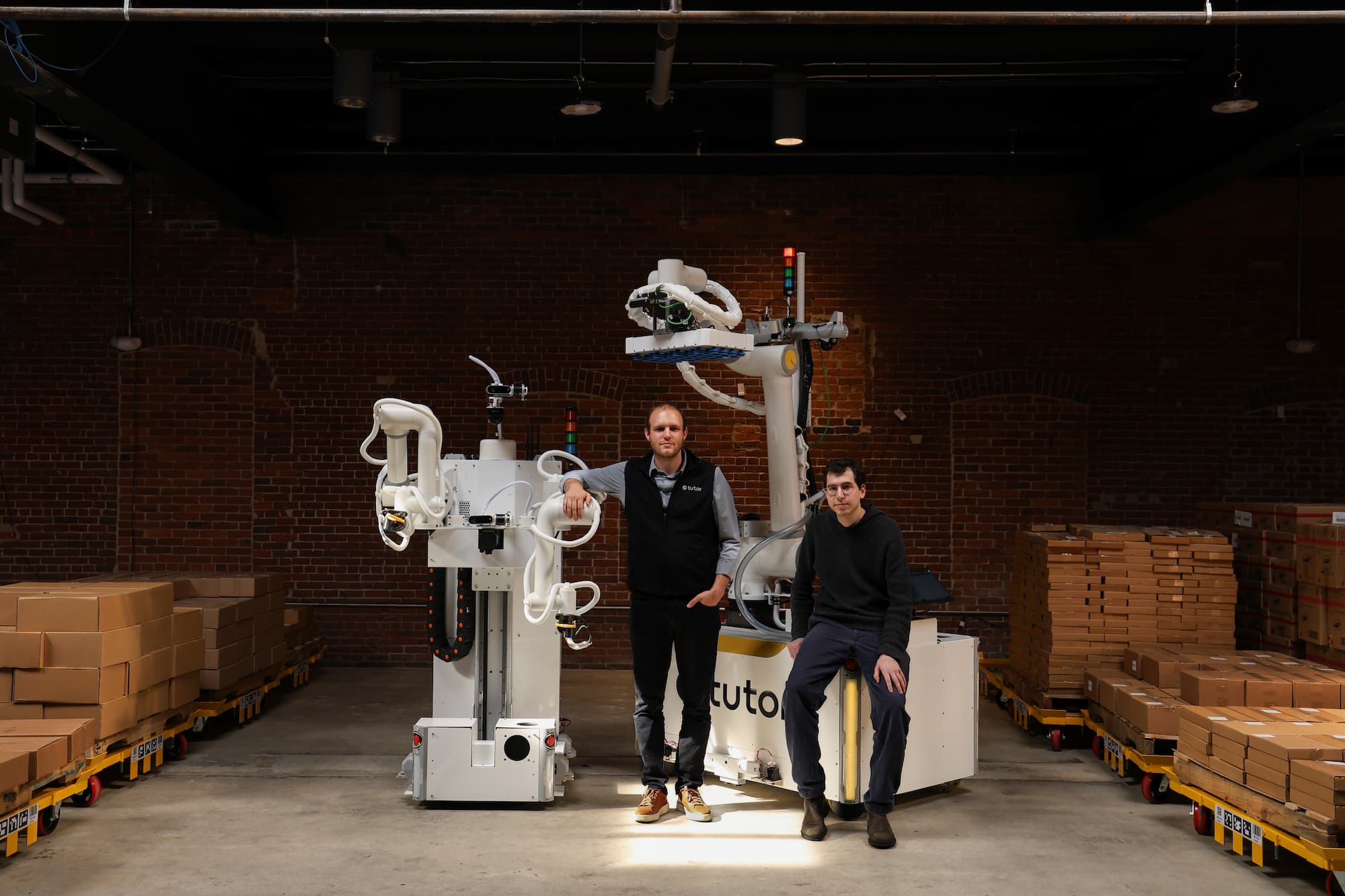
The physical world has no such record to train on. For robots to take over the lifting, moving and manipulation that keep factories and warehouses running, they need data from real work in real facilities.
Tutor Intelligence, a Watertown, Massachusetts robotics company that collects that data by putting robots to work, announced a $75 million Series B. The round brings its total capital raised to $117 million, following a $34 million Series A last December.
Tutor came out of MIT CSAIL and builds across the full stack: robots, foundation models and deployments. It places fleets of internet-connected robots in customer production sites, where remote operators the company calls “tutors” assist with tasks. Every completed task generates real-world experience data that trains Tutor’s own robot foundation model. Better models let the robots handle more work, which leads to more deployments. The company describes this as a network of intelligence in which each new deployment strengthens the entire fleet.
Its robots are called Sonny and Cassie. Tutor sells robot work the way businesses already buy labor: by the hour or by the pick. Customers make no upfront purchase and sign no long-term contract, and Tutor handles deployment, maintenance and regular software and model upgrades. The robots work in some of the largest U.S. manufacturing and logistics networks, handling goods such as breakfast cereals, snacks, candy, cosmetics, home goods and toys.
Josh Gruenstein is co-founder and CEO, alongside co-founder Alon Kosowsky-Sachs. Gruenstein says the models let robots do jobs they have never done before and make robots affordable on a new level, and that the company can hardly build robots fast enough to meet demand.
Andreessen Horowitz led the round. Union Square Ventures, which led the Series A, and Neo, which led the seed round, also participated. The company did not disclose its valuation or revenue.
The funds will support frontier robot foundation model training and the manufacturing and deployment of Sonny and Cassie. Tutor’s robots now work in almost four times as many facilities as a year ago, and the company is on track to have more than 1,000 robots under contract by the end of 2027, all built in and deployed from the United States. Nearly a third of organizations that received Tutor robots in the past 12 months were existing customers installing more of them.
Competitive landscape
Tutor competes with a growing field of physical AI companies. On the general-purpose robot model side, Physical Intelligence raised $600 million at a $5.6 billion valuation last November, Skild AI raised $1.4 billion in January, and Generalist AI raised a $400 million Series A at a $2 billion valuation in June, followed by another $200 million in August. These companies put the model itself at the center of their pitch.
Closer to logistics and manufacturing floors, Dexterity raised $95 million to develop physical AI, and Foundry Robotics raised a $100 million Series A last month for AI-run robotic assembly plants.
Tutor also trains its own foundation models, but treats them as one layer of a service. What sets it apart is the business model: supplying robot work by the hour or by the pick and feeding the resulting field data back into training.
MORE FROM THE POST
- Robot Training-Data Firm Mecka Raises $60M Series B
- SYNCERE Raises $11M Pre-Seed for LUME, a Floor Lamp That Folds Your Laundry
- Imperial Spinout Machenta Raises $40M Seed for Robots That Learn From a Single Demonstration
- Physical AI Manufacturer Multiply Labs Raises $75M Series B
- Fully Autonomous Surgical Robot Maker Aleph Surgical Raises $7.5M Pre-Seed
Share

Most Read
- 1
- 2
- 3
- 4
- 5

Leave a Reply