


South Korea Unveils “Nation-Led Startup Initiative” to Support 5K Founders with Up to $700K Each


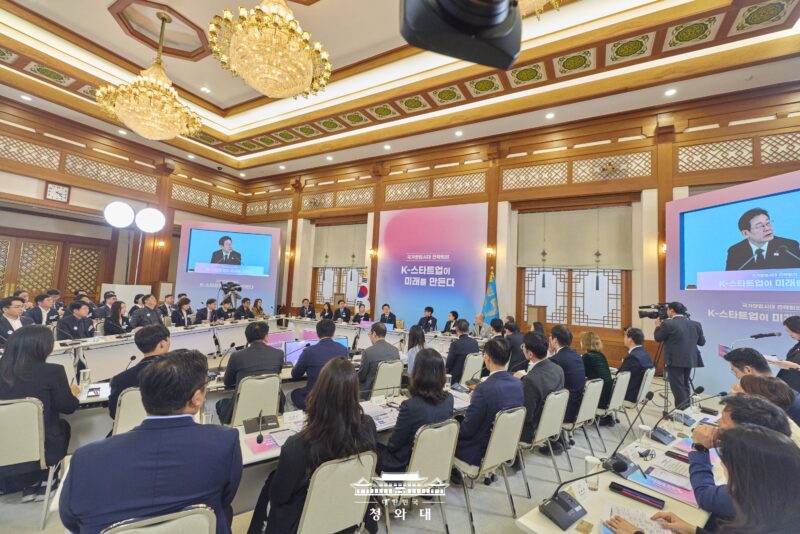
The Ministry of Economy and Finance and the Ministry of SMEs and Startups unveiled a sweeping startup support initiative at the “Nation-Led Startup Initiative Strategy Meeting” held January 30 at the Blue House. Around 60 participants attended, including government officials, startup founders, and industry representatives.
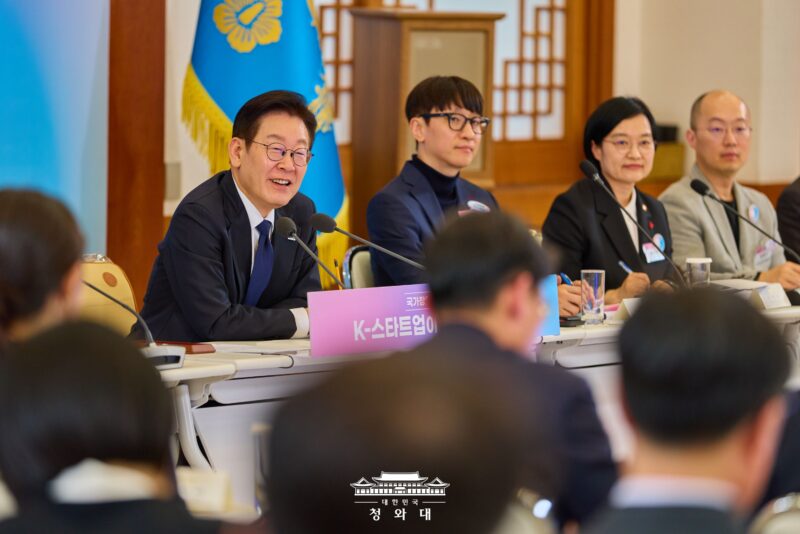
The government announced a fundamental shift in its employment paradigm—from helping people find jobs to empowering them to create jobs, with entrepreneurship at its core. Rather than merely supporting startups from the sidelines, the administration pledged to become a true partner that shares entrepreneurial risks, positioning “Korea Inc.” as a co-founder alongside entrepreneurs.
Deputy Prime Minister and Minister of Economy and Finance Yuncheol Koo described how “K-shaped growth”—where economic gains concentrate among large corporations, major metropolitan areas, and experienced workers while bypassing SMEs, rural regions, and young people—has become entrenched. This pattern has intensified competition for scarce stable employment. In response, the government aims to create an environment where anyone with an idea can launch a business anywhere in the country.

The government outlined four strategic pillars: ①launching the “Startup for All” project to seed entrepreneurship nationwide, ②driving momentum through tech startups and ③local startups as twin engines, while ④transforming the entire startup ecosystem to support these initiatives.
For tech startups, the government will establish 10 startup cities by 2030, including four major innovation hubs with concentrated talent. Sector-specific deep-tech programs for defense, climate tech, and pharmaceutical biotech will be rolled out sequentially. The goal is to build infrastructure that allows technology-based startups to take root and scale in regional areas.
To nurture local startups, the government will leverage regional assets like culture and tourism to develop 50 local commercial hubs and 17 “glocal” zones by 2030. Scale-up support for these startups will also be strengthened.
The ecosystem will be strengthened through regulatory sandboxes for startups in mega special zones, opening high-demand public datasets, establishing a 1 trillion KRW ($713 million) second-chance fund, and facilitating open innovation between corporations and startups.
Through these initiatives, the government seeks to usher in a “Nation-Led Startup Initiative” that combines entrepreneurial spirit with government partnership, turning “startups for all” into “growth for all.”
The Startup for All Project
The “Startup for All” project creates a safe space for bold experimentation through stage-by-stage mentoring, competitions, and government investment in startup activity funds. This platform will enable anyone with an idea to pursue entrepreneurship freely.
The government will identify 5,000 entrepreneurial talents nationwide—4,000 in tech and 1,000 in local sectors—providing each with 2 million KRW ($1,400) in seed funding. Applicants can choose their preferred support organization and need only submit streamlined, idea-focused documentation.
A nationwide network of 500 expert mentors from approximately 100 startup organizations and 1,600 advisors from Startup One-Stop Support Centers will serve as “Startup for All Supporters,” guiding founders through their journey.
Regional Startup Competitions
Regional competitions will be held across all 17 cities and provinces, followed by five regional finals where approximately 1,000 selected founders will compete. From these, around 100 “Startup Rookies” will emerge. “Regional Startup Festivals” built around these competitions will spread entrepreneurial energy nationwide.
Participants will receive up to 20 million KRW ($14,250) in commercialization funding at each stage, plus access to AI tools for business optimization. The 100 Startup Rookies will be eligible for follow-up funding of up to 100 million KRW ($71,200) the following year.
The regional competitions will culminate in a national grand finale at COMEUP, the global startup festival, featuring the 100 Startup Rookies. The grand prize winner will receive over 1 billion KRW ($712,000) combining prize money and venture investment. The government also plans to produce a reality-style “startup competition show” to bring entrepreneurial excitement to the broader public.
A dedicated 50 billion KRW ($35.6 million) “Startup Boom Fund” will be established to provide concentrated investment in the selected Startup Rookies.
Tailored Growth Pathways
Following participation in “Startup for All,” founders will be connected to customized growth tracks based on their focus areas.
Tech founders will benefit from increased government procurement, participation in international startup exhibitions, and opportunities to pilot technologies with 100 major domestic corporations and public institutions while accessing public datasets.
Local founders will receive comprehensive support including capital access, capacity building, and international market entry assistance. The government envisions transforming local startup content into distinctive regional culture, integrating inter-ministerial tourism programs to create “glocal” zones with global appeal.
Embracing Failure as a Stepping Stone
The government will strengthen the second-chance ecosystem to ensure that setbacks become assets for future success. “Challenge Career Certificates” will document “Startup for All” participation as legitimate work experience. A “Second-Chance Platform” anchored by the Second-Chance Support Headquarters will collect founder stories and issue “Failure Career Certificates” that can be leveraged for future startup program applications.
The public forum addressed three themes: the Startup for All project, sustained startup growth, and regional ecosystem development. Participants shared candid feedback on the announced policies.
Key suggestions included expanding professional incubation and consulting for early-stage startups, improving public perception of failure to encourage second chances, activating commerce and tourism around local startups, and designing startup cities that leverage regional industrial strengths.
Deputy Prime Minister Koo and Minister Sungsook Han responded: “We will incorporate the feedback from today’s discussion to rapidly implement the ‘Startup for All’ project and ensure this becomes a startup movement that citizens can truly feel.”
MORE FROM THE POST
- Korea’s “Startup for All” Wants to Make Founding a Company an Option for Everyone
- South Korea Approves Record $11.3B Budget for SMEs and Startups in 2026
- Seoul Launches Seven Key Strategies to Lead AI-Driven Industrial Transformation
- MSS Unveils $770M Fund of Funds to Boost Venture Investments, AI, and Regional Startups
- [Official] Korea’s MSS Announces $11.1 Billion for Deep-Tech and Global Startup Initiatives in 2025
Share


Most Read
- 1
- 2
- 3
- 4
- 5

Leave a Reply