


- Government
- ·
- AI
Seoul Unveils Vision to Become Global Physical AI Leader


Seoul is betting big on physical AI—artificial intelligence that doesn’t just generate text or images, but actually moves and operates in the real world. The city plans to turn itself into a massive testing ground where AI-powered robots and systems can be deployed and refined in actual urban conditions.
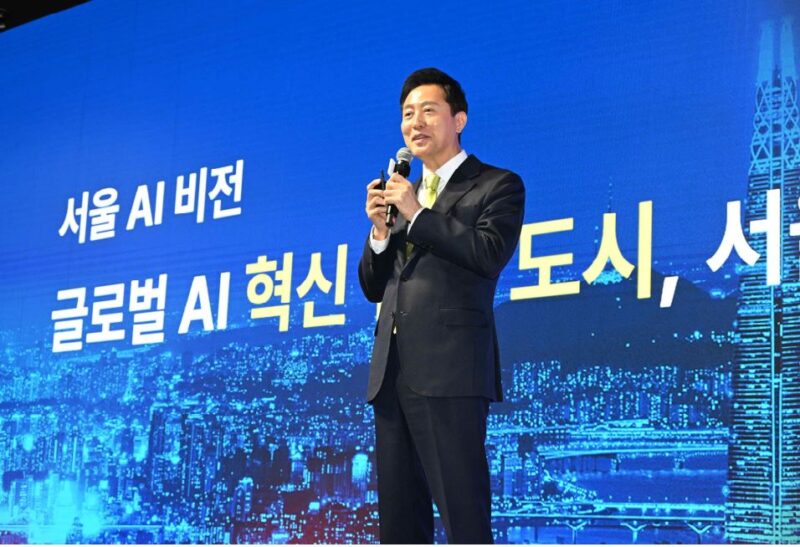
At the AI SEOUL 2026 conference Friday, Mayor Oh Se-hoon laid out an ambitious three-part strategy: build world-class infrastructure, create a thriving industrial ecosystem, and weave the technology into everyday life. Seoul isn’t just trying to attract AI companies—it wants to become the place where physical AI gets proven at scale.
The centerpiece is what Seoul calls the “Physical AI Belt”—linking the Yangjae AI cluster (the brain) with the Suseo Robot cluster (the body). Yangjae already houses over 430 AI startups and research centers. Suseo will be built out as a testing ground where robots and AI systems can actually run in real environments. The idea is to make it easy to develop AI in Yangjae, then immediately test it in Suseo.
Oh framed it as being about more than just technology. “The goal isn’t chasing speed,” he said. “It’s figuring out how technology can safely fit into people’s lives—and setting the standard for how that should work.” He wants Seoul to be the city that shows how to make AI useful for real problems: keeping people safe, helping the elderly, supporting first responders.
Building the Infrastructure
Yangjae is getting transformed into “Seoul AI Tech City,” which will incorporate the existing Seoul AI Hub plus the old grain wholesale market site and the Gangnam data center. Construction starts in 2028. Right now, Yangjae AI Hub already has about 430 startups working alongside top AI graduate programs and national research labs.
The Suseo area near the station is being built out as a full robot cluster by 2030. It’s happening in stages. The “Robot Plus Test Field” opened in 2024. The main facility, “Seoul Robot Tech Center,” will be done by 2030 and will handle everything from R&D to testing to commercialization. There’ll also be a venture town for robot companies and a theme park where regular people can try out the technology.
Beyond these two hubs, Seoul’s spreading physical AI across its existing industrial zones: Hongneung for biotech, Yeouido for fintech, Namsan for creative industries, Dongdaemun for fashion, G-Valley for manufacturing, and Magok for pharma and biotech.
Opening the City as a Testbed
Seoul’s putting $70 million (100 billion KRW) into turning the entire city into a testing ground through 2030. A “Testbed Demonstration Center” launching later this year will coordinate trials across public facilities and urban spaces, connecting companies directly from field testing to market opportunities.
The showcase will be the Yongsan International Business District, which Seoul wants to make a model smart city. The district will run on physical AI—from traffic management to disaster response to underground delivery robots. An integrated operations center will pull in real-time data through sensor networks, using digital twin technology to predict and optimize everything from traffic jams to energy use to emergency response.
The district will get self-driving cars, smart traffic control, robotic parking, and Korea’s first underground logistics system—plus city-wide energy management.
To fund all this, Seoul’s investing $490 million (700 billion KRW) in R&D through 2030. Another $105 million (150 billion KRW) through the “Seoul Vision 2030 Fund” will go specifically to physical AI startups, with the goal of creating the next wave of unicorns.
Seoul’s also building an “AI Global Alliance” with New York, Paris, Shanghai, and Quebec to scale the ecosystem internationally.
Bringing AI into Daily Life
Here’s where regular people will actually see the changes: transportation, healthcare, and public safety.
This October, Seoul becomes the world’s third city to run Level 4 fully autonomous robotaxis on regular streets—no safety driver required. The “Dawn Companion” autonomous bus, which currently runs one route between Dobong and Yeongdeungpo, is expanding to four routes total. Add in two driverless shuttles along Cheonggyecheon and six autonomous community buses, and Seoul will have 18 self-driving vehicles on the roads this year.
For healthcare and eldercare, physical AI will help fill workforce gaps. Seoul’s rolling out more rehabilitation robots, walking-assistance devices, and wearable exoskeletons that boost strength. Safety infrastructure gets AI-powered fire patrol robots and inspection drones. By 2030, the city’s spending $840 million (1.2 trillion KRW) to build smart systems for firefighting, disaster response, and infrastructure maintenance.
Everything in the public sector will have to meet Seoul’s AI ethics standards—the city sees this as a public resource that needs to protect citizens’ rights and safety, not just make things run more efficiently.
To get people comfortable with the technology, Seoul’s hosting a “Seoul AI Festa” in late February and a “Seoul Robot Show” in October, mixing tech demos with cultural programming.
MORE FROM THE POST
- Seoul Launches Seven Key Strategies to Lead AI-Driven Industrial Transformation
- Seoul AI Startups Partner with MILA-Quebec to Accelerate Global Market Expansion
- South Korea Taps Six AI Startups to Bring Public Data to Work for Small Businesses
- Seoul AI Hub and Mila Launch Second Year of Joint Research with 7 Korean Startups
- MSS Advances AI and Quantum Computing for Drug Development and Biotech Growth
Share

Most Read
- 1
- 2
- 3
- 4
- 5

Leave a Reply