


South Korea Launches $187M R&D Push to Bolster Regional SMEs


South Korea’s Ministry of SMEs and Startups has selected 306 projects under its Regional Innovation Leader Enterprise Development Program, committing $187M (KRW 280 billion) in R&D funding to be disbursed over the next two years. The initiative targets small and medium-sized enterprises outside the greater Seoul metropolitan area, with the dual goal of deepening technology innovation and building sustainable, industry-anchored ecosystems in local economies.
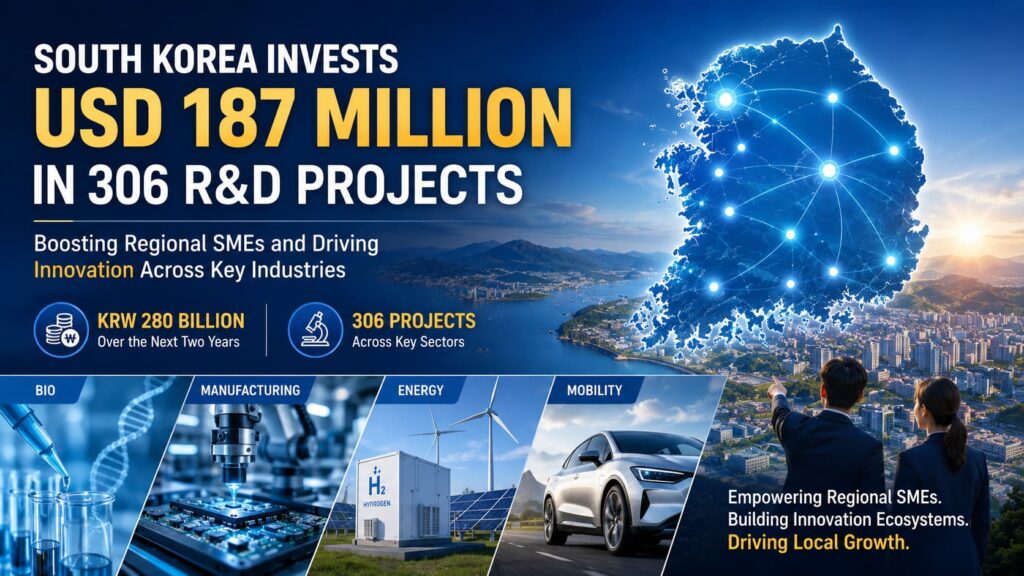
The program runs on two parallel tracks. The first, Core Industry Ecosystem Development, funds 157 collaborative projects bringing together industry, academia, and research institutions — including Pohang University of Science and Technology (POSTECH) and Gwangju Institute of Science and Technology (GIST) — to build sector-wide innovation capacity. The second, Regional Enterprise Capability Enhancement, channels direct R&D support to 149 individual companies to sharpen their competitive edge.
One of the more significant policy shifts this cycle is a broadened eligibility threshold. The program had previously been restricted to companies posting annual revenues of KRW 10 billion (approx. $7.1M) or more. Under the revised criteria, companies that invest at least 5% of their revenue in R&D now qualify — regardless of total revenue. The change was designed to bring in early-stage companies that may not yet have scaled commercially but already demonstrate serious research commitment.

The response was swift. Total applications more than doubled year-over-year, reaching 738 submissions — roughly 2.7 times the prior year’s figure. The selection process was also overhauled to improve transparency and reduce applicant burden: technology field-specific evaluations and standardized scoring were introduced, and in-person assessments were moved online.
The 306 selected projects span both the modernization of existing regional industries and a deliberate pivot toward future growth sectors. Selected companies show an average R&D intensity of 11.7%, rising to a striking 407.9% average among bio sector participants — a signal of deep-tech ambition across the portfolio.
Standout projects include a natural compound-based osteoarthritis treatment in Gangwon that targets disease progression directly, and a non-invasive urological tumor diagnostic system in Chungbuk using digital PCR to detect trace tumor DNA — addressing key limitations of conventional biopsy methods. On the manufacturing side, a Gyeongbuk company is developing an ultra-low-power edge AI vision inspection module for curved and flexible electronics, where flat-surface inspection technology falls short, while a Busan team is building a hybrid hydrogen storage module combining titanium additive manufacturing with carbon fiber reinforced polymer (CFRP) for next-generation hydrogen mobility applications.
In energy, a Gwangju company is developing an integrated EV battery control system that uses vehicle BMS data to extend battery reuse without requiring disassembly. A second Busan project focuses on cryogenic integrated measurement sensors for liquid hydrogen storage and transport — responding to growing demand from the hydrogen mobility market. Mobility projects include a lightweight aluminum alloy monoblock brake caliper system for high-performance EVs in Gyeongbuk, and a dual-channel wheel speed sensor in Chungnam designed to eliminate a key failure risk inherent in single-channel architectures.
Participating companies will also have access to the SME Innovation Voucher program, which supports the recruitment of qualified technical personnel — helping bridge the gap between R&D concept and commercialization.
MORE FROM THE POST
- Korea’s National AI Project Puts 264 GPUs Within Reach of SMEs and Startups
- Korea Wants Its Next Blockbuster Drug to Come From a Startup
- Korea Opens Applications for 2026 Program Pairing SMEs with Global Corporations
- Korea Pushes to Turn Japan Diplomatic Ties Into Real Biotech and Startup Deals
- South Korea Taps Six AI Startups to Bring Public Data to Work for Small Businesses
Share



Leave a Reply