



Korea’s Venture Market Hits Second-Highest Q1 on Record







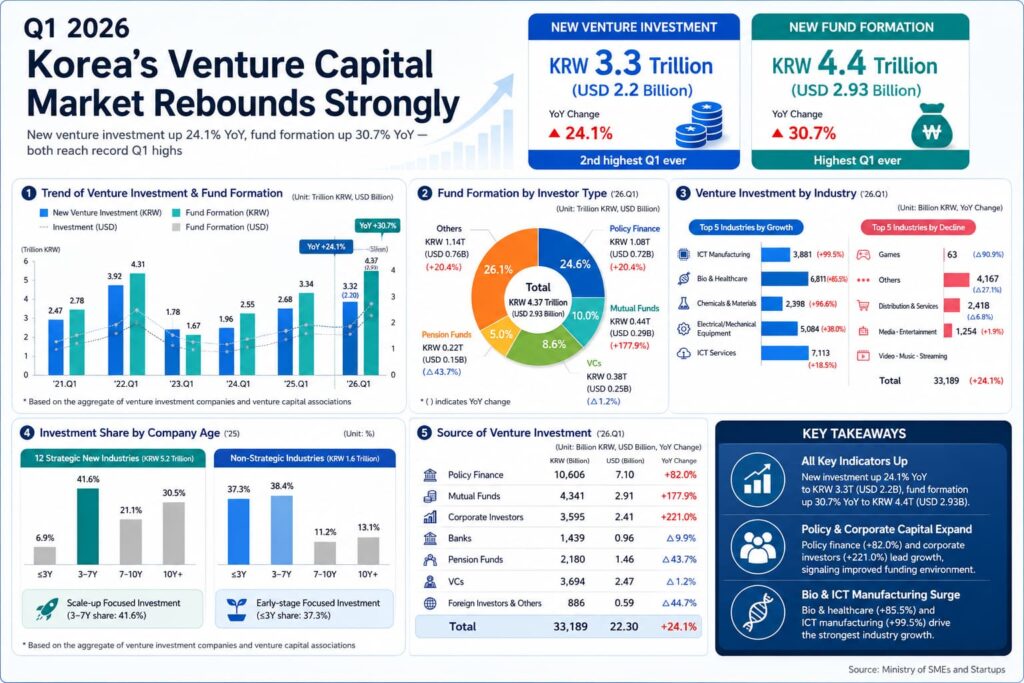
Korea’s venture capital market is back in full growth mode. New venture investment in the first quarter of 2026 reached KRW 3.3 trillion (approximately USD 2.2 billion), up 24.1% year-on-year — the second-highest Q1 figure ever recorded, trailing only the peak of the venture boom in 2022. New fund formation came in even stronger at KRW 4.4 trillion (approximately USD 2.93 billion), a 30.7% year-on-year increase and the highest Q1 figure on record.
The scale of the rebound stands out even against the low-rate environment of 2021. Q1 2026 investment volume was 34.3% higher than Q1 2021, while fund formation surpassed the same period by 57.2% — a clear signal that the market has not merely recovered from its 2023 trough but entered a new phase of expansion. When capital deployed by comprehensive financial investment business entities — which carry a mandate to supply risk capital — is included, total growth capital flowing to SMEs and venture companies in Q1 2026 exceeded KRW 5 trillion (approximately USD 3.33 billion).
ICT services led all sectors with a 21.4% share of Q1 investment, a position it has held for five consecutive years, driven largely by rising interest in artificial intelligence. Bio and healthcare came in second at 20.5%, with investment surging 85.5% year-on-year — KRW 313.9 billion above Q1 2025 — fueled by a series of large-ticket deals, including at least one exceeding KRW 100 billion in the quarter. Electrical, mechanical, and equipment rounded out the top three at 15.3%, with active investment across robotics, fuel cells, and aerospace.

The fastest year-on-year growth came from ICT manufacturing, which surged 99.5% — nearly doubling in a single year. Large investments in AI semiconductor companies drove the increase. BOS Semiconductors, founded in 2022 and selected for MSS‘s Deep-Tech Incubator Project for Startup in 2023, is a representative example: the company, which designs AI semiconductors for mobility applications, attracted major investment in both 2025 and Q1 2026 — the kind of trajectory the program was designed to support.
Twenty-six companies attracted investments of KRW 10 billion or more in the quarter, including ten based outside the greater Seoul metropolitan area. Large deals were recorded in Daejeon and Chungbuk in bio and healthcare, and in South Gyeongnam in electrical, mechanical, and equipment — reflecting sustained investor interest in regional companies anchored in their core industries. In South Gyeongnam, Songwol Technology — a 2022-founded startup manufacturing aircraft and satellite components using carbon fiber and composite materials — attracted a significant investment, continuing a trend of strong investor interest in the region’s defense and aerospace sector that gained momentum in 2025.
Across all company age brackets, both investment volumes and the number of investees grew year-on-year — with one exception. For companies up to three years old, the number of investees rose 8.9%, but total investment fell 9.5%. This reflects the current market’s structural tilt toward deep tech, which tends to attract capital at later stages, rather than any loss of confidence in early-stage companies. In non-deep tech sectors, companies up to seven years old still account for over 75% of investment, with the under-three-year cohort alone representing 37.3%.
To address the relative gap in early-stage funding, MSS has designated early-stage companies as the second-largest allocation category in its 2026 Korea Venture Investment (KVI) Fund of Funds first regular contribution round — at KRW 356.2 billion — and introduced preferential treatment for funds committing a set proportion of capital to early-stage companies.
“The fact that both venture investment and fund formation grew sharply in Q1 2026, following a year that was already the second-best on record annually, is a very positive signal,” said Minister Han Seong-Sook. “MSS will continue expanding Korea Fund of Funds contributions and advancing regulatory improvements to attract private investment, so that promising ventures can grow into the unicorns of tomorrow.”
MORE FROM THE POST
- MSS Reports Korea’s Venture Investment Rebound in 2024, Outpacing Global Trends
- South Korea Reports 6% and 42% Growth in Venture Investments and Funds Early in 2024
- South Korea Launches Open Innovation Challenge to Bridge Startups and Industry Giants
- Korea’s Venture Investment Surges 14% to $9.6B in 2025
- South Korea Launches Pan-Government Initiative to Support Startup Global Expansion
Share


Most Read
- 1
- 2
- 3
- 4
- 5

Leave a Reply