





The center of gravity in AI is shifting from training to inference — the work of actually running models once they are built. Industry estimates suggest inference will eventually demand 15 to 20 times more compute than training. Yet most of today’s AI clouds were built for training, and no clear leader has emerged in the inference category.
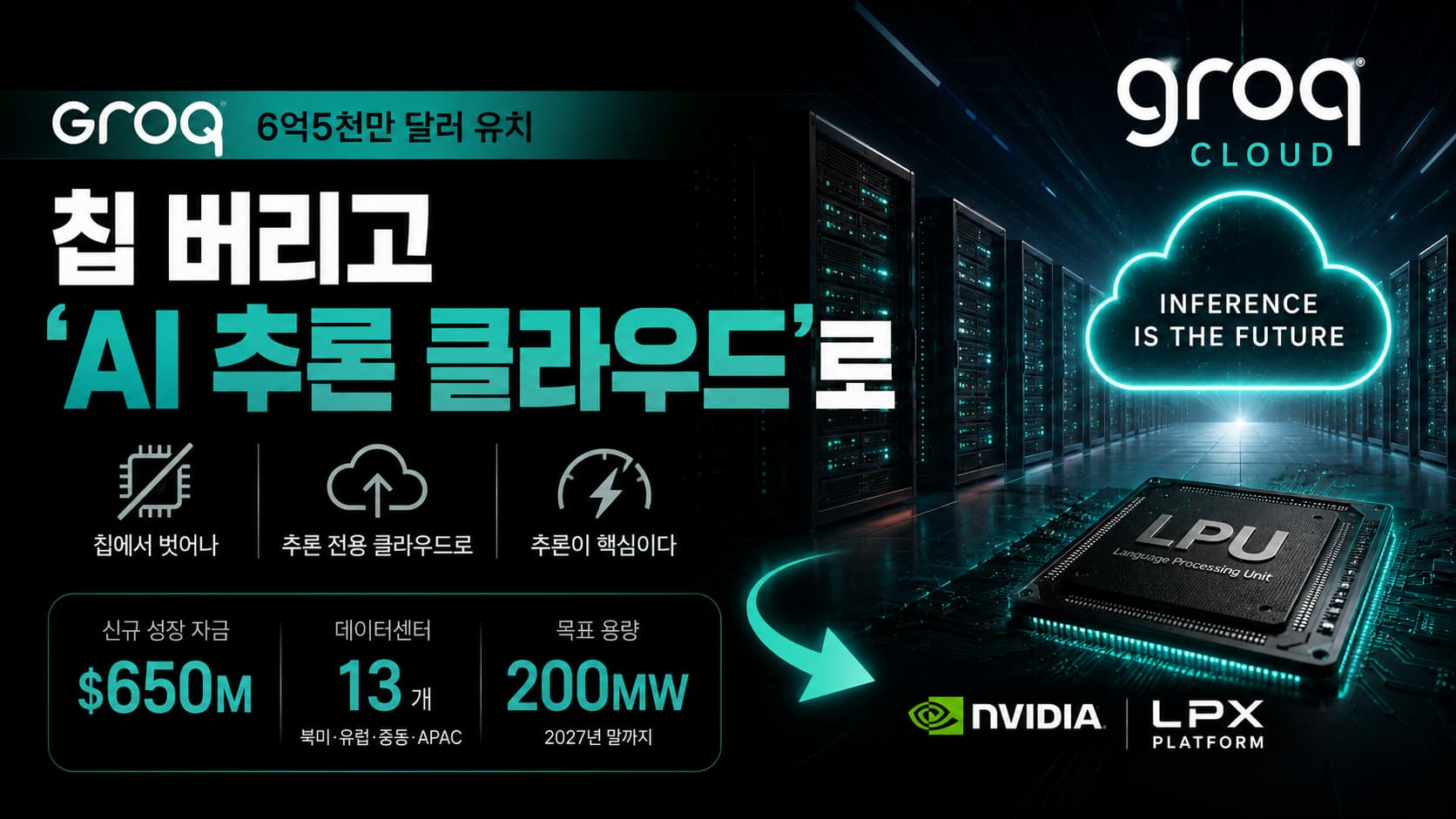
Groq is chasing that gap. Founded in 2016 by an engineer who had worked on Google’s AI chip (the TPU), the company pioneered the LPU (Language Processing Unit), a chip purpose-built for inference, and runs GroqCloud to deliver it. Today it operates 13 data centers across North America, Europe, the Middle East, and Asia-Pacific, serving more than five million developers who process trillions of tokens every week.
Groq’s real plot twist came late last year. In December 2025, Nvidia agreed to acquire Groq’s assets for roughly $20 billion (approximately KRW 27 trillion) — the largest deal in Nvidia’s history — and to license its technology on a non-exclusive basis. At this year’s GTC, Nvidia unveiled its next-generation LPX platform built around Groq’s inference technology. Having effectively handed its chip technology to Nvidia, Groq has refocused the entire company on a single goal: operating an AI inference cloud — one that will even run the Groq-powered LPX systems Nvidia now sells.
In line with that shift, Groq has announced $650 million (approximately KRW 880 billion) in new growth capital. The round was led by existing investors Disruptive and Infinitum, both of which hold seats on Groq’s board, with participation from investors who chose to reinvest. With Groq’s board chairman also heading lead investor Disruptive, the pivot is firmly investor-driven. The company did not disclose a new valuation; its previous $750 million (approximately KRW 1 trillion) round in September 2025 valued it at $6.9 billion (approximately KRW 9.3 trillion).
The fresh capital will fund the fit-out of Groq’s 13 existing data centers with its latest inference technology, including Nvidia’s LPX systems. The company aims to scale to 200 MW of capacity by the end of 2027.
A Crowded Race for the Inference Cloud
Groq is far from alone in chasing a dedicated inference cloud. Baseten, which routes each request to the most suitable model to keep inference costs down, is reportedly raising $1.5 billion at a $13 billion valuation. Modal Labs, a serverless platform, raised $355 million at a $4.65 billion valuation and has crossed $300 million in ARR. Cerebras, which like Groq builds inference-specific chips, raised $5.5 billion in its IPO and saw its shares double on debut. TensorWave, betting on AMD chips, reached unicorn status with a $350 million Series B, while newcomer General Compute has entered the fray pitching an “inference-first neocloud.”
Whether Groq’s second act succeeds will hinge on a simple question its leadership is betting the company on: that running AI, not building it, is where the largest infrastructure market in technology will be.
MORE FROM THE POST
Share

Most Read
- 1
- 2
- 3
- 4
- 5

Leave a Reply