



Etched Raises $700M at $21B Valuation After Jane Street Tested Its Chip


Fewer than 1% of people worldwide have access to frontier AI models. The models keep improving every month, but the cost and volume of actually running them has not kept pace. Inference — the stage after training, where a model answers a question — has become the industry’s bottleneck, and with it comes a question: should general-purpose GPUs designed for training keep doing that job?
Etched has given the same answer since day one. Burn the transformer architecture directly into silicon. Give up flexibility, and take speed and power efficiency in exchange.
One rack changed the round
Etched announced a $700 million Series D at a $21 billion valuation. That is more than double the $10.3 billion it carried a month ago on a $300 million Series C, and roughly four times the $5 billion it was worth in January.
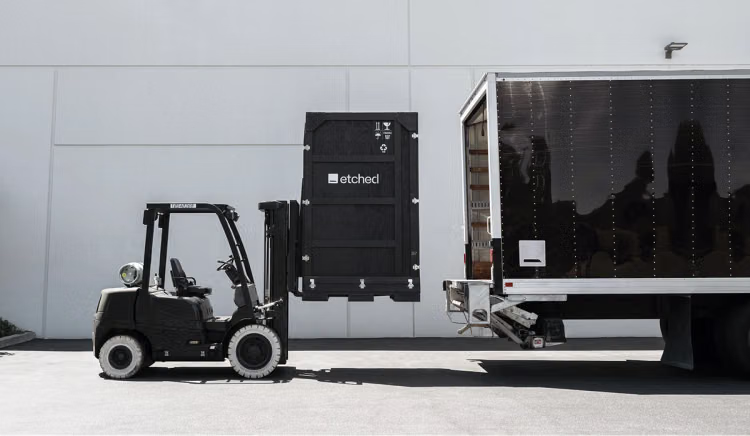
The round was led not by a venture firm but by a customer. Jane Street, the quantitative trading firm, tested Etched’s hardware before committing. The firm said it was pleased with early results, that Etched’s approach to inference delivers the precision it needs for its most demanding workloads, and that it is glad to have its own rack running in its datacenter.
That rack was Etched’s first shipment to any customer, which is why the company titled the announcement “From Zero to One.” Jane Street was already an investor, and has also backed MatX, the LLM-specific chip company founded by former Google TPU designers. Proprietary trading capital is moving directly into inference hardware.
Kleiner Perkins, Sequoia Capital, Andreessen Horowitz, Peter Thiel, Tiger Global, Bain Capital Ventures, Neo, Stripes, Primary, Positive Sum, Diffusion, Argo and Blackstone joined the round. SK hynix participated in last month’s Series C.
Splitting prefill from decode
Etched does not sell a chip on its own. It sells what it calls frontier inference clusters, splitting inference into two stages and giving each its own hardware.
Prefill, where the model reads and understands the context of a prompt, runs on a chip built to operate at low voltage. Lower voltage means more transistors can be packed in without hitting the thermal ceiling that limits other high-end parts — heat, not area, is what caps density. Decode, where the answer is generated token by token, relies on custom memory and interconnect the company calls cluster-scale memory, letting many chips share a single fast, low-latency memory pool.
Manufacturing runs on TSMC’s N4P process. The first chip worked on the first attempt, which is uncommon for a semiconductor startup at this stage.
One shift is worth noting. Early Etched built silicon around specific models, and its flagship was Sohu, a transformer-only chip. That was still the framing when the company came out of two years of stealth with working silicon and $1 billion in customer contracts. It now supports any frontier model across its systems, removing the risk of hard-wiring a single model into silicon. The order book passed $1 billion as of June.
Three who left Harvard
Gavin Uberti, Chris Zhu and Robert Wachen dropped out of Harvard in 2022 to start Etched. All three are Thiel Fellows, and the company is based in San Jose, California.
The bet they left school on was simple: the transformer architecture behind GPT, Claude, Gemini and nearly every commercial AI system would keep dominating. If the architecture holds still, a chip built only for that architecture beats a general-purpose one. It was a bet that would have made the company worthless had the architecture shifted. Four years on, it has held.
The company says scaling to gigawatt capacity brings a new set of problems: new factories, global supply chains, fleet software, and self-improving kernel agents.
The competitive field
Inference silicon has drawn more funding than any other hardware category this year, but the strategies diverge.
Some are going head-on. Cerebras took its dinner-plate-sized wafer-scale chip to Nasdaq, raising $5.5 billion with the stock up 108% on day one. SambaNova raised $1 billion at an $11 billion valuation, and d-Matrix took $275 million at $2 billion. Positron AI reached unicorn status claiming Nvidia-equivalent performance at a third of the power. MatX, closest to Etched’s approach, raised $500 million for its LLM-specific chip.
Others retreated from hardware. Groq signed a $20 billion technology licensing deal with Nvidia, dropped its chip business for an inference cloud, and restarted this month with a $350 million Series A. The split between selling your own silicon and selling service on someone else’s is now an open question.
The heavier pressure comes from big tech building in-house. Google split its eighth-generation TPU into separate training and inference parts, and OpenAI finished its first in-house inference chip with Broadcom in nine months. When the largest buyers of compute start designing their own silicon, the addressable customer pool for specialist startups narrows. That Etched found its first customer in finance rather than in a hyperscaler is worth reading in that light.
MORE FROM THE POST
- Cognition Raises Over $2B at $48B Valuation
- Rillet Achieves Unicorn Status With $100M Series C Funding
- Profound Raises $180M Series D, Hits $1.8B Valuation to Build the AI Platform for Marketing
- Factory Raises $200M at $5B Valuation, Tripling in Five Months
- Temporal Raises $550M Series E at $12.55B Valuation
- AI
- AI Infra
- Andreessen Horowitz
- argo
- Bain Capital Ventures
- Blackstone
- Diffusion
- Etched
- funding
- Inference
- Jane Street
- Kleiner Perkins
- mega funding
- Neo
- Overseas funding
- Peter Thiel
- Positive Sum
- Primary
- sequoia capital
- seriesD
- Stripes
- Tiger Global
Share

Most Read
- 1
- 2
- 3
- 4
- 5

Leave a Reply