




Running a service like ChatGPT means lashing together thousands of GPUs so they work as one giant computer. The hard part isn’t stacking more GPUs — it’s connecting them fast enough. Copper has handled that job so far, but as AI clusters scale up, copper interconnects are running into both bandwidth and power limits at once. That’s why the industry is shifting from copper to optics, and why a new generation of scale-up optical switching is suddenly in demand.
A Valencia Spinout Built a Programmable Optical Switch
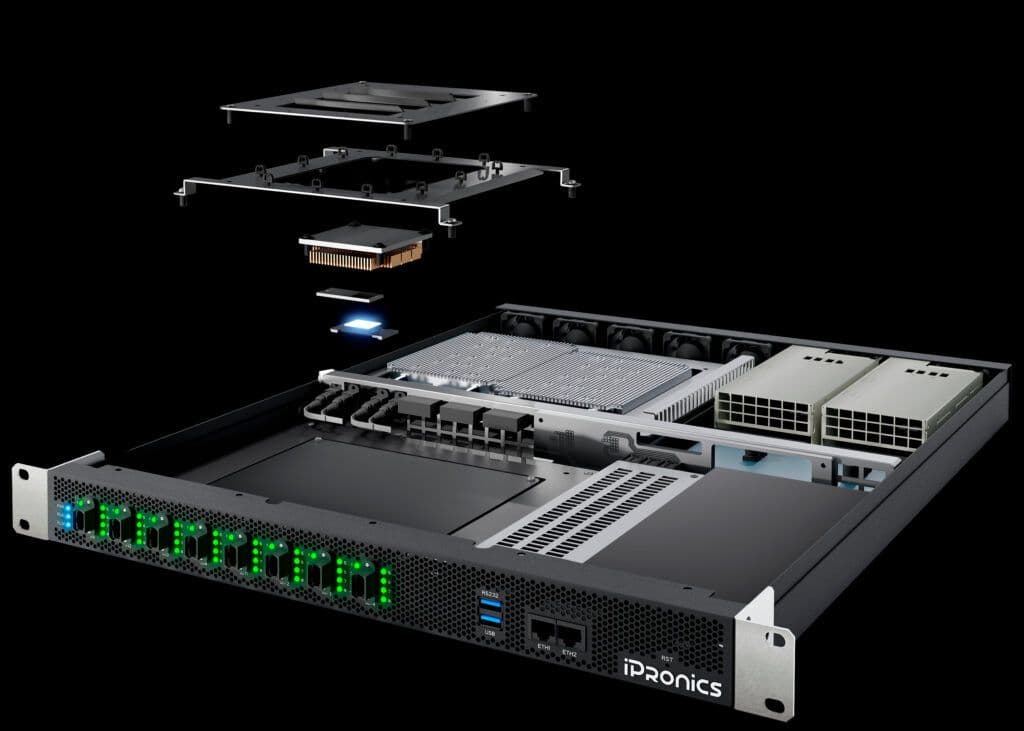
iPronics builds programmable optical circuit switching (OCS) based on silicon photonics. The company spun out of Universitat Politècnica de València in Spain in 2019. Its flagship product, iPronics ONE, is a rack-mounted optical switch with integrated control, telemetry and APIs that lets AI clusters reconfigure their connectivity in real time for training and inference workloads. The company says this improves GPU utilization, cuts energy use, and lets data centers scale without costly network overhauls.
CEO Christian Dupont joined iPronics in 2024. He brings more than 30 years in high tech, including a stint running Texas Instruments’ wireless business in the U.S. and Europe, and has served as CEO of several optical MEMS startups; he holds a master’s in engineering from EPFL in Switzerland. Founder and CTO Daniel Pérez-López earned a PhD in photonics from Universitat Politècnica de València before founding the company in 2019.
iPronics announced $125 million in Series B funding co-led by Maverick Silicon and Light Street Capital. Nvidia joined as a new investor, alongside existing and new backers Triatomic Capital, Bosch Ventures, Catalight Capital, the European Innovation Council Fund, The Tate Family Trust, Fine Structure Ventures, Amadeus Capital Partners, Build Collective and Criteria Venture Tech. The round brings iPronics’ total funding to $177 million.
Manish Muthal, senior managing director at Maverick Silicon, said the explosive growth of AI workloads has pushed traditional network infrastructure to its power and bandwidth limits, making optical circuit switching more critical than ever; he’s joining the board. Shef Osborn, a partner at Light Street Capital, said iPronics offers the most scalable and cost-effective approach to solid-state optical switching at the interconnect layer.
Light Street advisor Geoffrey Tate is also joining the board. Tate was formerly senior VP of microprocessors at AMD, founding CEO of Rambus (which he took public and led for over a decade), and later co-founder and CEO of Flex Logix, an AI inference hardware company acquired by Analog Devices — he also sits on the board of rival photonics firm Ayar Labs. Young Sohn of Catalight Capital, which runs a dedicated AI-infrastructure fund, is joining as an advisor; Sohn previously served as corporate president and chief strategy officer at Samsung and as CEO of Inphi, and sits on the boards of Arm and Cadence Design Systems.
iPronics plans to use the funding to accelerate commercialization and has opened a Santa Clara, California office to build out its U.S. presence.
The Race to Replace Copper With Light
iPronics isn’t alone in trying to solve AI’s copper bottleneck with optics. Ayar Labs has raised $500 million around co-packaged optics (CPO) — a different technical approach from iPronics’ circuit switching, but aimed at the same problem: the speed and power limits copper imposes between GPUs. Celestial AI has raised $250 million around its “Photonic Fabric,” and Retym has raised more than $180 million for programmable coherent DSP technology. Quintessent raised a $40 million Series A targeting the laser bottleneck in optical interconnects.
MORE FROM THE POST
- CScale Exits Stealth With $145M Series C to Build Optical Interconnect for Gigawatt-Scale AI
- Taiwan’s GMI Cloud Raises $668M, With Korean Capital Piling In
- Neocloud Nscale Raises $3.36B in New Funding
- Verda Raises $189M Series B, Becomes Europe’s Newest AI Cloud Unicorn
- Ayar Labs Expands 2026 Funding to $650 Million
- AI Infra
- Amadeus Capital Partners
- Bosch Ventures
- Build Collective
- Catalight Capital
- Criteria Venture Tech
- European Innovation Council Fund
- Fine Structure Ventures
- funding
- iPronics
- Light Street Capital
- Maverick Silicon
- mega funding
- Nvidia
- Overseas funding
- seriesB
- The Tate Family Trust
- Triatomic Capital
Share

Most Read
- 1
- 2
- 3
- 4
- 5

Leave a Reply