





Air cargo has a structural problem that’s been building for years. Pilot costs keep rising, and most cargo planes are just retired passenger jets converted after the fact rather than built for freight from day one. That makes regional routes with thin demand uneconomical, so air cargo service to those areas quietly disappears — and on the defense side, when supply lines get cut, there aren’t many good alternatives. One startup building aircraft designed around cargo from the ground up just raised a large round to do something about it.
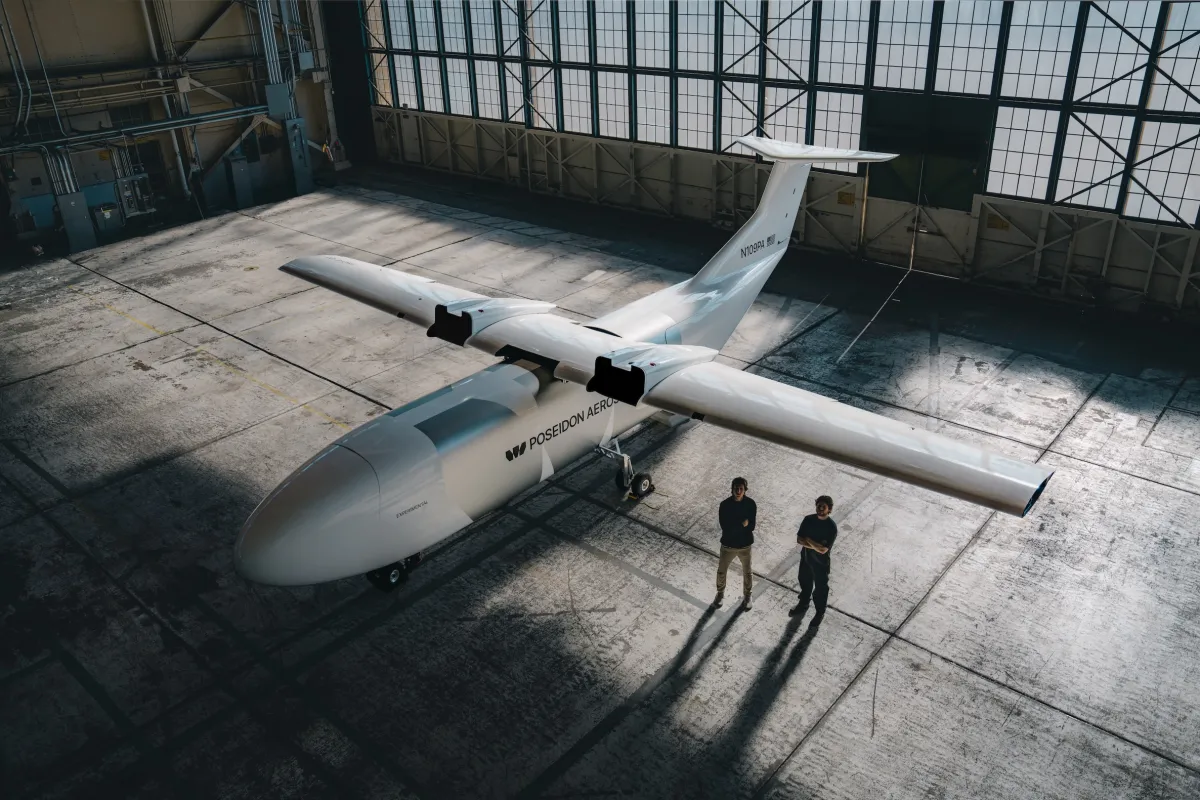
An Aircraft Designed Around Cargo, Not People
Poseidon Aerospace, founded in 2024 and headquartered in Alameda, California, designs, builds and operates unmanned cargo aircraft. Its flagship aircraft, Egret, is an unmanned regional freighter with roughly a 50-foot wingspan, designed to carry multiple tons of cargo at a fraction of the operating cost of today’s regional freighters. Poseidon expects Egret’s first uncrewed flight by the end of this year. In 2025, it successfully developed and flew Seagull, a quarter-scale demonstrator built to validate the aircraft’s design and control architecture. It’s also developing Heron, a seaplane variant.
Poseidon skipped vertical takeoff and landing technology and electric or hydrogen propulsion in favor of fixed-wing aircraft with conventional combustion engines, on the reasoning that nothing beats the energy density of carbon-based fuel yet — so the company is focused on cutting cost through the unmanned operating model itself rather than the propulsion. On the commercial side, Poseidon doesn’t plan to sell aircraft to carriers; it intends to operate its own regional cargo service, using the flexibility of not needing pilot bases or crew duty-time limits to serve regional, remote and underserved routes that conventional carriers find uneconomical. On the defense side, it’s designing the aircraft to operate in contested or infrastructure-poor environments, aiming to make military logistics harder to disrupt.
Co-founder and CEO David Zagaynov studied computer science at UC Berkeley and worked as a software engineer at Amazon. Co-founder and CTO Parker Tenney studied mechanical engineering at Cal Poly and worked at Lockheed Martin. The two met while both working on logistics at Amazon in 2024 and founded the company after repeated conversations about the rise of advanced air mobility startups.
An Oversubscribed Series A, With Korea’s Hanwha Joining
Poseidon Aerospace announced the close of an oversubscribed $60 million Series A led by TQ Ventures. New investors JAWS, G Squared and Hanwha Asset Management USA joined, alongside existing backers Starship Ventures, Drover Ventures and Draper Associates. The round comes less than a year after the company’s $11 million seed round last November.
CEO David Zagaynov said: “Most aircraft are designed first around the people flying them and then adapted to carry cargo. We are starting with a different question: How would you design an aircraft if its only purpose were to move payload as efficiently and reliably as possible?” TQ Ventures co-founder and partner Schuster Tanger said: “Air cargo is one of the world’s most important pieces of infrastructure, yet the aircraft and operating models behind it have changed remarkably little. David, Parker and the Poseidon team are taking a disciplined, first-principles approach: use proven technologies where they work, redesign the aircraft around payload and build an operating model that can deliver lower costs and higher utilization.”
The funding will take Poseidon’s first full-scale aircraft through its flight-test campaign, establish and scale its first production line, expand its engineering and operations teams, and continue delivering against its commercial and defense customer programs.
Others Building Unmanned Cargo Aircraft
Several companies are chasing unmanned air cargo from different angles. Reliable Robotics retrofits autonomy onto existing cargo aircraft rather than designing new airframes, and is targeting autonomous cargo flights starting this year. Natilus, like Poseidon, is designing a purpose-built cargo airframe from scratch. Elroy Air is building Chaparral, a hybrid-electric vertical takeoff and landing cargo drone — a different technical path from Poseidon’s fixed-wing, combustion-engine approach. On the retrofit-autonomy side, Xwing and Merlin Labs are also active.
MORE FROM THE POST
- CesiumAstro Raises $730M Series D at a Valuation Above $4.5B, Unveils 737-Satellite Constellation
- Ground Station Startup Northwood Space Raises $375M Series C
- Foundry Robotics Raises $100M Series A to Run Autonomous Assembly Factories
- The Exploration Company Raises $450M, Europe’s Largest Space-Tech Series C
- Pixxel Raises $100M Series C, India’s Largest Space-Tech Round
- Autonomous Vehicle
- defence
- Draper Associates
- Drover Ventures
- funding
- G Squared
- Hanwha Asset Management USA
- JAWS
- mega funding
- Overseas funding
- Poseidon Aerospace
- seriesA
- Starship Ventures
- TQ Ventures
- 우주항공
Share

Most Read
- 1
- 2
- 3
- 4
- 5

Leave a Reply