










Terrestrial cellular networks cover only about 15% of Earth’s landmass. Tracking anything beyond that has meant bolting on dedicated satellite hardware costing $25 or more per device — a price only the highest-value assets could justify. Everything else goes untracked, and asset theft and loss cost the average mid-sized business $13 million a year.
A Bluetooth Chip Becomes a Satellite Beacon
Hubble Network said it has opened its satellite-powered Bluetooth network to the public, moving from early pilots to general availability. The system turns the Bluetooth Low Energy radio already built into everyday devices into a satellite uplink through a firmware update — no new hardware required. For new designs, adding connectivity costs under 50 cents in bill of materials, roughly a tenth the cost of a cellular modem and a fiftieth the cost of a dedicated satellite modem. Any company already on Hubble’s terrestrial network can now extend to satellite coverage with a firmware update, and new customers can register an off-the-shelf dev kit and see data flowing within minutes.
Until now, satellite tracking was a premium add-on reserved for shipping containers and industrial equipment expensive enough to justify the cost of failure. Hubble’s bet is that erasing that line changes what gets tracked at all: because the connection rides on a Bluetooth chip already inside the product, Haro has pointed to tracking a pair of sneakers from a warehouse to a front doorstep as the kind of everyday item that becomes economical to follow in real time.
What actually moves over that satellite layer, though, is a tiny packet — location and status, not data. That puts Hubble in a different lane from the broadband ambitions of SpaceX’s Starlink, built out of Redmond, or Amazon’s Leo satellite service, based in nearby Kirkland; Hubble isn’t trying to replace a phone call or a data plan, but to plug the low-power gap in the roughly 85% of the planet cellular networks never reach.
$200M Series C, Unicorn Status
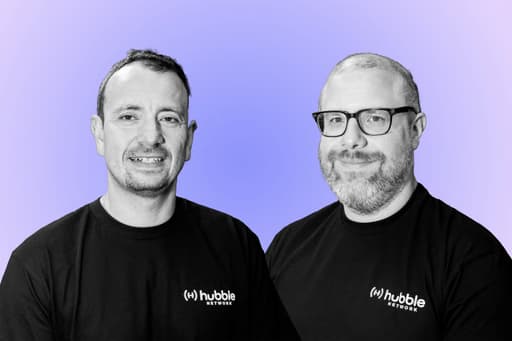
Hubble was founded in 2021 by Alex Haro, CEO, and Ben Wild, CTO. Haro previously co-founded and took public the location-sharing app Life360. Wild spent time at Amazon, where he invented and led product for Amazon Sidewalk, the retailer’s low-power wireless mesh network.
The company raised $200 million in a Series C round led by Smith Point Capital, with participation from Seraphim, Carthona Capital, Earthshot Ventures, Y Combinator, and RPM Ventures. The round brings Hubble’s total funding to $300 million and pushes its valuation to $1.6 billion, making it a unicorn just a year after closing a $70 million Series B in September 2025.
“When we said we’d connect Bluetooth chips to satellites, most of the industry said the physics wouldn’t allow it,” Haro said, adding that the company is turning that early skepticism into a global opportunity. Keith Block, founder and CEO of Smith Point Capital, said the cost and complexity of connectivity had until now limited visibility to only the most valuable assets, and that Hubble has built the infrastructure to track and monitor virtually any asset worldwide.
The six low Earth orbit satellites Hubble uses today were built and are operated by Spire Global — Hubble supplies only the Bluetooth payload riding on top, and isn’t a satellite manufacturer itself. The next-generation fleet, expanding to 60 satellites by 2030, will instead be built on Muon Space‘s newly unveiled MuSat XL platform, with Hubble as its first customer. Hubble’s complementary Terrestrial Network spans more than 100 million gateways across 170 countries and roughly 3 million square miles, with more than 500,000 devices now active — a tenfold jump from a year ago.
Samsara, the connected-operations software company, is piloting Hubble’s satellite service for field equipment management. Hubble has also partnered with Texas Instruments, InPlay, and Reelables.
Who Else Is Chasing This Gap
Hubble isn’t alone in chasing the connectivity gap cellular networks leave behind — but each rival is wiring up something different.
Barcelona-based Sateliot targets sensors that already speak standard cellular IoT (NB-IoT), stepping in only where a carrier’s own ground network doesn’t reach — more a complement to telecom operators than a competitor — serving agriculture, livestock, fisheries, and environmental monitoring; it secured a €30 million loan from the European Investment Bank to expand its nanosatellite constellation.
Skylo Technologies doesn’t fly its own satellites at all — it leases capacity on existing geostationary ones to power satellite SOS on Google’s Pixel 9 phones, Motorola’s satellite-messaging accessory, and links for trucking fleets and industrial sensors, and it raised $30 million to scale that model.
SpaceX shut down the dedicated-modem IoT service it ran through its Swarm Technologies subsidiary in 2025, folding that business into Starlink’s ‘Direct to Cell’ service instead. Off-the-shelf cellular modems that already meet the 3GPP standard connect straight to satellites with no new hardware — the same “use what’s already there” philosophy as Hubble, just aimed at cellular chips rather than Bluetooth ones.
Hubble’s pitch is that it needs none of the above — no new cellular chip, no satellite-capacity lease, no dedicated modem — just the Bluetooth radio already sitting in the device. Fortune Business Insights values the global satellite IoT market at $2.01 billion in 2025, projecting growth to $6.51 billion by 2034, with direct-to-device connections expected to account for 68.84% of the market in 2026.
Five years after founding, Hubble has grown to roughly 70 employees. The fresh capital will fund the satellite build-out as the company works to make tracking economically viable for everyday goods, not just high-value cargo.
MORE FROM THE POST
- CesiumAstro Raises $730M Series D at a Valuation Above $4.5B, Unveils 737-Satellite Constellation
- Ground Station Startup Northwood Space Raises $375M Series C
- Space Pharma Reentry Capsule Maker Varda Space Raises $251M Series D
- Angle Health Raises $600M at a $2.7B Valuation
- EnduroSat Raises $205M, Joins the Unicorn Club
- Carthona Capital
- Earthshot Ventures
- funding
- Hubble Network
- IoT
- mega funding
- Overseas funding
- RPM Ventures
- Seraphim
- seriesC
- Smith Point Capital
- spacetech
- unicorn
- Y Combinator
Share

Most Read
- 1
- 2
- 3
- 4
- 5

Leave a Reply