





Renewable energy’s biggest weakness is that the power stops the moment the sun sets or the wind dies down. In recent weeks, investors have thrown money at nearly every way to fill that gap — gas turbines (Parallax, which WOWTALE covered last week), nuclear, on-site generation. Now it’s fuel cells’ turn.
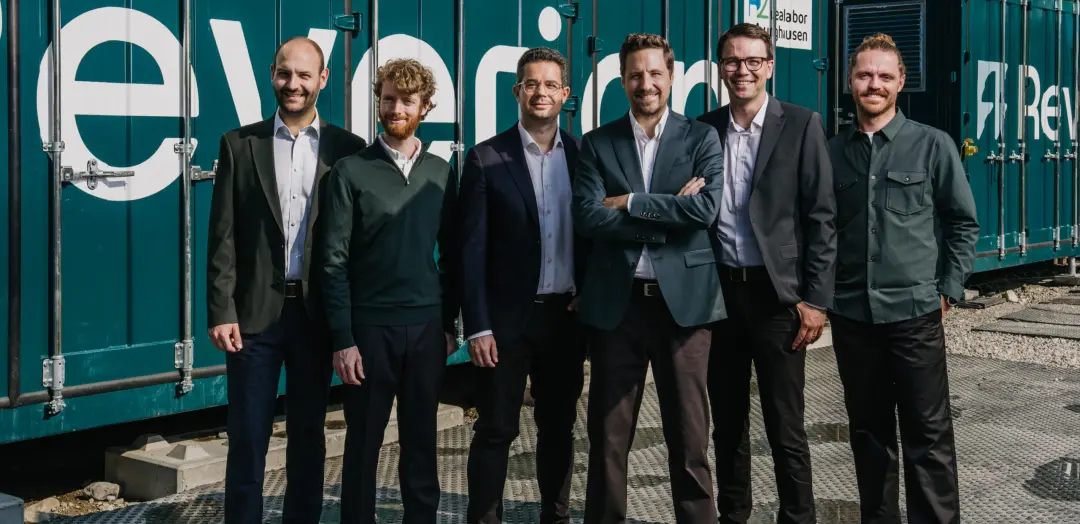
Germany’s Reverion said it has closed a $175 million Series B. Kembara led the round — Mundi Ventures’ European deep tech and climate fund, which closed €750 million in February to become Europe’s largest fund of its kind. Allianz, KfW Capital, Aurum Impact, and Carbon Equity joined as new backers, alongside returning existing investors.
Reverion builds reversible solid oxide fuel cell (SOFC) power plants. Despite the name, a fuel cell isn’t a battery. A battery discharges chemical energy it has already stored; a fuel cell is closer to a generator, producing electricity only for as long as fuel keeps flowing in. In normal operation, Reverion’s system converts biogas, natural gas, or hydrogen directly into electricity through an electrochemical reaction — no combustion — generating power on demand rather than drawing it from storage. The process captures the fuel’s CO₂ in pure form; when the fuel is biogas, that CO₂ is biogenic, making the plant’s operation carbon-negative. Measured in live customer operation on early production units, its electrical efficiency hits 74.2% — nearly double a conventional generator and, the company says, a world record. Run the same unit in reverse, and it becomes an electrolyzer: instead of consuming gas to make electricity, it consumes surplus electricity to make storable gas. That’s the long-duration storage play — energy banked as gas instead of in a battery, then converted back to electricity on demand through the same device.
“Solar and wind give us clean energy, but only when the weather cooperates,” said Stephan Herrmann, CEO and co-founder. “By closing this Series B, we are laying the foundation for industrial mass production. We are building the dispatchable, carbon-negative engine that allows grids and heavy industry to run 100% clean, 24 hours a day, 365 days a year.”
Demand is spreading fast beyond biogas sites into the tech sector. For data center operators facing years-long grid connection delays and mounting environmental pushback, Reverion offers a way to bypass the grid entirely using local gas infrastructure. “We are seeing explosive international demand for our systems as utilities and industrial customers recognize that true energy security requires dispatchable clean power,” said Felix Fischer, COO and co-founder. “With seven commercial plants operating in the field and output per unit upgraded to 500 kW, this capital ensures we can rapidly clear our backlog and steer the company toward long-term profitability.”
Reverion is putting most of the new capital into a megafactory in Germany to meet a commercial pipeline worth more than $2 billion, ramping annual manufacturing capacity tenfold to 250 megawatts. Headcount at its headquarters near Munich has grown from 100 to more than 200 recently, and the new site will add up to 800 more jobs. Founded in 2022 as a spin-off from the Technical University of Munich, the company traces back to Herrmann’s PhD research on high-temperature fuel cells in 2015; Fischer joined in 2017 to validate the concept at lab scale before the company formally launched.
“Solid oxide fuel cells are the most efficient way to convert gas into electricity, and Reverion sets the global benchmark in this field,” said Robert Trezona, Climate Lead at Kembara. “The growth market lies in powering data centers, where Reverion’s negative carbon footprint counts as much as efficiency. Hyperscalers need massive, reliable power, but they cannot compromise on their climate commitments.”
Reverion isn’t alone in chasing AI data centers with solid oxide fuel cells. Already-public Bloom Energy dominates the field — it expanded its Brookfield partnership fivefold from $5 billion to $25 billion, struck a $2.65 billion supply deal with American Electric Power, and signed a 2.8-gigawatt agreement with Oracle. Fuel cell makers collectively signed $7.65 billion in binding data-center agreements between last October and January alone, by one count. UK-based Ceres Power licenses its technology rather than manufacturing directly, and launched a data-center-specific platform, Ceres Endura, this past April. U.S.-listed FuelCell Energy has also landed a data-center supply deal worth up to 380 megawatts.
Against that field, Reverion’s differentiation is clear: where most rivals optimize only for forward generation, Reverion’s reversible system also runs as an electrolyzer, its 74.2% efficiency leads the pack, and running on biogas takes it past carbon-neutral to carbon-negative.
MORE FROM THE POST
- VEIR Raises $110M Series C to Scale Superconducting Power Delivery for AI Data Centers
- Gas-Turbine Startup Parallax Raises $117M, Exits Stealth to Solve AI’s Power Problem
- TAR Raises $120M Series A at $1B Valuation to Build Off-Grid Power for AI
- Mazama Energy Raises $135M Series B to Push Superhot Geothermal Past 750°F
- A Battery That Rusts to Store 100 Hours of Power: Form Energy Raises $750M
Share


Leave a Reply