










HexaEnergy is a deep-tech startup developing transparent, lightweight solar cells from a new boron-carbon-nitrogen (BCN) material.
The company is preparing to raise USD 380,000 (500 million KRW) in pre-SeriesA funding in Q4 2026.
Mandates requiring buildings to cover a set share of their energy use with renewables are spreading fast worldwide. Korea first applied Zero Energy Building (ZEB) rules to public buildings in 2020. Since December 2025, private buildings with a gross floor area of 1,000 square meters or more must also cover at least 20% of their power use with renewable energy, while public buildings face a higher 40% standard.
The standard applies from the point of the building permit application, not the start of construction, so almost every new building now in design is already covered. Europe and Japan have similar mandates in force, and more than 95% of the renewable energy in urban buildings comes from solar.
The problem is that there are few practical ways to meet the standard. Crystalline silicon cells, the first-generation technology that dominates the market, are heavy and rigid. They are installed on roofs and as facade BIPV (Building Integrated Photovoltaics), but weight limits keep them from using the full surface area. BIPV facade panels cannot replace curved surfaces or transparent windows, so of a building’s total surface (about 50% windows, 40% facade and 10% roof), no more than 30% is actually usable.
Second-generation cells such as CIGS and CdTe are lighter, but the material itself cannot become transparent, so they offer no answer for windows. Third-generation cells such as perovskite and organic materials can be made thin and transparent, but their stability is low and they have not secured adequate lifespans. Products that did achieve stability lose efficiency, falling to around 10%, far from commercial viability. Most “transparent solar” products on the market are simply opaque silicon panels patterned with gaps. No product made from a truly transparent material has yet been commercialized.

HexaEnergy aims to fill that gap with BCN. CEO Hanbin Ko researched electronic applications of nanomaterials such as graphene at Korea University. During his doctoral studies he came across BCN by chance and pursued separate research on it, then founded the company as he earned his degree. Graphene is made only of carbon and is a semiconductor with no band gap. BCN’s band gap changes with its carbon ratio, which gives it semiconductor properties and lets it absorb whichever wavelengths of light are desired.
According to the company, this makes it possible to build transparent solar cells that absorb only infrared and ultraviolet light while letting visible light through, as well as flexible solar cells whose thickness and color can be tuned atomic layer by atomic layer. At its darkest, most opaque setting, a module currently reaches up to 18% power conversion efficiency. That is below first-generation silicon (20-22%), but by the company’s own evaluation standards the lifespan reaches 25-30 years or more. Its annual degradation rate is about 0.25%, better than silicon’s 0.3%. Korea Conformity Laboratories certified testing of efficiency and lifespan is under way.
HexaEnergy is running a proof of concept (PoC) with Kolon Global on windows in double-pane glass form. It aims to obtain certified test reports this year and launch the product in March 2027. After receiving a cumulative USD 152,000 (200 million KRW) in seed funding, the company plans to raise a further USD 380,000 (500 million KRW) this year. We spoke with Ko about his challenge to turn windows into power-generating space.
What is HexaEnergy?
We apply a new BCN material to solar power devices to make them lighter and more transparent than existing ones. With this technology, we are developing a solution that can increase a building’s solar generation by up to 2.5 times.
What is wrong with existing solar panels?
Most solar devices are made of silicon, which is heavy, hard and inflexible, so the places where it can be installed are very limited. The panels we commonly see are laid across wide natural spaces such as mountains, fields, lakes, the sea and farmland. It is contradictory that we have to damage nature in order to install solar power. So interest has recently grown in using the surfaces of urban buildings instead.
But even on buildings, silicon panels are heavy and rigid. They can be fitted to facades, but mostly they go on roofs, and even there weight limits keep roof utilization low. They are also used in part as BIPV replacing facade materials, but they cannot be applied to curved surfaces, and between weight limits and the inability to replace transparent windows, usable facade area is limited too. As a result, the maximum area utilization of silicon panels comes to 30% or less.
When and how did you start HexaEnergy?
I was working on my doctorate at Korea University and founded HexaEnergy right as I graduated. In my doctoral research I applied nanomaterials such as carbon and graphene to electronic materials. Along the way I came across a material called BCN, and I wanted to build it myself, so I pursued separate research on it.
Fortunately, my academic advisor had started a company. I was not a formal employee, but I took part as a founding member and watched the early commercialization process up close. That experience helped when I founded HexaEnergy.
What exactly is BCN, and how does it differ from graphene?
BCN is named after the first letters of boron, carbon and nitride (nitrogen). It is easiest to understand by comparison with graphene, which has carbon atoms arranged in a hexagonal honeycomb. Our BCN has the same honeycomb structure, but it is made of three elements, boron, carbon and nitrogen, rather than carbon alone.
Graphene is made only of carbon, so it has no band gap and therefore no semiconductor properties at all. Our BCN, on the other hand, has a band gap that changes with the proportion of carbon atoms. That gives it semiconductor properties, and we can freely adjust the wavelengths of light it absorbs.
Graphene is best known as a battery material, but that is mostly zero- and one-dimensional graphene. We are developing a two-dimensional, large-area nanomaterial. Two-dimensional large-area graphene is generally used as a transparent electrode, whereas our BCN is a semiconductor used in optoelectronic devices that can absorb or emit light.
How do you make a transparent solar cell from this material?
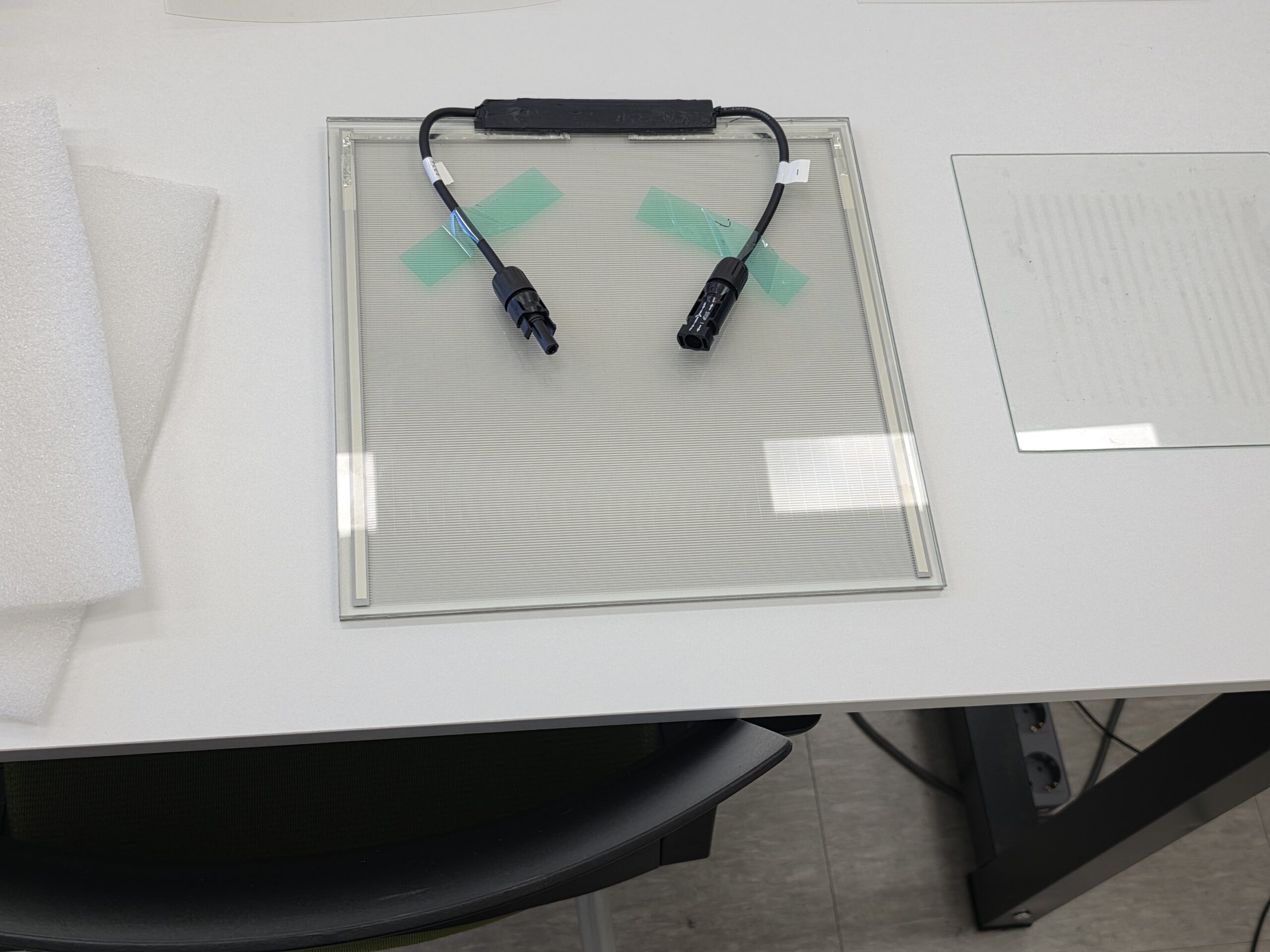
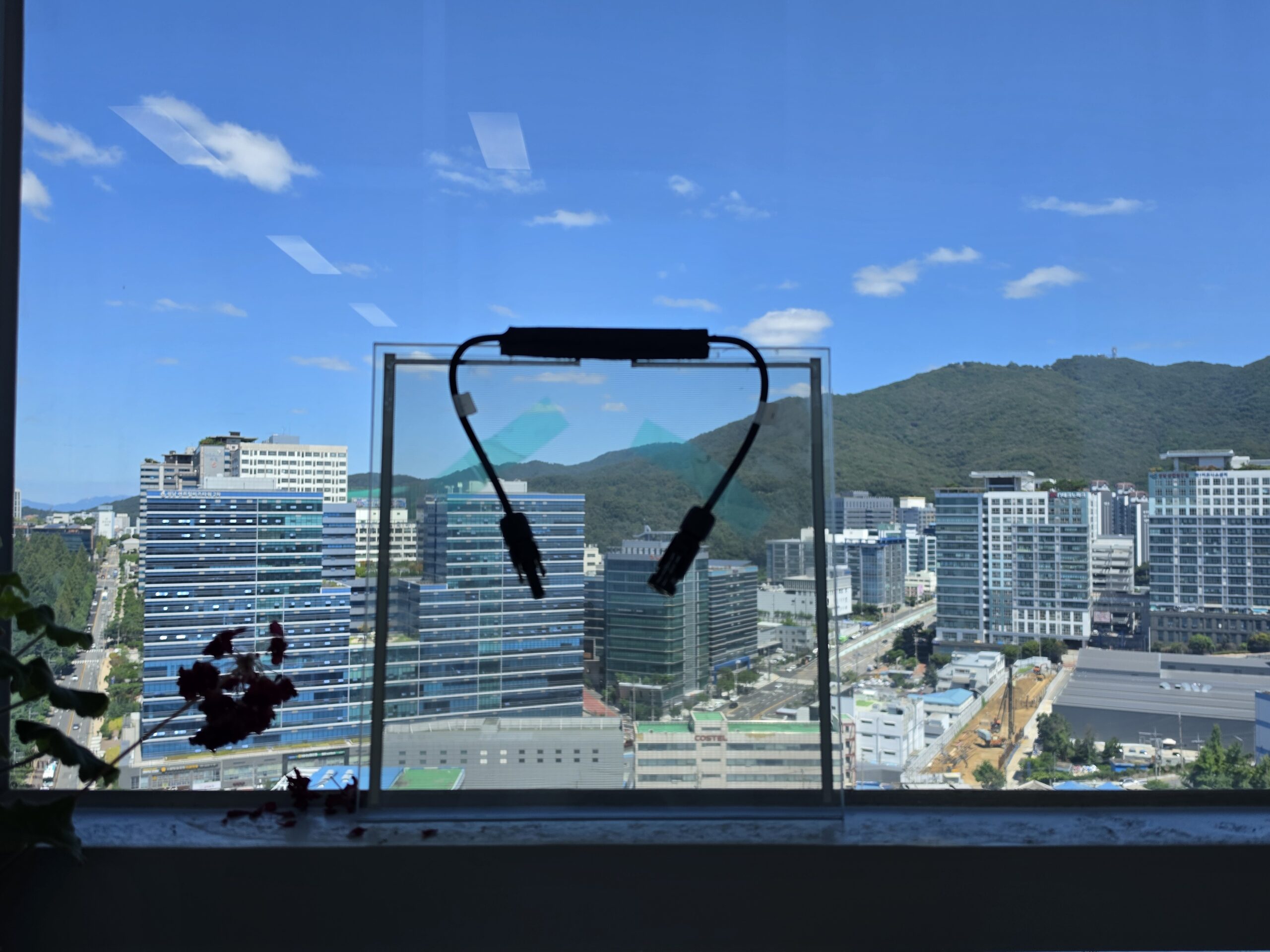
BCN can be designed to absorb only the light you want. If it absorbs infrared or ultraviolet and lets visible light pass straight through, you get a solar cell far more transparent than existing panels. It is also flexible, so flexible solar cells are possible. And because p-type, intrinsic and n-type layers can be controlled atomic layer by atomic layer, we can build nano-scale solar cells.
Because of silicon’s atomic structure, its properties change or the structure itself becomes unstable below a certain thickness, so it is hard to make thin and transparent.
Our BCN, by contrast, can be built one atomic layer at a time, so we can freely adjust transparency and design the wavelengths it absorbs. For example, if we design it to absorb red light, the material looks blue, so we can control color to some extent as well.
Why does applying it to windows matter so much?
Windows make up about 50% of a building’s surface, the facade about 40% and the roof about 10%. Conventional solar is not transparent, so it cannot use the half of the surface taken up by windows at all. Even within the 40% facade, curved sections and areas with weight limits are off the table, so in the end only 30% or less of a building’s total area is usable.
And because of the zero-energy building mandate I mentioned, this problem can no longer be put off. Public buildings have been covered since 2020, and since December 2025 private buildings with a gross floor area of 1,000 square meters or more must cover at least 20% of their power use with renewable energy (40% for public buildings). The standard applies from the building permit stage, has to be reflected from the design phase, and after completion buildings also go through a certification process that verifies actual generation.
Solar effectively accounts for 95% of renewable energy in urban buildings. Until now, the response has been to maximize insulation performance or cover the entire rooftop with panels. Under the post-2025 standard that is not enough, so demand for new technology that makes use of windows is growing.
Has there been no solar technology that can be applied to windows until now?
Existing technology makes products that “look transparent” by patterning an opaque silicon panel, blacking out some parts and leaving others empty. The drawbacks are clear: it looks poor and generates less power.
There are third-generation materials such as perovskite and organics that are themselves transparent, but their stability is still far too low to secure a lifespan, so they have not been commercialized. Some have been made into products with improved stability, but the extra processing cuts performance so much that, as far as I know, efficiency is only around 10% even in an opaque state.
To sum up, solar cells fall into three generations. The first is silicon, heavy and rigid but with the highest efficiency. The second is CIGS, CdTe and similar, light and flexible but still opaque. The third is perovskite, organics, dye-sensitized cells and so on, whose materials can be thin and transparent but lack stability. No product made from a transparent material has been commercialized so far.
Where does HexaEnergy’s BCN fit among those three?
It keeps the transparency and flexibility of third-generation cells while fixing their stability problem. Most third-generation materials are organic-based and have short lifespans, but our BCN is an inorganic material, so its stability is far better. By our own evaluation standards, we expect a lifespan of 25-30 years or more. We are currently running certified testing through Korea Conformity Laboratories.
So in terms of transparency it is close to third generation, while on stability alone it behaves more like second generation. You could describe it as a material that combines the strengths of both.

How much performance have you achieved?
For a finished module, first-generation silicon cells have an energy conversion efficiency of about 20-22%. When we make ours at its darkest, close to opaque, we have reached up to 18%. That is lower than first generation, but we have already reached second-generation performance, which is enough for commercialization.
Our strength, though, is not the absolute efficiency figure but the ability to generate power even while transparent. So for now we are focusing on the window market, where transparency is needed, rather than competing on energy efficiency, and our first target is window-type solar cells that can meet the coming zero-energy building mandate. We believe there is room in theory to raise efficiency beyond first-generation levels, and our ultimate goal is to replace silicon solar cells as well. According to a Korea Conformity Laboratories certified test report, at 50% transparency we achieved 8.3% power generation efficiency and a light utilization efficiency (LUE) of 4.15%, the highest among transparent solar modules of at least 0.5 square meters.
On lifespan, solar materials inevitably suffer crystal damage when light creates electron-hole pairs, and performance gradually declines. This is called degradation. First-generation silicon cells typically carry a 25-year warranty and an annual degradation rate of about 0.3%. By our own measurements, we have reached about 0.25% per year.
Have the performance and lifespan figures been verified?
The figures I just gave are based on our own measurements. However, through the PoC with Kolon Global we are applying our product to actual windows, and we plan to obtain a separate certified test report on the same product. The Korea Conformity Laboratories certification I mentioned is already under way. We already hold a test report for power generation performance, and we aim to obtain certification this year that allows us to use the product at actual product specifications in module form.
How far along is commercialization, and what is your roadmap?
We are at the stage of building credibility, working with various partners to verify that our product actually generates power and can become a product. Once we receive the certified test reports and finalize product specifications, we can launch right away, so we are targeting a launch by March 2027.
There are two product forms. In one, we build the solar cell directly on glass, replacing the glass itself. In the other, we build the cell on the shatter-resistant film that sits between laminated glass layers and supply it in film form. With Kolon Global we are doing the glass-replacement type, applying our product to double-pane windows to evaluate generation performance in real conditions and obtain certified test reports through the PoC. The film type is being pursued separately with another company.
Which companies are showing interest?
The largest demand comes from construction companies. To get a building permit they must meet solar installation standards, and with conventional solar that is hard to do, or the building’s appearance suffers badly if they do, so demand is high for solar technology that uses windows. Beyond builders, we are working on PoCs with a range of companies, including window makers, solar panel manufacturers and solar installers.
What does your team look like?
I oversee technology development and commercialization. A director who co-founded the company with me handles prototype development and certification. The rest of the team is made up of hired employees.
What have you achieved over the past two years?
Four months after our founding we were selected for the Ministry of SMEs and Startups’ TIPS R&D program, which let us develop steadily. We were also selected for Super-Gap Startup 1000+ (DIPS). I think our biggest achievements are running a PoC with a large company like Kolon Global and proving our solar generation performance in practice.
On funding, in 2024 we received USD 76,000 (100 million KRW) in seed investment from The Yoonmin Foundation, which got us into TIPS. In 2025 we received a USD 76,000 (100 million KRW) follow-on investment from Korea Social Investment, bringing our cumulative investment to USD 152,000 (200 million KRW). Recently we won the grand prize at the Climate Energy Environment Startup Competition hosted by the Ministry of Climate, Energy and Environment, with USD 7,600 (10 million KRW) in prize money. We have won 13 awards in total.

Why are you raising funds now, and how much?
We plan to raise USD 380,000 (500 million KRW) this year. The money will go toward the real-world PoC demonstrations I described and toward obtaining certified test reports for entering overseas markets as well as Korea. The test reports cover several items, so we need foreign certifications as well as domestic ones.
Can you sum up why investors should back HexaEnergy now?
Worldwide, mandates requiring buildings to cover a set share of their energy use with renewables are already in force. That includes Korea’s zero-energy building policy, and similar mandates are in effect in Europe and Japan. At this moment, HexaEnergy has developed, with the new BCN material, the world’s first truly transparent solar power device technology, and we are applying it to windows to build a new solution that responds to these mandates.
In short, there are three reasons. First, building energy regulation is taking hold in earnest. Second, the technology has reached an important point where it can convert into real revenue. Third, we hold core technology and have a competitive team. With this USD 380,000 (500 million KRW) investment, we aim to turn this technology into an actual product and begin commercialization in earnest.
MORE FROM THE POST
- [Korean Startup Interview] Sodalive: Turning Finished Webtoon Characters into AI Creators
- GreenySystem Raises $6.72M in Strategic Investment to Scale AI-Powered E-Waste Recycling
- HydroXpand Raises Pre-Series A Funding to Advance Next-Generation Hydrogen Technology
- Green-DA Secures Pre-Series A Investment for Waste-Based Bio-Aviation Fuel Production
- [KSGC Interview] MONA Bridges Businesses and Communities for Sustainable Impact in Korea
- BCN Solar Cell
- BIPV
- greentech
- HexaEnergy
- Interview
- Kolon Global
- pre-SeriesA
- Transparent Solar
- Zero Energy Building
Share

Most Read
- 1
- 2
- 3
- 4
- 5

Leave a Reply