





AI demand is shifting from training models to running them, and inference is where the power problem bites. McKinsey expects inference data center demand to grow 35% a year through 2030, outpacing training at 22%. The constraint is electricity: before anyone builds a new power plant, simply getting the needed capacity connected to the existing grid can take years. Torus, a manufacturer that started in energy storage, says it can sidestep that wait with a single prefabricated unit that combines power, storage, cooling and compute.
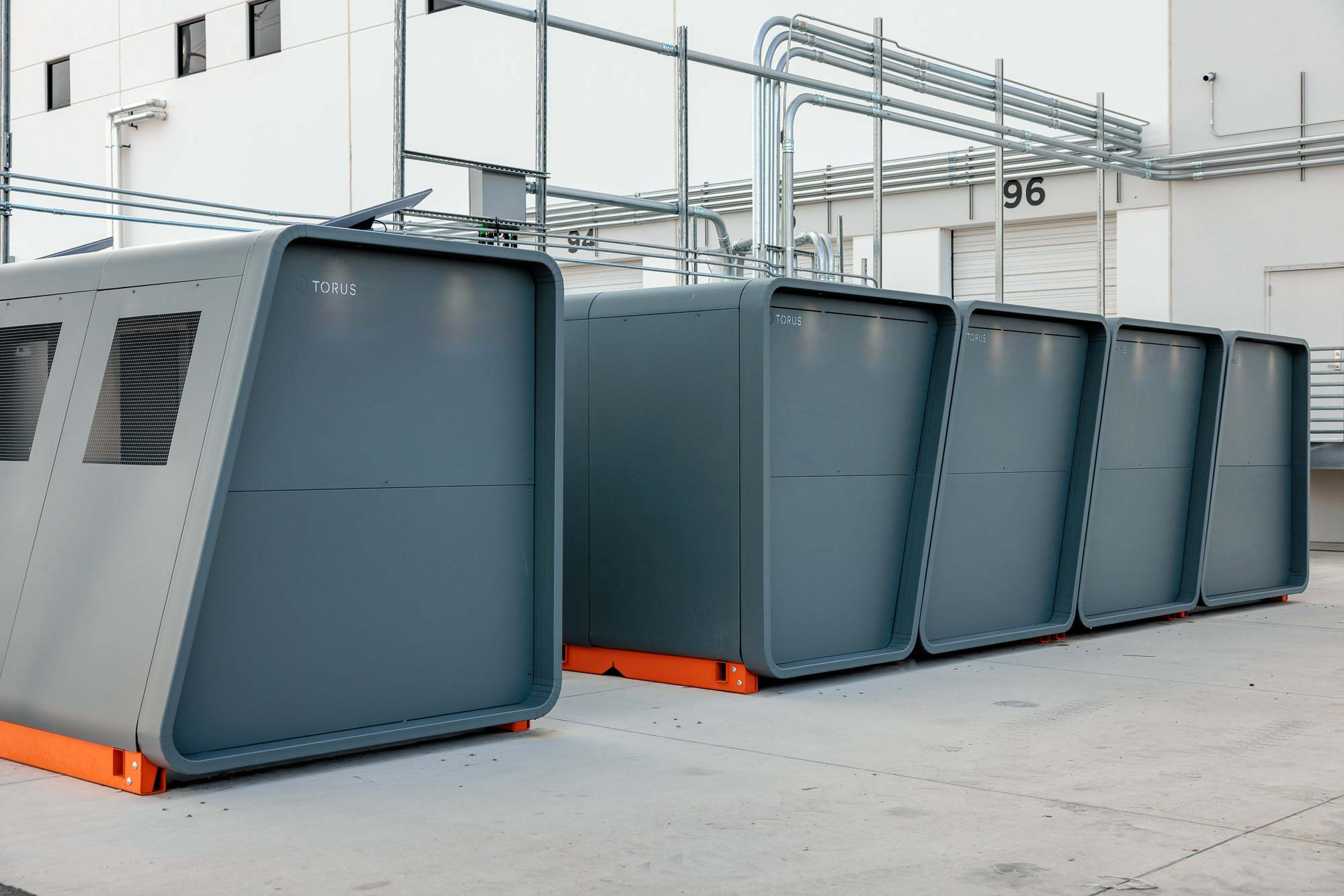
Torus, a Salt Lake City maker of distributed power and compute infrastructure, said on November 11 (US time) that it has launched Torus Foundry and raised $500 million in growth capital. Foundry bundles power, storage, cooling, networking and compute into one prefabricated system. Instead of a multi-year hyperscale campus, the company says, it adds capacity at an existing site within weeks.
Torus’s approach is to use grid capacity that sits idle between substations and commercial or industrial buildings. It draws spare transformer-level power behind the meter without new transmission, on the view that the bottleneck is capacity, not generation. Every Foundry ships paired with Torus Reserve, an energy storage and management product. Flywheels and batteries absorb demand peaks so more compute fits on the same connection, modulate load in milliseconds and serve as backup power during outages. The company says it takes 12 to 16 weeks from contract to a live AI workload, and it supplies networking and security through Torus Protect as a turnkey offering, including operations and maintenance.
Founder and CEO Nate Walkingshaw said most companies try to bring power to the chip, while Foundry brings the chip to the power. Inference runs around the clock and responds to users in real time, so smaller distributed sites close to demand suit it, he argued, as well as enterprises that want control over security and intellectual property.
Systems range from 1 to 20 MW per site, and the smallest model is about the size of a cargo van. No building construction is needed; the company says site preparation takes about a week and installation and commissioning one or two days. Units are built at GigaOne, a 545,000-square-foot factory in Salt Lake City that opened its first production line earlier this year and, according to Torus, has added a line every 21 days in 2026. The Foundry line can produce 500 MW of IT load and is planned to expand to 1 GW. About 400 employees in Utah handle development, design and manufacturing. Torus says its closed-loop, waterless cooling cuts water use by 95% compared with evaporative designs.
$500 million led by Magnetar
Magnetar led the round, with ICONIQ, Origin Ventures, Ridgeline Partners and Trinity Capital participating. Magnetar also invested $200 million in Torus in September last year, according to the company. The proceeds will go toward expanding GigaOne and deploying Reserve and Foundry units across the US. The company did not say whether the capital is equity or debt, and it did not disclose a valuation.
Foundry’s first customers are Hydra Host and an AI cloud provider that Torus did not name. Magnetar also took part in Hydra Host’s $100 million Series A in June, so it has funded both sides of the deal. Foundry is offered in three forms: power and enclosure only, a bare-metal version with GPUs installed, and a dedicated single-tenant option for enterprises. Torus says thousands of GPUs are already deployed in Foundry and it plans to reach more than 47,000 by the end of 2027. It did not disclose how much of that is live for customers or any revenue figures.
Two crowded fields: modular data centers and power
Factory-built data centers are already a busy category. Armada supplies containerized modular data centers to defense and energy customers and raised a $230 million Series B in May at a $2 billion pre-money valuation. Mavria is pitching factory-stamped data centers and has raised about $130 million in total at a $1 billion valuation, though it has not disclosed customers or delivery timelines. Where those companies make the data center itself the product, Torus positions its edge as bundling hidden grid capacity with storage so compute lands where power already exists.
Others target the power bottleneck directly. VoltaGrid places natural gas engines on site and raised $1 billion from Blackstone and Halliburton, while Joulent builds power plants next to data centers and raised $1.75 billion from National Grid. GridCARE goes after the same idle grid capacity as Torus, using software to find it. Torus argues that using already connected capacity beats building new generation, but its 12-to-16-week timeline and large-scale GPU deployment remain company claims for now.
MORE FROM THE POST
- VEIR Raises $110M Series C to Scale Superconducting Power Delivery for AI Data Centers
- Microsoft Veterans’ Edelbyte Raises $70M Seed and Series A Led by Sequoia to Challenge Data Infrastructure Giants
- Fractile Raises $720M Series C to Break the AI Inference Memory Bottleneck
- Generative Media Inference Platform fal Raises $1.3B Series F
- Neocloud General Compute Raises $100M Series A as CoreWeave Sell-Off Spooks Sector
- AI Infra
- Energy
- funding
- ICONIQ
- Magnetar
- mega funding
- Origin Ventures
- Overseas funding
- Ridgeline Partners
- Torus
- Trinity Capital
Share

Most Read
- 1
- 2
- 3
- 4
- 5

Leave a Reply