

Anthropic’s Amended IPO Filing: $17B Third-Quarter Revenue and a Valuation of Up to $1.4 Trillion


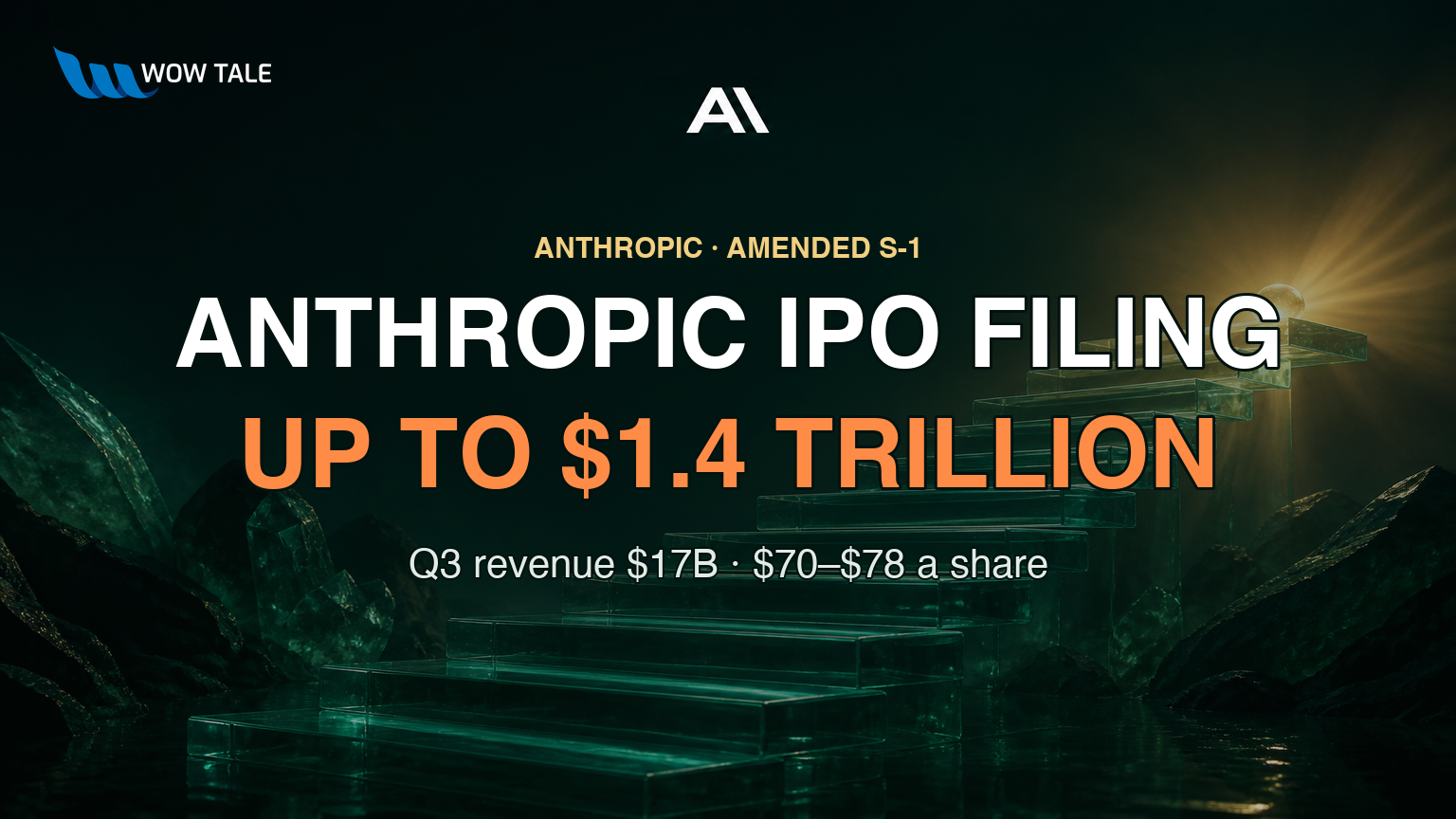
Anthropic’s second amended S-1, filed on Nov. 10, puts its IPO price range at $70 to $78 a share. Using the filing’s share count, the valuation works out to about $916 billion to $1.02 trillion, and up to $1.405 trillion on a fully diluted basis at the top of the range, which counts options and convertible notes. The filing also carries financials through the third quarter. Revenue for the first nine months was $33.24 billion, about 13 times a year earlier, and net loss was $104 billion. We compared it with the Oct. 26 original and our earlier analysis of the S-1. The final price and proceeds are not set. Media reports say pricing is Nov. 18 and first trade Nov. 19 under the ticker ANT, but the filing gives no dates.
The “$1.4 trillion” is a fully diluted figure
The filing states no valuation. Using its share count, about 13.09 billion shares of all classes will be outstanding after the offering and placement. That is about $916 billion at $70 and about $1.02 trillion at $78. The $1.405 trillion figure in reports counts options, RSUs and convertible notes, meaning fully diluted. Anthropic was valued at $965 billion in its Series H in May. Depending on the share count, the IPO is similar to that mark or well above it.
The filing also computes what new buyers take on. Pro forma net tangible book value at Sept. 30 is $1.90 a share, and investors buying at $74 face immediate dilution of $65.79 a share.
What the third quarter changed
The original S-1 carried June 30 financials. The Nov. 2 amendment moved to Sept. 30. Revenue for the first nine months was $33.24 billion, about 13 times the $2.55 billion a year earlier. Subtracting the first half’s $16.3 billion puts third-quarter revenue near $17.0 billion. Operating loss for nine months was $1.26 billion, up from $693 million in the first half, so about $570 million came in the third quarter, more than the first-half quarterly average of roughly $350 million. The operating loss rate is still around 3%.
Net loss was $104 billion, up from $80.7 billion at midyear, about $23.3 billion of it in the quarter. Changes in the fair value of convertible notes and derivatives added about $21.9 billion in the quarter, bringing the nine-month total to $94.3 billion. As in our earlier analysis, it is a non-cash item that grows as the company’s value rises; $135.1 billion of the $156.2 billion accumulated deficit comes from it.
Cash and equivalents were $95.6 billion and short-term investments $36.3 billion, about $131.9 billion in all, against about $131.7 billion at June 30. Another $14.8 billion is available under the credit facility. The amendment adds run-rate revenue of about $81 billion at Oct. 31, up $10 billion from Sept. 30. Customers spending $100,000 or more a year rose from just over 950 to more than 11,900 in a year.
801 million of the 825 million shares come from the company
The original left the share count blank. The amendment says Anthropic is selling 801.35 million of the 825 million Class A shares and existing stockholders are selling 23.65 million. The company gets nothing from the stockholder sale. Underwriters can buy another 123.75 million shares, or 15%. Across the range, the company’s share of the offering is about $56.1 billion to $62.5 billion and the selling stockholders’ share is $1.7 billion to $1.8 billion. The widely quoted “up to $64.4 billion” is the total offering.
At the $74 midpoint, net proceeds to the company are about $84.6 billion, counting the $26 billion private placement and after fees and expenses, or about $93.7 billion if the underwriters’ option is fully exercised. Anthropic left uses broad: working capital, compute and infrastructure, hiring, possible acquisitions, and tax withholding on RSU settlement.
The $26 billion Class N sale is not all new money
Google, Nvidia, AMD, Broadcom, Microsoft, Micron and TSMC have agreed to buy $26 billion of non-voting Class N stock at the IPO price. At $74, Google and Nvidia each take 135.1 million shares for about $10 billion, AMD 33.8 million for about $2.5 billion, Broadcom, Micron and Microsoft 13.5 million each for about $1 billion, and TSMC 6.76 million for about $500 million. That totals 351.35 million shares.
Google’s purchase is the full exercise of its option under the Google 2026 note purchase agreement to buy Class N stock in connection with the IPO. It cut the remaining amount under that agreement from $20 billion to $10 billion. Google’s $10 billion is a portion of an investment it had already committed. AMD’s $2.5 billion also satisfies part of its commitment under the hardware supply agreement to buy up to $5 billion of Class N stock, which is released in steps as AMD GPU delivery milestones are met. The private placement is not all fresh cash.
Class N stock is not registered in the offering and is not covered by lock-ups with the underwriters or market standoff agreements with the company. The placement closes after the offering and needs stockholder approval, and the IPO does not depend on it. TSMC’s piece appears to be the investment its board approved.
Commitments reach $900.9 billion
The biggest blank to be filled was compute commitments. The original left the total empty. The amendment puts purchase commitments and leases, including those signed after Sept. 30, at about $900.9 billion. About $451.6 billion falls before the end of 2030, the rest runs through 2045, and about $70.7 billion is due in the next 12 months. About $186.2 billion sits in agreements with termination rights or conditions that must be met before they start. Arrangements without a fixed dollar amount are estimated separately at $150 billion to $175 billion.
That differs in scope from the $265.6 billion in non-cancelable hosting commitments at June 30 that we cited before. The new total adds equipment leases, leases not yet commenced and short-term commitments. The Microsoft agreement alone calls for $47.2 billion to $49.2 billion from November 2026, and a single August agreement tied to Lambda is about $34.9 billion.
Lock-ups and retail
The share supply schedule appears for the first time. About 15.5 billion shares are covered by lock-up or market standoff agreements. They run 180 days, or up to 365 days for the co-founders and holders of 0.5% or more on a fully diluted basis. About 3.6 billion shares could become eligible for sale within the 180 days, and up to 10% of the locked-up securities held by non-founder directors, officers and current and former employees can be sold from the first trading day. Some directors and affiliates have indicated interest in up to $303 million of shares. These indications are not binding. Retail brokers including Schwab, Fidelity, Robinhood, SoFi and E*Trade are part of the selling group.
How the risk language shifted
The risk factor on AI-accelerated research changed with each filing. The Oct. 26 original said only that Anthropic might not recognize a speed-up until after it happened. The Nov. 2 amendment said internal estimates indicated it might imminently meet the threshold for “dramatically accelerated progress” in its Responsible Scaling Policy. The latest amendment goes further. Anthropic says it determined it has met the threshold, based on what it expects from future models and its overall pace of progress rather than on what it has observed from current ones. Many media reports still quote the earlier “may imminently meet” wording.
The vocabulary changed too. “AI” appears 576 times, down from 775 in the original. “Frontier intelligence” rose from 2 mentions to 61 and “super intelligence” from 1 to 25. The glossary in the latest version says the terms AI, super intelligence and SI are used interchangeably.
MORE FROM THE POST
- TSMC to Invest Up to $1B in Anthropic and OpenAI as the Foundry Buys Into Its Customers
- Meta Launches $35B Stock Offerings Despite $82B in Cash, Testing How Far AI Capex Can Stretch
- Anthropic’s S-1 Fully Dissected: The Truth Behind the $80.7B “Loss”
- Google Unveils Gemini Work Agent as Big Tech’s Agent Race Heats Up
- Microsoft Is Behind on AI Models. Its Answer Is to Own the Office Instead.
Share

Most Read
- 1
- 2
- 3
- 4
- 5

Leave a Reply