



- AI
- ·
- Enterprise
Anthropic Launches Claude Ship, Handing Code Review, Fixes and Approvals to AI Agents







A developer pushes a change, a teammate reads it, asks for fixes if something is off, and clicks “approve” to merge it into the main code. That everyday loop of software teams can now be handed to AI agents from start to finish.
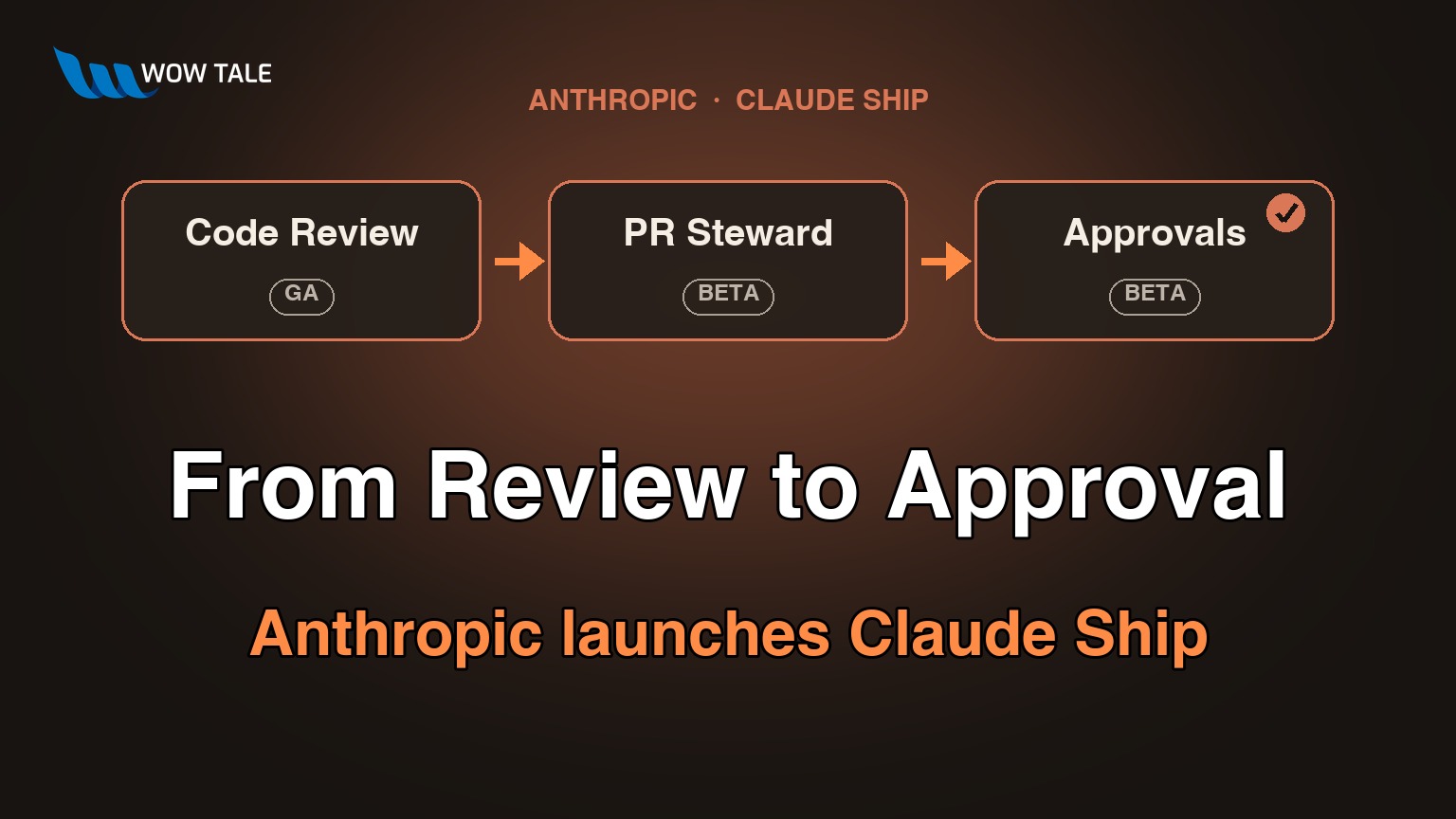
On November 23 (US time), Anthropic launched Claude Ship in beta, a bundle of agents that review, fix and approve pull requests on GitHub. A pull request, or PR, is how a developer asks a team to merge a code change into its codebase. Claude Ship is available to Claude Team and Enterprise organizations whose code lives on GitHub. Anthropic describes what changes through three agents.
First is Code Review, the only one that is generally available. It examines a PR through multiple lenses, challenges its own findings to filter out weak ones, sorts what remains by type and posts it to the PR. Teams choose a quick, standard or deep review level for each repository.
Second is PR Steward, in beta, which takes over the chores that follow a push. When automated checks (CI) fail, the code conflicts with other changes, or Code Review, another tool or a person leaves feedback, the agent fixes the problem and pushes again. It is designed not to approve or merge. After each push it comments on what it changed and how to undo it, and users steer it with @claude or halt it with @claude stop.
Third is Claude Approvals, also in beta, and the most notable change. It approves PRs according to a policy file the team writes in plain language and keeps in the repository. Anthropic likens it to “a smarter CODEOWNERS file,” referring to the GitHub feature that assigns who must approve changes to which files. Policies can draw on Code Review findings or custom classifiers, and the agent starts working once a policy file sits on the repository’s default branch. Anthropic recommends starting in observe-only mode, where Claude watches without approving, and only then requiring its green light through branch protection rules. Existing protection rules and required checks still apply, and admins can switch Approvals off.
Individual developers get a route too. A /ship command, rolling out in Claude Code and the desktop app from launch day, pushes a ready change, opens the PR, runs the review and works through feedback and failing checks. Whether the change actually merges depends on the developer’s permissions and the repository’s branch rules.
TechCrunch noted that AI coding tools already offered code review, but that handing approval authority to an AI agent is new. Anthropic does not pitch fully autonomous sign-off. It warns that Claude Ship may miss bugs or security vulnerabilities and calls Claude’s review one layer of a broader process. As evidence it cites its own Claude Code team, where merged PRs more than doubled from June to September while the share of reverted changes fell by more than 40%. The figures are self-reported and no absolute counts were given.
Usage is billed by tokens, separately from a plan’s included usage. Admins can set spend limits for Code Review and PR Steward. Claude Approvals has no base charge, but its classifiers are billed on tokens, and a policy that relies on Claude’s review triggers a billed Code Review even in observe-only mode. /ship counts as regular Claude Code usage. Eligible Enterprise organizations can claim at least $10,000 in credits by January 15, 2027, to be used within 30 days of claiming. Organizations with zero data retention, a HIPAA configuration or customer-managed encryption keys cannot use it.
Code review is the most crowded corner of AI coding. Competitors fall into four groups: startups that focus on review alone, coding-tool makers, platforms such as GitHub, and security and quality vendors.
Start with the specialists. CodeRabbit is the most widely used: when a PR opens, it uses the whole repository and the team’s coding standards as context to flag bugs and security holes. The company says it has 20,000 customers and 8.5 million connected repositories. It raised $143 million at a $1.5 billion valuation and is widening into “change management,” which ranks the flood of incoming PRs and explains the blast radius of each change. Greptile‘s strength is context: it maps the whole repository like a graph to trace which other modules a change affects, and it learns a team’s habits from reviewers’ past comments. It has raised $25 million. Qodo is strongest on enterprise control. It turns an organization’s coding rules into enforceable policies so every developer is held to the same standard, and reviews across multiple repositories. Large companies such as Walmart, Nvidia and Ford are customers, and it raised a $70 million Series B in March. cubic, backed by Y Combinator, pitches reviews built for complex codebases and starts at $30 per developer per month.
Coding-tool makers have absorbed review too. Cursor‘s Bugbot concentrates on catching real bugs in GitHub PRs. Teams can apply their own rules, there is no separate subscription, and Cursor puts the average cost at $1.00 to $1.50 per review. Last December Cursor agreed to acquire the code review platform Graphite, whose review agent Diamond turns comments into code fixes and repairs failed automated checks, after a $52 million Series B. Cursor has since been acquired by SpaceX for $60 billion. Cognition‘s Devin Review groups related changes, flags bugs and security problems, and lets the Devin AI engineer fix them in one click, across GitHub, GitLab, Azure DevOps and Bitbucket. Cognition raised more than $2 billion at a $48 billion valuation.
Then there is the platform itself. GitHub’s Copilot code review is included in the Copilot subscription many teams already pay for, which lowers the barrier to adoption. It tags comments with severity and suggested fixes, offers Lite, Balanced, Max and Adaptive effort levels, and costs roughly $0.25, $1.50 and $10 per review at the first three. On November 17 GitHub added secret detection and cross-repository context in public preview, and made Azure DevOps support generally available.
Security and quality vendors are moving into AI code verification as well. SonarQube says it verifies both human and AI-written code for more than 7 million developers, and Snyk pitches an independent security layer that continuously validates AI-generated code.
Against that field, Claude Ship’s distinction is that the company that builds the models is shipping review, fixes and approval as one bundle. CodeRabbit, though, is moving in the same direction, with a triage feature that routes low-risk changes to automated handling. Several vendors claim the top spot on “independent” benchmarks, but the results are published by the vendors themselves and are hard to compare. Anthropic recently priced its IPO at $83 and raised a record $81.3 billion. Wowtale’s AI coding startup landscape (in Korean) maps the wider field.
MORE FROM THE POST
- Enterprise AI Spend Hits $176.8B as Frontier Labs Take 69%
- Meta Acquires Conductor, the App That Runs AI Coding Agents in Parallel
- Microsoft Is Behind on AI Models. Its Answer Is to Own the Office Instead.
- Anthropic Merges Cowork and Chat, Launches Claude Docs and Slides
- Anthropic’s Q2 Revenue Reported Above $11.5B — Profitable, and Ahead on the IPO Track
Share

Most Read
- 1
- 2
- 3
- 4
- 5

Leave a Reply