










The race to move drug discovery from the lab bench to the computer is heating up. An MIT-born startup that first built its following with open-source models is now selling proprietary models and a platform on usage-based pricing, has signed six of the world’s 20 largest pharma companies, and has raised $110 million.
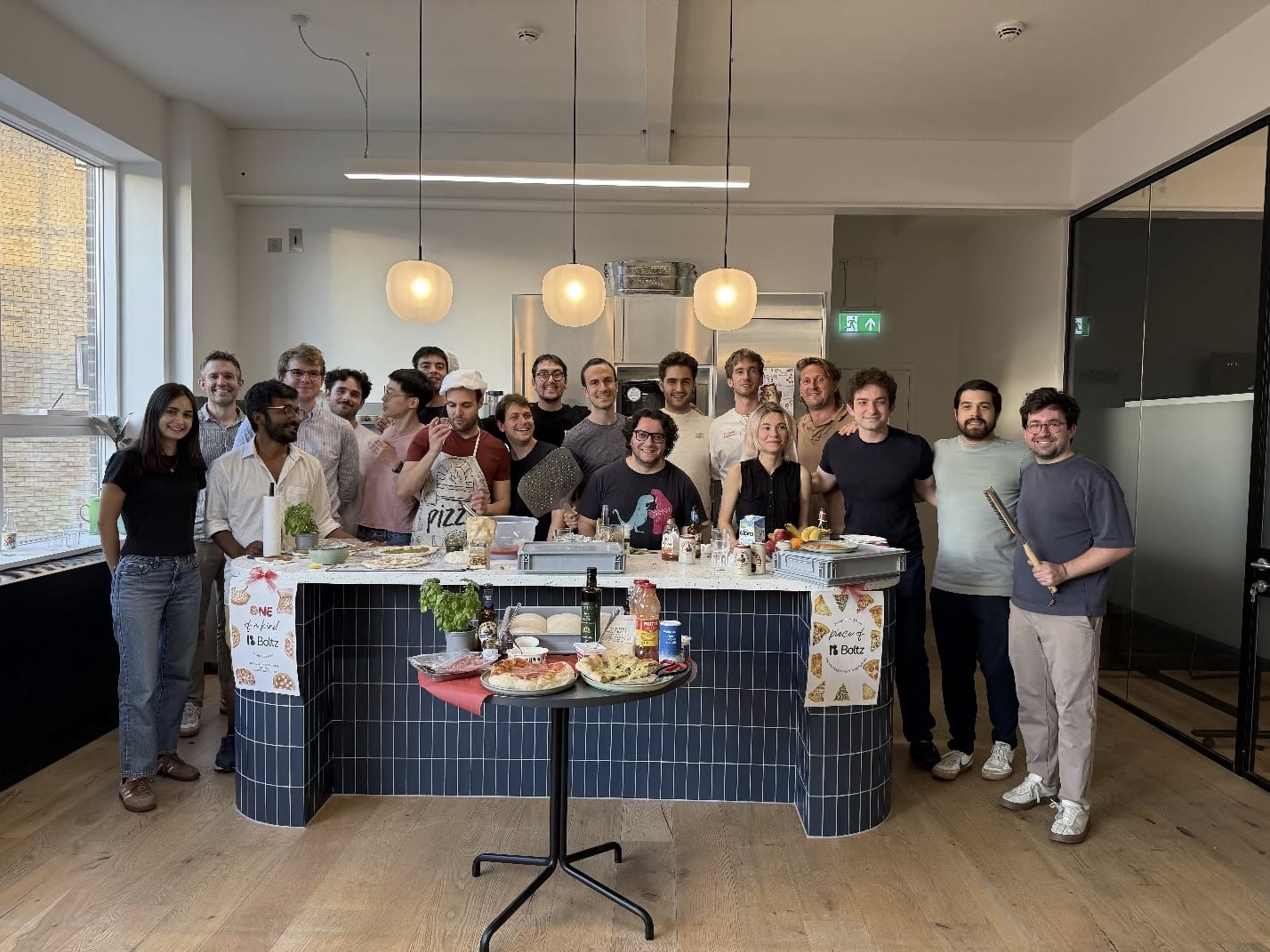
Boltz builds AI models that predict the structure and binding of biomolecules such as proteins and small molecules, and that design new ones. It is a public benefit corporation based in Cambridge, Massachusetts, and its roots are open-source models created by researchers at MIT’s Computer Science and Artificial Intelligence Laboratory (CSAIL). Boltz-1, released in November 2024, claimed AlphaFold 3-level accuracy for predicting the structure of complexes. Boltz-2, released in June 2025, predicts binding affinity alongside structure and, according to its developers, runs more than 1,000 times faster than physics-based calculations. In October 2025 the team added BoltzGen, which designs protein and peptide binders. All three were released with code and weights, so anyone can download and use them.
Commercialization began in January, when Boltz launched Boltz Lab, a platform for scientists to use its models, alongside a $28 million seed round and a multi-year collaboration with Pfizer. In June it released its first proprietary models, BoltzMol-1 and BoltzProt-1. Unlike the three earlier models, these are not open models. The company says it used them to find small-molecule hits and design protein binders for a majority of the challenging targets it pursued, in a fraction of the time and cost of traditional methods or earlier models. It has not disclosed the targets or specific results.
Its revenue model looks like open core: the open models are free for anyone to download, while Boltz charges for its proprietary models and for Boltz Lab, the service that runs them. Pricing is usage-based, in “molecular tokens,” units of molecular information processed per task. A quick prediction uses few tokens and a full design campaign uses many. Boltz says tokens processed for paying customers have grown 50-fold since June, without saying how much of that comes from proprietary versus open models. On a four-week rolling average, usage reached about 8 times the mid-June baseline by August, passed 25 times in late October and hit 50 times on November 8. Users own what they create in Boltz Lab, customer data is not used for training, and an API connects the models to AI agents such as Claude Code and to existing workflows.
Six of the world’s 20 largest pharma companies are customers, with Pfizer, GSK, Takeda and BMS named. Pfizer will fine-tune Boltz models on its historical discovery data to build exclusive models and keeps ownership of any molecules developed. In October, BMS agreed to deploy the Boltz platform on its NVIDIA DGX SuperPOD infrastructure and co-develop custom models using its own data.
Boltz was founded by CEO Gabriele Corso, Jeremy Wohlwend and Saro Passaro, who came from Regina Barzilay’s lab at MIT CSAIL. Corso and Wohlwend recently finished their PhDs and Passaro was a research scientist. Corso is also a co-author of the molecular docking model DiffDock. In just over a year the company has grown to about 40 scientists and engineers from AI labs, academia, tech, finance, pharma and biotech.
Boltz announced a $110 million Series A and did not disclose a valuation. Bessemer Venture Partners led the round, and Bessemer’s Andrew Hedin and Byron Deeter are joining the company. Existing investors Andreessen Horowitz, Amplify Partners, Zetta Venture Partners and Obvious Ventures doubled down, and Greycroft, F-Prime Capital, Hummingbird and R&D cloud software company Benchling joined as new investors. With the seed round, total funding is about $138 million, by Wowtale’s addition.
The money goes toward more compute and data, meeting growing demand from pharma partners and hiring. Boltz says its upcoming models already generate noticeably better molecules, and its long-term goal is for a scientist to go from a therapeutic hypothesis to a human-ready molecule without leaving the computer.
Competitive Landscape
Boltz’s rivals fall into three groups. The first sells models as a service, which makes them the direct competitors. Chai Discovery raised $400 million in July in a round led by Index Ventures at a $3.8 billion valuation, and Eli Lilly and Pfizer already use its platform. According to press reports, Chai signed a deal with Lilly in January to build a custom model trained on Lilly’s proprietary data, the same approach Boltz takes with Pfizer and BMS. Latent Labs, founded by an alumnus of the Nobel-winning AlphaFold team, raised $50 million in 2025.
The second group also builds its own drug-candidate pipelines. Isomorphic Labs, which descends from AlphaFold, raised a $5 billion Series C on November 17 after a $2.1 billion Series B in May. According to comparison guides, AlphaFold 3’s code carries a non-commercial license and its weights go only to academic researchers who apply, so commercial use runs through Isomorphic itself. That contrasts with Boltz-1 and Boltz-2, released under the MIT license, which permits commercial use. Basecamp Research and Superluminal also build their own pipelines with AI.
The third group is big pharma and AI labs. Nvidia and Lilly committed up to $1 billion over five years to a joint AI drug-discovery lab, OpenAI acquired the drug-discovery agent startup Orchestra Bio, and Anthropic bought Coefficient Bio for $400 million. Boltz customer BMS also led Pathos AI’s $237 million Series E, so pharma companies are buying models while betting on other AI players too.
Boltz points to three differences. It built its researcher base first with open models that can be used commercially (Andreessen Horowitz said they had already reached every top-20 pharma company by the time of the seed round), it builds custom models on pharma companies’ data while leaving ownership of the output with the customer, and its announcement focuses on supplying models to scientists rather than on its own drug candidates. The gaps are large, though. A $110 million Series A is small next to Chai Discovery’s $400 million or Isomorphic’s $5 billion, and its open models can be downloaded by rivals too. Andreessen Horowitz itself flagged pharma companies’ in-house AI pipelines and frontier labs with large compute budgets as risks, since they are chasing the same opportunity. For more on the competitive landscape, see here.
MORE FROM THE POST
- AI Drug Design Lab Isomorphic Labs Raises $5B Series C
- Mithrl Raises $20M to Scale Its Biopharma AI Infrastructure
- Medical Imaging AI Startup Soombit AI Raises USD 9.1M Series A, Selected for Scale-up TIPS
- Formation Bio Launches $600M Fund to Buy and Develop Stalled Clinical-Stage Drugs
- Wearable Robot Startup Hurotics Raises Series A Funding Led by Atinum Investment
- a16z
- AI
- Amplify Partners
- Benchling
- Bessemer Venture Partners
- BioHealth
- biotech
- Boltz
- Drug Discovery
- F-Prime Capital
- funding
- Greycroft
- Hummingbird Ventures
- mega funding
- Obvious Ventures
- Overseas funding
- seriesA
- Zetta Venture Partners
Share

Most Read
- 1
- 2
- 3
- 4
- 5

Leave a Reply