



Icarus Raises $25M for Solar-Powered Stratospheric Aircraft It Calls a Modern-Day U-2







Icarus, a U.S. startup that builds solar-powered unmanned aircraft to fly in the stratosphere for reconnaissance and communications, has raised $25 million. In a LinkedIn post on Thanksgiving, November 26, CEO Henry Kwan announced the round and described the company as building “the modern-day U2 spy plane,” pitched as autonomous, solar-powered and low-cost. The U-2 is the high-altitude reconnaissance aircraft the United States has flown since the Cold War. The investors, the round’s stage and the valuation were not disclosed.
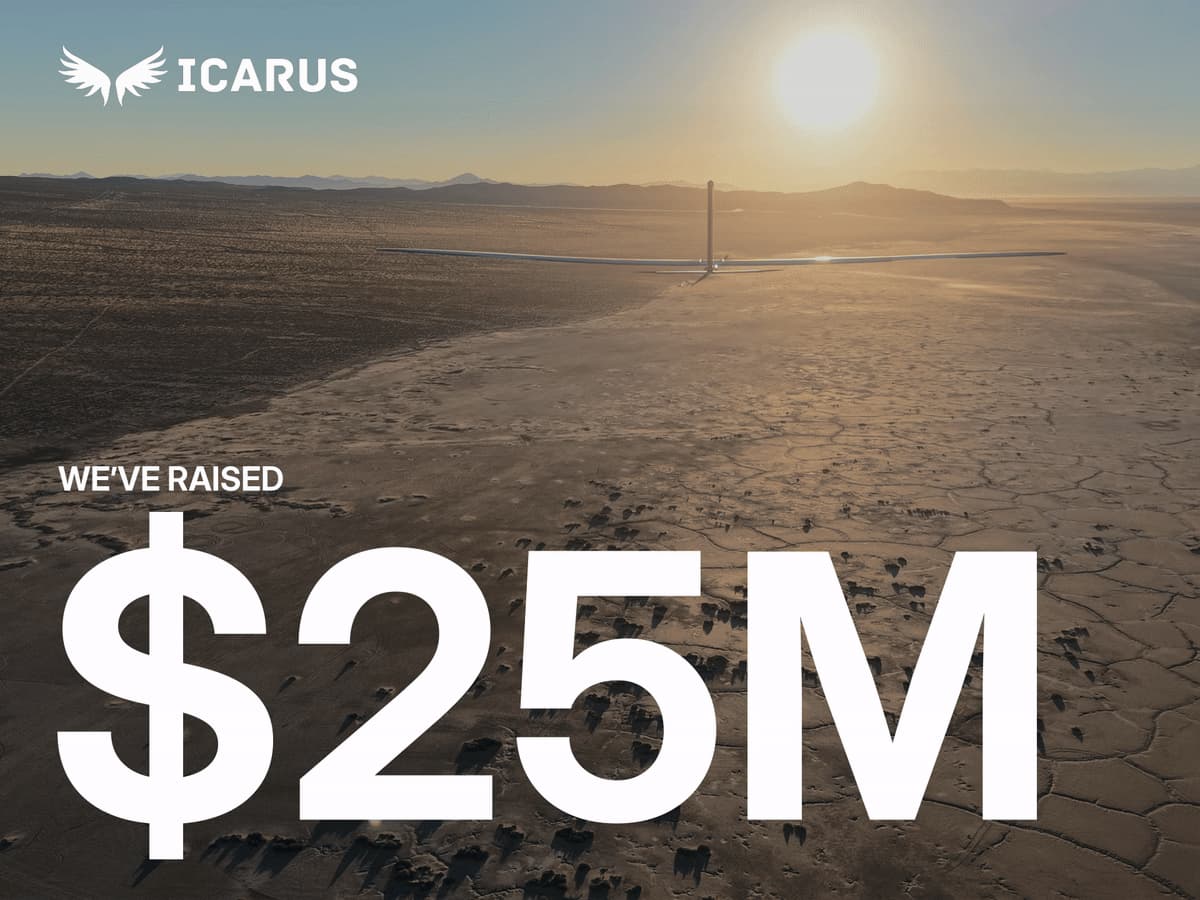
Kwan thanked investors, the team, partners and customers in turn, and gave the credit to his team. After late nights, 4 a.m. starts for Mojave and deployments around the world, he wrote, it was the team that built the aircraft and put it at 70,000 feet (about 21,000 meters). The money will go toward Phase 1 of what he called the “Secret Icarus Master Plan”: building small, affordable solar-powered aircraft for intelligence and communications. Phases 2 to 4 were left unexplained (“If you know, you know”). The company says it wants more builders, more production and more flights, with better reliability, faster deployments and lower costs, and it is still hiring.
The gap that satellites, balloons and aircraft leave open
Icarus’s aircraft is called APOLLO. It is a solar-powered unmanned aircraft designed to fly at 60,000 feet (about 18,000 meters) and above. According to a U.S. Army newsletter, it is a low-cost, mass-producible platform that stays aloft for long periods to provide persistent sensing, communications relay and data backhaul. The company says a single aircraft can monitor up to 7,500 square kilometers and send data with a latency of 5 to 10 milliseconds.
The technology targets the space that satellites, balloons and ordinary aircraft leave open. A satellite follows a fixed orbit, so an adversary knows when it passes overhead. A balloon drifts with the wind. A conventional aircraft burns fuel for as long as it is in the air. A solar-powered stratospheric aircraft can stay over one area for a long time. Taro Fukuyama, an Icarus investor, made the same argument in a post on X explaining why he invested, and put the price of an aircraft at around $100,000.
Icarus was founded in 2023, started out in a garage in El Segundo, near Los Angeles, and joined Y Combinator’s Fall 2025 batch. Its record with the U.S. Army stands out. According to an Army FUZE newsletter, Icarus took first place and a $25,000 prize at the Army’s xTech|Live competition at SOF Week in 2025 and won another $30,000 at xTech|Search 9. It then landed a Phase I Army Small Business Innovation Research (SBIR) contract worth up to $250,000 and took part in the Valiant Shield exercise in Guam in June. Along the way APOLLO moved from Technology Readiness Level (TRL) 3 to 7, on a scale where 1 is basic research and 9 is fielded operation, and the four engineers who entered the competition grew into a team of about 50.
Kwan, the founder, studied aerospace engineering at Georgia Tech. According to his YC profile, he built drones for NASA and worked on satellites at Orbital.
Money is already pouring into reconnaissance and surveillance
Icarus is not alone in the stratosphere. Sceye received an investment from SoftBank as the first tranche of its Series C to scale its stratospheric platform, and Skydweller, which builds solar-powered long-endurance aircraft, and Airbus-backed AALTO compete in the same field.
Looking across defense and reconnaissance technology, even more capital is flowing. Anduril raised a $5 billion Series H in May at a $61 billion valuation, and AI reconnaissance drone maker TEKEVER raised a $580 million Series D in September.
The $25 million, however, is so far confirmed only by the CEO’s post. The investors have not been named, and most of the flight performance figures are the company’s own, leaving outside verification still to come. The question is whether Icarus can build at real scale the small, affordable aircraft it calls Phase 1.
MORE FROM THE POST
- Arva AI Raises $20M Series A to Automate Financial Crime Compliance at Banks
- Unsiloed AI Raises $7.5M Seed to Make Documents as Computable as Databases
- Model ML Raises $250M at $1.5B Valuation for Personal AI Agents in Finance
- Hardware Engineering Platform Nominal Raises $240M Series C at $3B Valuation
- Drone Delivery Firm Zipline Raises $1.5B at $21.5B Valuation
Share

Most Read
- 1
- 2
- 3
- 4
- 5

Leave a Reply