



- AI
- ·
- Enterprise
- ·
- Funding
Unsiloed AI Raises $7.5M Seed to Make Documents as Computable as Databases


Finance, law and healthcare run more on documents than on databases. A startup that wants AI agents to read and write the information inside filings, contracts and clinical records the way software works with tables in a relational database has raised $7.5 million in seed funding.
Unsiloed AI builds an API that turns PDFs, images and spreadsheets into JSON and Markdown that large language models (LLMs) and AI agents can understand. It is based in San Francisco, was founded in 2025 and went through Y Combinator’s Fall 2025 batch. It offers three operations: parsing, which preserves document structure in Markdown; extraction, which returns the fields requested in a JSON schema; and splitting, which separates multi-document files and divides long documents into retrievable chunks. According to press reports, it uses dual-stream vision models that read tables and charts, heat-map-based chunking and a decoder tuned to industry terminology.
Its core claim is to put a deterministic document layer on top of probabilistic LLMs. The founder pointed to the fact that LLMs are inherently probabilistic, so outputs can drift or hallucinate. Every extracted value comes with a confidence score and a citation to its location in the source, so reviewers can check uncertain values directly. It can be deployed in a virtual private cloud, on premises or in fully air-gapped environments, and connects to storage such as S3, SharePoint, Google Drive and Snowflake. Pricing starts at one cent per page.
All accuracy figures are the company’s own. According to a technical brief, it reached 99.78% accuracy across about 84,000 data points extracted from 542 financial documents supplied by an enterprise customer, compared against leading AI models, Microsoft Azure Document Intelligence and the customer’s in-house tool. On the olmOCR-Bench document-parsing benchmark it scored 88.0, ahead of Reducto’s agentic mode at 66.0 and Unstructured at 39.9. The company itself notes that strict string matching can flag harmless formatting differences and that academic benchmarks can underrepresent charts and forms. None of this has been independently verified.
Customers include vertical AI startups, financial services companies and law firms. According to press reports, users include an unnamed bank, a law firm that runs it on its own servers for contracts and archived case files, and voice-AI startup Bolna AI, which uses it to ingest knowledge bases for voice agents.
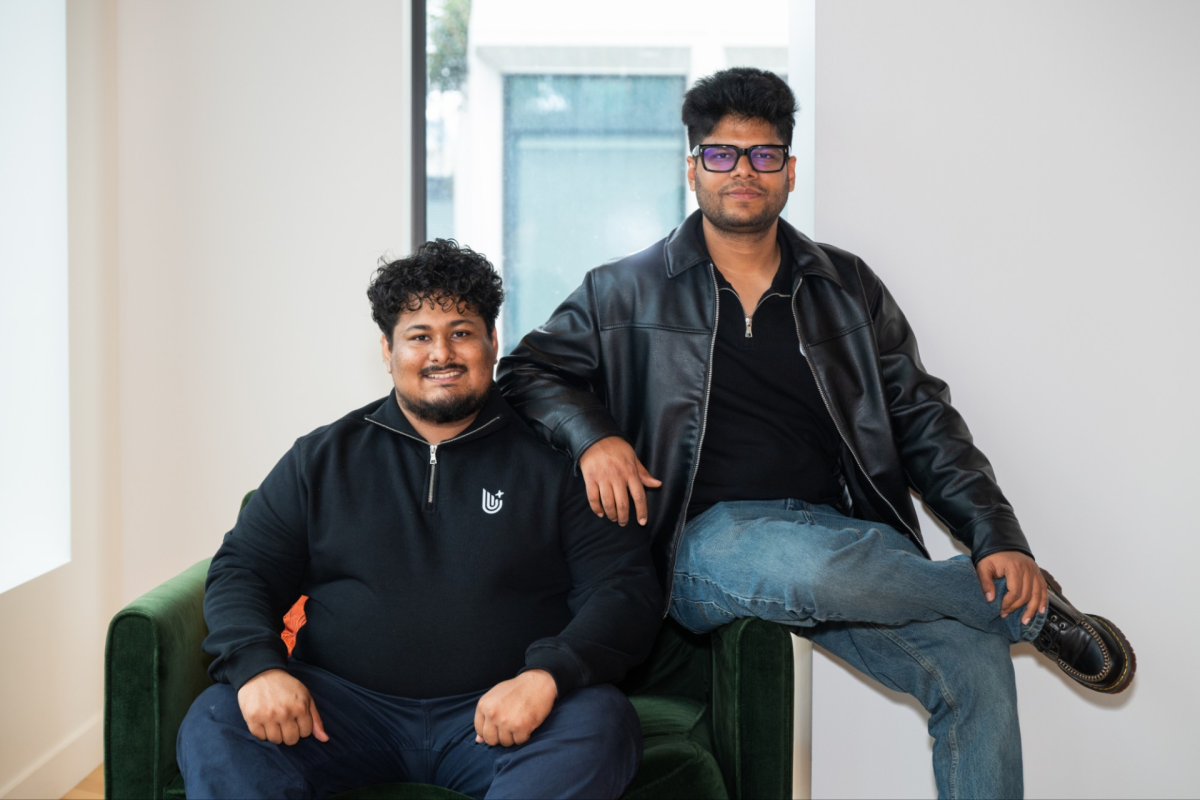
The company was founded by CEO Aman Mishra and CTO Adnan Abbas, classmates at IIT Kharagpur. Mishra built an ultra-low-latency trading system at a hedge fund and was the first engineer at a San Francisco startup building AI copilots for firms such as Goldman Sachs and Charles Schwab. Abbas, who studied at MIT and IIT Kharagpur, built multimodal models deployed at a Fortune 10 company and worked on autonomous navigation systems at Mercedes-Benz. The company says it has brought together researchers and engineers from Google DeepMind, Cognition and quant trading firms, and press reports put headcount at seven.
Unsiloed announced a $7.5 million seed round and did not disclose a valuation. Felicis led the round, with participation from Y Combinator, Orange Collective, Uncorrelated Ventures and angel investors Aarthi Ramamurthy and Beth Turner. The company also thanked early partners and investors including Schema Ventures, Entrepreneurs First, Transpose Platform and Eight Capital Management. The money goes toward hiring researchers and engineers, expanding sales and building proprietary datasets.
Competitive Landscape
Document parsing has both specialist startups and big tech. Press reports name Reducto, Unstructured, Microsoft and Amazon document services and general-purpose AI models as Unsiloed’s competitors. Reducto raised a $75 million Series B in October 2025, and LlamaIndex raised $19 million in March of that year to build custom agents on unstructured data. In Korea, Searchdoc raised $2.1 million for large-document and industrial-drawing analysis.
Unsiloed’s differentiators are verifiability, with a confidence score and source for every value, and the air-gapped deployment that regulated industries demand. But its funding is small next to leaders such as Reducto, and its accuracy numbers are self-reported and will need to be validated as customer cases accumulate. For more on the competitive landscape, see here.
MORE FROM THE POST
- Fragment Launches With $56M to Have AI Agents Resolve Procurement Exceptions at Large Manufacturers
- TypeSafe AI Raises $40M Seed for a Model That Doesn’t Talk
- Remanence Raises $30 Million Seed to Turn AI Agent Runs Into Models Companies Own
- Model ML Raises $250M at $1.5B Valuation for Personal AI Agents in Finance
- Noetive Raises $41M Seed to Build an AI “Brain” for Factories and Warehouses
- AI
- enterprise AI
- Felicis
- funding
- Orange Collective
- Overseas funding
- seed
- Uncorrelated Ventures
- Unsiloed AI
- Y Combinator
Share

Most Read
- 1
- 2
- 3
- 4
- 5

Leave a Reply