


Korea Targets 50 Unicorns, 10K AI Startups by 2030 with $27B Annual Venture Investment Goal


The Korean Government has unveiled an ambitious plan to transform Korea into one of the world’s top four venture ecosystems by 2030, setting bold targets of 50 unicorns, 10,000 AI and deeptech startups, and $27 billion USD (40 trillion KRW) in annual venture investment.
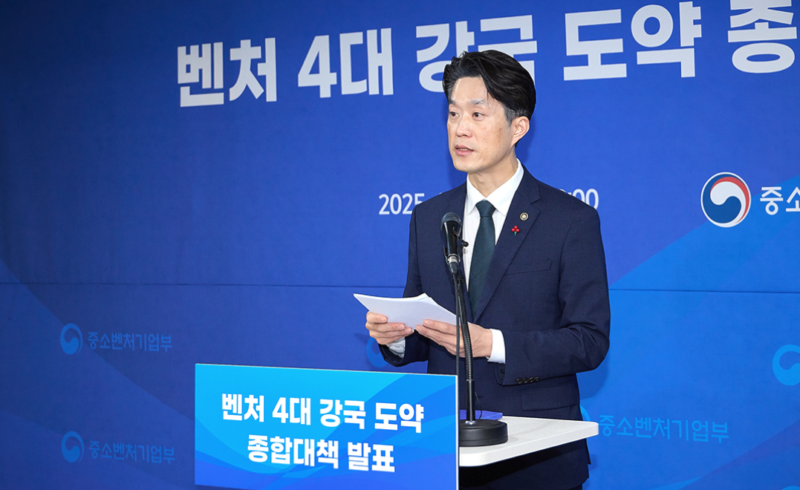
The Ministry of SMEs and Startups (MSS) announced its “Comprehensive Strategy for Advancing to the Top Four Venture Powers” at a joint government meeting in Seoul. Unlike previous piecemeal initiatives, this represents the first holistic policy framework placing ventures at the heart of national growth strategy, integrating technology, regional development, talent, and capital into a unified vision.
AI and deeptech are redrawing industry boundaries and reshaping the global economic order, with unlisted ventures and startups leading the charge. In an era where technological speed and impact drive national competitiveness, there’s growing recognition that ventures—pursuing disruptive innovation despite uncertainty—have become essential engines of economic growth.
Major economies like the United States and China have already mobilized their venture ecosystems as tools of national strategy, integrating capital, technology, talent, and even security capabilities. The innovation frontier has also shifted beyond platforms and software into hardware-intensive domains like space, defense, and energy.
Korea, meanwhile, faces its own structural headwinds: demographic decline, slowing growth, and industrial stagnation. The traditional growth playbook is reaching its limits, prompting the government to pivot toward a venture-centered strategy as the foundation for future competitiveness.
Korean ventures have already proven their transformative power over the past three decades. They helped Korea recover from the 1997 financial crisis, drove the internet and mobile revolution, and built the platform economy. The numbers tell the story: as of 2023, venture companies employed 935,000 people—more than Korea’s four largest conglomerates combined. In 2024, 985 venture-origin companies surpassed $67.7 million USD (100 billion KRW) in revenue, and ventures now account for over a third of all domestic listed companies.
Yet ventures have revolutionized industries from retail to finance, energizing both the real economy and capital markets through job creation, investment, and IPOs. But structural barriers remain: deeptech sectors still depend heavily on large corporations, the ecosystem is concentrated in Seoul, talent inflow is limited, and risk capital for large, long-term bets remains scarce.
Rather than patching these gaps incrementally, the government has redesigned its entire policy framework. The new strategy doesn’t just support ventures—it makes them the centerpiece of national economic growth.
The plan sets clear targets: 10,000 AI and deeptech startups, 50 unicorns and decacorns, and entry into the global venture investment league with $27 billion USD (40 trillion KRW) in annual deal flow. The goal isn’t short-term subsidies but building a self-sustaining ecosystem where technology, capital, talent, and markets flow together organically.
The government has designed four major strategies with 15 specific initiatives, all built around feedback from entrepreneurs and ecosystem participants.
Building Global Big Tech Champions
Korea will allocate a portion of its 50,000 GPU stockpile to venture R&D and pilot projects, while restructuring policies around six strategic industries to nurture 10,000 AI and deeptech startups by 2030. The “Next-Generation Unicorn Project” will channel up to $67.7 million USD (100 billion KRW) per company in staged investment and guarantees, totaling $9.2 billion USD (13.5 trillion KRW) through 2030. Large-scale follow-on investments linked to the National Growth Fund will provide additional support.
Open innovation programs will shift from fixed grants to milestone-based funding tied to measurable progress. Collaboration hubs and shared-value models will help ventures translate technical breakthroughs into market products. The government will also expand public procurement beyond early-stage startups to include mature venture products and services, opening B2G opportunities for mid- and late-stage companies.
Starting with Silicon Valley, Korea will establish startup campuses in Tokyo, Singapore, London, and New York, while building a global startup hub in Seoul. Joint ventures with overseas Korean entrepreneur networks, co-investment funds, and strengthened AroundX programs will provide sector-specific pathways to international markets.
A new “Startup One-Stop Support Center” will use AI to streamline legal, tax, and management support throughout the startup journey. Korea will also introduce a three-phase system for identifying, debating, and resolving regulatory barriers, with wide-area regulatory free zones to tackle industry-wide regulatory bottlenecks.
Spreading Innovation Beyond Seoul
A new “Re-challenge Support Headquarters” will coordinate second-chance policies through 19 regional support centers, working to shift cultural attitudes toward entrepreneurial failure. By 2030, Korea will establish a $677 million USD (1 trillion KRW) re-challenge fund. Failed entrepreneurs who couldn’t repay guaranteed debts will gain access to technology guarantees for new ventures, and expanded limits on joint investment liability will lower the cost of trying again.
Ten regional startup cities will be built around five major innovation hubs and three special zones. Expanded Startup Parks will serve as regional anchors, while Creative Economy Innovation Centers (CCEIs) will concentrate resources on local programs. Regional startup festivals will showcase local talent. TIPS will reserve up to 50% of slots for regional companies with relaxed investment requirements, and deeptech hubs linked to KAIST and other specialized universities will spread beyond the capital region.
A $2.4 billion USD (3.5 trillion KRW) regional growth fund, seeded by the Fund of Funds, will direct capital to local ventures. Regional investment quotas and incentives will be introduced across Fund of Funds subsidiaries. KVIC regional offices and angel investment hubs will expand to the five major hubs and three special zones. Expanded early-stage funds and relaxed regulations on startup accelerators and angel groups will boost seed-stage activity.
The government is considering Social Venture Act legislation to align Korea’s social venture definition with global standards and integrate it into the venture company framework. Impact funds will provide stable capital, with over $101.6 million USD (150 billion KRW) in annual impact guarantees planned. TIPS will also reserve 10% of spots for ESG-focused startups.
Attracting Top Talent
Korea will update the Venture Business Act to clarify government responsibilities and expand venture company recognition to include mid-sized firms, ensuring innovative companies can keep growing without losing their status. Venture investment contracts will be reformed to match global standards, shifting from unanimous consent requirements to collective agreement models and encouraging standardized contract templates. Multiple voting rights will be rationalized to balance governance and operational flexibility, while the government will study “FLIP” companies—Korean startups that relocated overseas but still contribute to the domestic economy.
The “Startup for All Project” will identify 1,000 aspiring entrepreneurs annually, selecting 100 “startup rookies” through competitive rounds to receive commercialization and investment support. Stock option rules will be simplified, allowing board-level approval, and the below-market grant limit will jump from $3.4 million USD (5 billion KRW) to $13.5 million USD (20 billion KRW) to make equity compensation more attractive. To professionalize venture capital management, Korea will introduce GP Entity structures that clarify performance attribution and reduce conflicts of interest.
A new high-level coordination body with representatives from government, parliament, and industry will provide strategic direction for the venture ecosystem. A comprehensive portal will promote entrepreneurship and “pay it forward” culture, supporting policy coordination, knowledge archiving, and networking. A “Senior Venture Fund” will encourage successful entrepreneurs to invest in the next generation. Venture Week will become a statutory event, a “Venture Hall of Fame” will honor pioneers, and companies reaching $67.7 million USD (100 billion KRW) in revenue will join the “Venture Milestone Club”—cementing venture success as a national achievement.
Scaling Investment to $27 Billion Annually
The Fund of Funds will enter its “2.0 era” as an open investment platform. A new national account for pension and retirement funds will shift first-loss risk to the Fund of Funds, while expanded fiscal commitments and extended fund lifespans will strengthen its platform role. An inter-ministerial operation committee will improve transparency and strategic alignment. The government will actively encourage statutory funds, retirement accounts, and international capital to participate in venture investing.
Financial regulations will be rewritten to encourage venture investment by private institutions. Banks investing in policy funds will receive clear guidance on risk-weighting, while large investment banks will face mandatory allocations to risk capital, including unlisted venture deals. Eased rules around external fundraising and overseas investment will stimulate corporate venture capital (CVC) activity and strategic investments by large and mid-sized companies.
Tax incentives for private venture investment will be significantly enhanced. The age limit for investee companies will extend from 7 to 10 years, and corporate tax credits for Fund of Funds investments will increase. The government will also review special relationship rules to accommodate corporate follow-on investments through venture funds. Korea Technology Finance Corporation will evolve into a comprehensive technology finance platform, and a legislated reporting center will combat unfair investment practices.
Korea’s SME M&A platform will be upgraded to provide end-to-end support for deal sourcing, advisory, and financing, with major expansions in M&A funds and guarantees. M&A guarantee capacity will grow from $203 million USD (300 billion KRW) in 2025 to $1.4 billion USD (2 trillion KRW) by 2030. A variety of secondary fund structures—including general secondary, LP stake liquidity vehicles, and continuation funds—will be launched to create a robust intermediate exit market for venture investors.
The government plans to spend the next month actively communicating the strategy to stakeholders and the public, rather than treating the announcement as a one-off event. It will strengthen dialogue with parliament to advance key legislative initiatives and roll out major programs starting in the first half of next year, including a swift 2025 Fund of Funds investment announcement aligned with the 2.0 framework.
Minister Sung-sook Han said the success of Korea’s next-generation unicorns “will depend on global expansion capabilities beyond the domestic market and technological competitiveness to solve high-difficulty deeptech challenges.” She added that MSS “will work closely with related ministries to accelerate institutional reforms and policy implementation, mobilizing all available resources so that ventures and startups can grow into K-big tech companies and create new economic legends for Korea.”
MORE FROM THE POST
- Korea Commits $1.5B to Fund-of-Funds, Targeting $3B in Total Venture Capital
- South Korea Approves Record $11.3B Budget for SMEs and Startups in 2026
- Korean Government Unveils $28.7 Billion Venture Investment to Fuel Third Venture Boom
- Korea’s TIPS Program Achieves $11.11 Billion in Investments Over a Decade
- Korea’s MSS Launches Global Startup Center in Seoul to Support Foreign Entrepreneurs
Share

Most Read
- 1
- 2
- 3
- 4
- 5

Leave a Reply