


Nine Korean Startups Make Forbes Asia 100 to Watch 2026


Nine South Korean companies have been named to the Forbes Asia 100 to Watch 2026, underscoring how Korea’s startup pipeline is expanding from consumer platforms into AI infrastructure, industrial robotics and drug discovery.
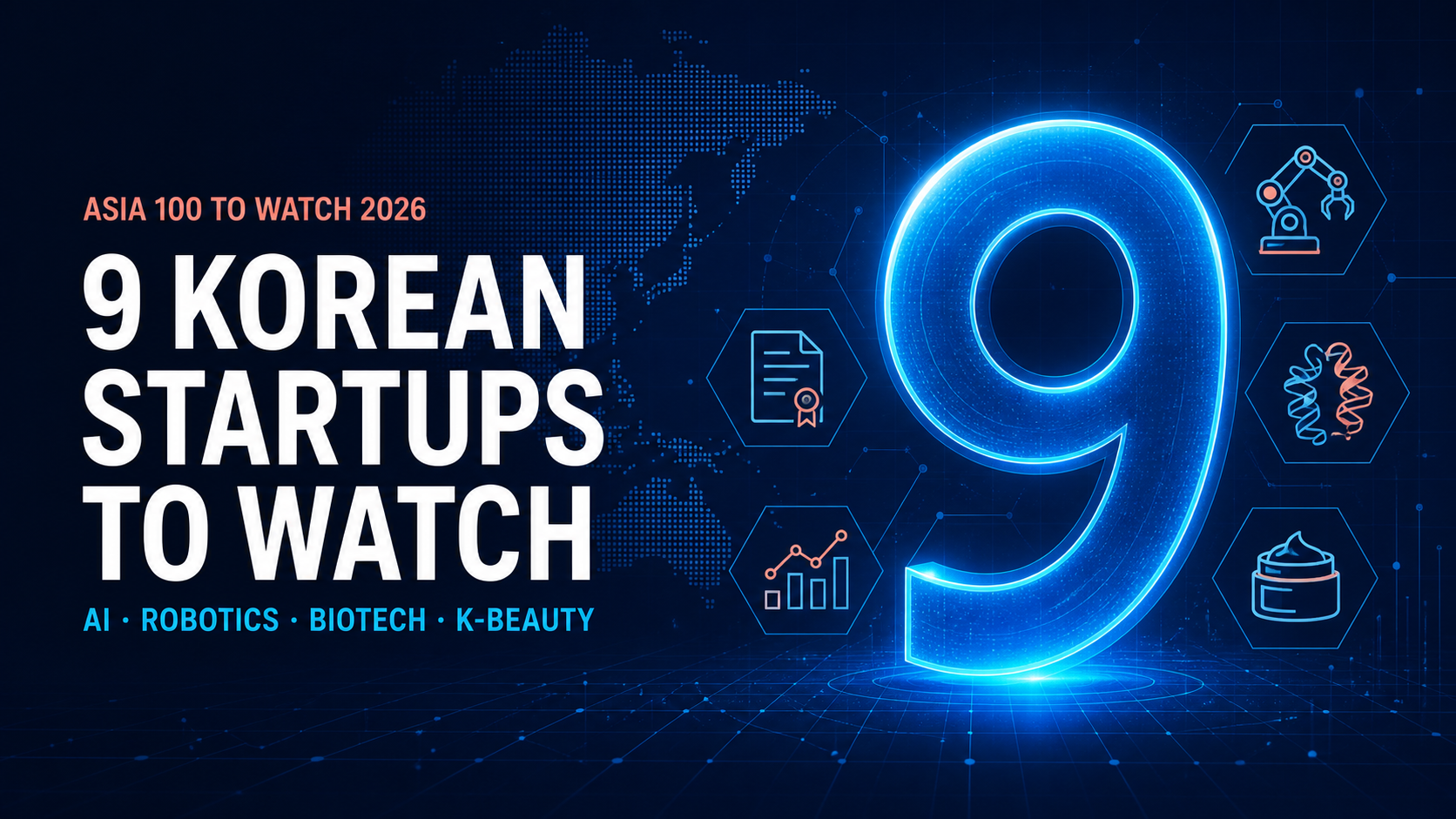
The Korean companies selected this year are BiTELAB, DIDEN Robotics, Featuring, Galux, Hyper Accel, RLWRLD, Veramore, Wert Intelligence and Whitecube. Four operate in AI-driven enterprise technology, robotics or semiconductor infrastructure, while three represent consumer-facing businesses in beauty, brand commerce and mobile engagement.
Forbes considered privately held, for-profit companies headquartered in the Asia-Pacific region with no more than $50 million in annual revenue and no more than $100 million in total funding. Companies were evaluated on factors including regional impact, innovation, growth and their ability to attract talent.
AI Moves Into Marketing, Patents and Drug Discovery
Featuring uses AI to analyze social media data for influencer marketing and content strategy. Its platform tracks more than 200 million social media accounts and serves more than 3,500 clients, according to Forbes. The company has raised 22 billion won in total, including a $10.6 million Series B round announced in May.
Wert Intelligence applies proprietary AI models to patent search and analysis. Forbes said Wert has more than 30,000 users across 9,000 organizations. The company raised 16.5 billion won in July in a round led by Altos Ventures to support its expansion into Japan.
Galux uses AI to design protein drugs, particularly antibodies. It has established research partnerships with global pharmaceutical companies including AstraZeneca and Boehringer Ingelheim. In February, Galux secured a $28.8 million Series B round, bringing its total funding to approximately $46.6 million.
Industrial Robotics Emerges as a Korean Strength
DIDEN Robotics develops two- and four-legged robots for hazardous and repetitive tasks in heavy industry. Its quadruped robot Spider uses magnetic feet to move across steel structures for inspection and welding. DIDEN Robotics secured seed funding from Bluepoint Partners and Company K Partners in 2024. It has signed contracts with two Korean shipbuilders and a European customer.
RLWRLD develops AI models that allow five-fingered robotic hands to perform tasks in factories, warehouses, stores and hotels. The company raised $26 million in a Seed 2 round in February, bringing its total seed funding to approximately $41 million.
The two companies illustrate complementary directions in Korean robotics. DIDEN is building hardware for hazardous industrial environments, while RLWRLD is developing the intelligence layer that enables robots to learn and perform a wider range of physical tasks.
Hyper Accel Targets the Economics of LLM Inference
Hyper Accel develops semiconductors and server systems optimized for large language model inference. Its LLM Processing Unit is designed to run AI inference with lower infrastructure and energy costs.
The company is conducting proof-of-concept tests with Naver Cloud for data center deployment and with LG Electronics for AI devices. Hyper Accel raised approximately $41.2 million in Series A funding from investors including Korea Investment Partners, Korea Development Bank, KB Investment, Mirae Asset Venture Investment, SBVA, LB Investment and Vickers Venture Partners. Forbes estimates that it has raised approximately $74 million in total.
K-Beauty Startups Use Capital to Expand Overseas
BiTELAB operates a portfolio of Korean consumer brands led by haircare label lilyeve. The brand has gained traction at CJ Olive Young and on Amazon in the United States. In May, BiTELAB raised more than $6.9 million in its first external funding round from Atinum Investment and CJ Olive Young.
Veramore is a skincare brand targeting consumers in their 20s and 30s. In July, it completed an undisclosed pre-Series A round led by Rakuten Capital, with Strong Ventures participating as a follow-on investor. The deal was Rakuten Capital’s first investment in a K-beauty brand, and Veramore plans to use Rakuten Group’s network to expand in Japan.
Whitecube Takes Consumer Engagement to Japan
Whitecube operates Challengers, a mobile platform that rewards consumers for completing personal goals and participating in branded campaigns. More than 1,100 brands use the platform, which has over 2 million registered users in South Korea.
Whitecube entered Japan in early 2025 and has attracted more than 70,000 users there. The company has raised approximately $5 million from investors including Altos Ventures, Pearl Abyss Capital, Smilegate Investment and Woori Venture Partners.
A Pipeline Built Around Applied Technology
The nine Korean companies do not fall under a single technology trend. What connects them is the application of technology to clearly defined industries and the ability to move beyond the domestic market.
Hyper Accel is targeting the cost of running large AI models. DIDEN Robotics and RLWRLD are bringing automation into physical workplaces. Galux and Wert Intelligence apply specialized AI to protein design and patent analysis. BiTELAB and Veramore are using global demand for Korean beauty products as an entry point into overseas markets, while Whitecube and Featuring are expanding platform businesses across borders.
Taken together, the selections suggest that Korea’s next generation of global startups may be defined less by general-purpose consumer apps and more by companies combining technical specialization, industrial partnerships and market-specific expansion strategies.
MORE FROM THE POST
- Rosota Raises $965K Seed Round to Build AI-Native Surgical Robots
- RLWRLD Raises $26M in Seed 2 Round to Scale Physical AI Across Industrial Sites
- Galux Secures $28.8M Series B for AI-Powered Antibody Drug Design
- Hyper Accel Raises $41 Million to Boost AI Semiconductors for LLMs
- Connecteve Secures $3M funding for AI in Musculoskeletal Software and Surgical Robotics
- AI
- BioHealth
- BiTELAB
- DIDEN Robotics
- featuring
- GALUX
- Hyper Accel
- K-beauty
- Korean startup
- RLWRLD
- robotics
- Semiconductor
- Veramore
- wert Intelligence
- Whitecube
Share

Most Read
- 1
- 2
- 3
- 4
- 5

Leave a Reply