





A robot can only act safely in the physical world if it can see it accurately. Most robotics platforms today assemble their perception from off-the-shelf components that were never designed to work as one system, and they pay for it in latency, calibration drift, and data that’s hard to trust.
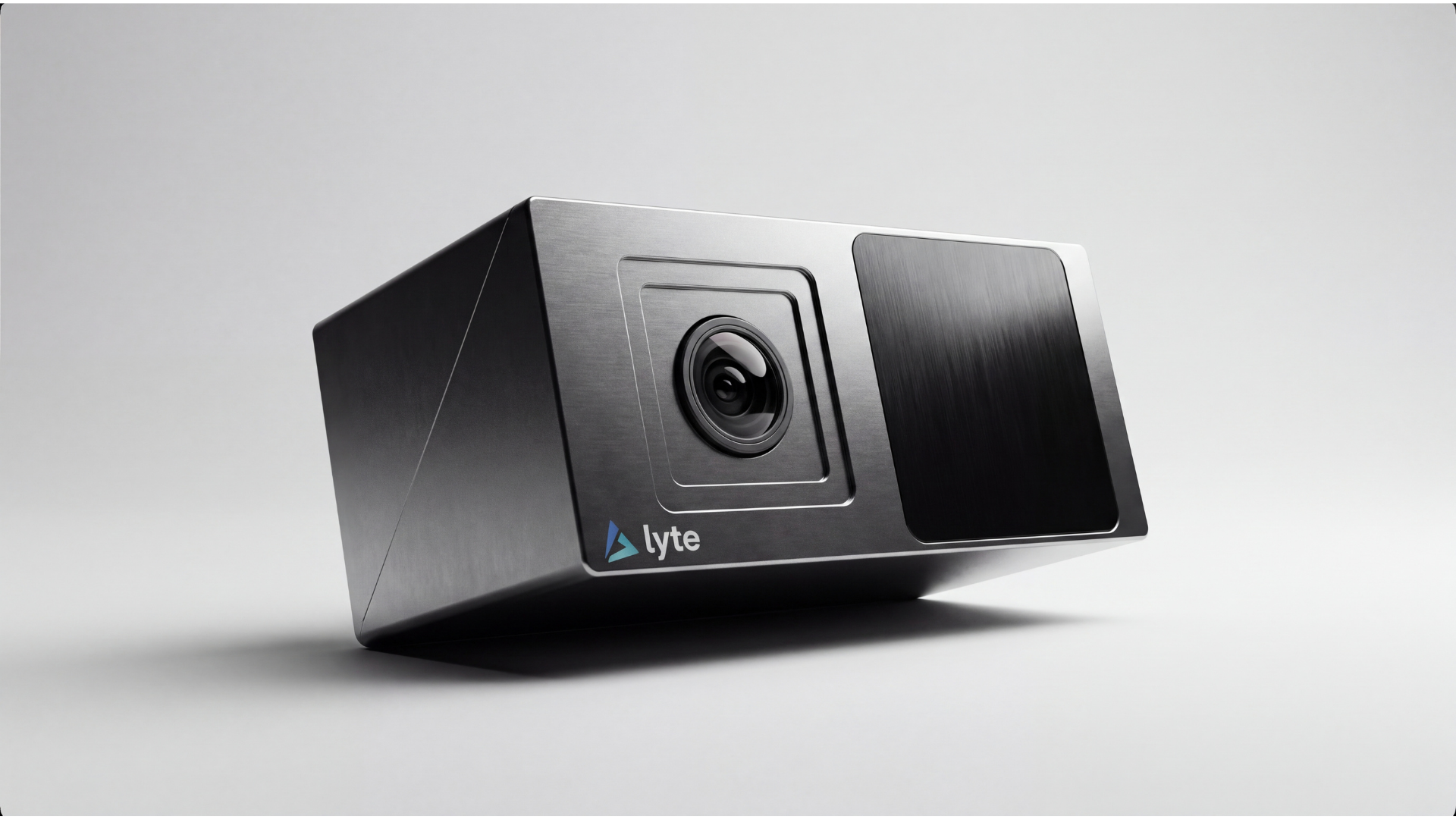
Lyte builds what amounts to a robot’s eyes. A person sees, balances using inner-ear and body cues, and lets the brain fuse that information into a sense of where they are and what’s moving around them. Robots need the same thing, but until now they’ve gotten it by bolting together cameras, LiDAR, and inertial sensors sourced from different vendors that were never built to work together. The mismatch shows up as calibration drift — is the camera’s view, the LiDAR’s distance reading, and the IMU’s motion data all describing the exact same instant? — and as latency getting that fused picture to the robot’s arms and legs in time. Even small errors leave a robot acting on a view of the world it can’t fully trust.
Sunnyvale, California-based Lyte wants to fix that by designing every one of those components as a single system from the start, and it has raised $165 million in Series C funding led by Maverick Silicon to do it, the company announced. The round values Lyte at $1.6 billion post-money. High-resolution imaging plays the role of the eyes, 4D coherent vision measures distance and motion the way LiDAR does, and inertial sensing handles balance — Lyte puts all of it on its own custom silicon, synchronized to a single timeline. That means position and motion are measured natively in hardware rather than reconstructed after the fact in software, according to the company. The resulting platform, LyteVision, was named CES 2026 Best of Innovation in Robotics.
Lyte was founded in 2021 by former Apple and PrimeSense engineers whose earlier work brought 3D perception to the mainstream through Microsoft Kinect and later became foundational to Face ID, reaching more than a billion people worldwide. “Physical AI has a sensing problem before it has a model problem. A robot cannot act safely on data that does not faithfully describe the world,” said CEO Alexander Shpunt. Lyte’s chairman is Avigdor Willenz, the serial semiconductor entrepreneur who founded Galileo Technology (sold to Marvell for $2.7 billion in 2000) and Annapurna Labs (sold to Amazon for roughly $370 million in 2015).
The round was led by Maverick Silicon, whose managing partner Andrew Homan is joining Lyte’s board. Fidelity Management & Research Company, which led Lyte’s Series B, returned alongside Atreides Management, Key1 Capital, and Ora Global (formerly Exor Ventures), among other existing and new investors. Total capital raised since the company’s 2021 founding now stands at $272 million. The funding will go toward scaling production of Lyte’s sensing silicon and LyteVision platform, advancing its AI and perception capabilities, and expanding deployments with robotics and industrial customers. The company plans to grow substantially across silicon, software, optics, manufacturing, operations, and go-to-market.
The robot-perception silicon race
The market for silicon and sensors that give robots their sense of sight is still wide open, with no clear winner yet. In traditional LiDAR, Ouster and Cepton supply sensors for autonomous vehicles and robotics. Recogni, whose “Scorpio” chip estimates distance to objects within 300 meters of accuracy using camera footage alone, raised a $102 million Series C in 2024 led by Celesta Capital and GreatPoint Ventures, bringing its total to $175 million — a bet that cameras alone, without LiDAR, can solve perception. Metalenz, which spun metasurface optics out of a Harvard lab to compress multiple lenses into a single thin chip, already ships in more than 140 million consumer devices and is now expanding into 3D sensing and biometrics. Most of these companies focus on a single sensor or chip, while Lyte owns the full stack from silicon to sensors to perception software. It also sits at a different layer than foundation-model companies like Physical Intelligence and Skild AI, which build the robot’s “brain” — if those are the brain, Lyte is the eyes.
MORE FROM THE POST
- Physical AI Chipmaker SiMa.ai Raises $150M Series C at $1.45B Valuation
- Robot Brain Developer Generalist Raises Another $200M, Two Months After Its $400M Round
- D-Robotics Raises $400M Series C Led by Mirae Asset
- Action-Model AI General Intuition Raises $220M at $6.2B Valuation
- Angle Health Raises $600M at a $2.7B Valuation
- AI
- Atreides Management
- Fidelity Management & Research Company
- funding
- Key1 Capital
- Lyte
- Maverick Silicon
- mega funding
- Ora Global
- Overseas funding
- physical ai
- robotics
- seriesC
- unicorn
Share

Most Read
- 1
- 2
- 3
- 4
- 5

Leave a Reply