





Robot software is still written one task at a time. Teaching a factory arm a new job means programming the motion by hand, and even a minor change — a switch to larger boxes, say — sends engineers back to the code. Robots that ship with AI models are only marginally better: teaching them something new usually means fine-tuning the network, which takes time. A large share of what it costs to deploy a robot sits not in the hardware but in that teaching step.
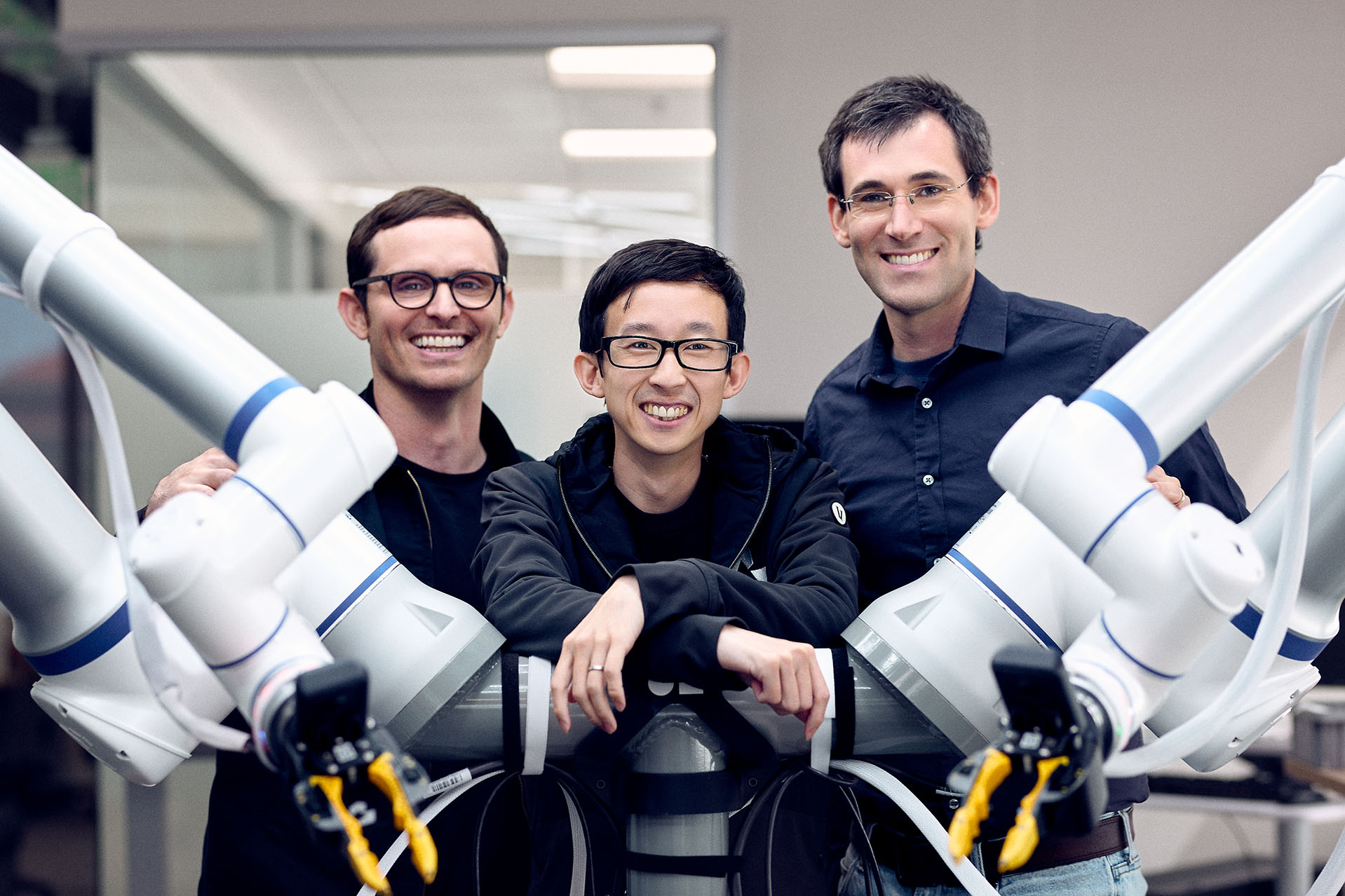
Generalist builds none of the hardware. It builds the brain — a robot foundation model meant to work across machines and tasks rather than being tied to either. Its first model, GEN-0, showed last November that scaling laws hold in robotics too: more physical experience and larger models predictably produce more capable systems. GEN-1, released in April, pushed that to 99% reliability on simple physical tasks and execution up to three times faster than the prior state of the art.
GEN-1.5, unveiled on August 19, changed how the model is taught. A person performs the task with their bare hands, and the robot’s own cameras — or sensors strapped to the demonstrator’s hands — record it. The company says the model can learn a new task in context from as little as 12 seconds of demonstration data. Across 10 sample tasks, it completed 59% on average after a single demonstration, rising to 83% with a few more.
Generalist was founded in 2024 by Pete Florence, Andy Zeng and Andrew Barry. Florence was a senior research scientist at Google DeepMind and a lead developer of Gemini Robotics, the company’s robot control model; he earned his computer science PhD at MIT under Russ Tedrake. The founding team drew engineers from OpenAI, DeepMind and Boston Dynamics.
Axios reported on August 24, citing a source, that Generalist has raised roughly $200 million more. The round surfaced through a federal filing rather than a company announcement. 8VC led it, joined by a number of existing backers who were not named. Neither the participant list nor a valuation for this round has been disclosed, and the company has yet to comment publicly.
The pace is what stands out. On June 4 the company announced $400 million at a $2 billion valuation, taking its total raised past half a billion dollars. Radical Ventures led that round, with 8VC, Union Square Ventures, Hanabi Capital and Norwest coming in as new investors and existing backers NVIDIA, Boldstart Ventures, Spark Capital, Bezos Expeditions and NFDG all following on. NVIDIA has been in since March 2025, when the company was still in stealth. Add the new $200 million and the total sits near $700 million.
Who Else Is Building Robot Brains
Robot foundation models have already produced several companies carrying multibillion-dollar valuations without shipping any hardware.
Physical Intelligence, developer of the π0 family of general-purpose robot policies, is widely seen as the front-runner. It raised $600 million led by CapitalG last November at a $5.6 billion valuation, and in March was reported to be in talks for roughly $1 billion at an $11 billion valuation.
Skild AI, founded by former Carnegie Mellon professors, pitches an “omni-bodied” model that can control a robot without knowing its exact body. Its $1.4 billion Series C in January, led by SoftBank Group, valued the Pittsburgh company at more than $14 billion — the highest in this layer.
Genesis AI trains its universal robot model on synthetic data from a simulator it says runs up to 430,000 times faster than real time. It came out of stealth in July last year with a $105 million seed round co-led by Eclipse and Khosla Ventures, and shipped its first model, GENE-26.5, in May.
Florence has argued that robotics today sits roughly where the internet did just before large language models arrived — at the start of the stretch where scale alone buys capability. Another $200 million two months on reads as a bet that getting through that stretch first is mostly a question of how much compute and data you can afford.
MORE FROM THE POST
- D-Robotics Raises $400M Series C Led by Mirae Asset
- Lyte Raises $165M Series C to Give Robots a Trustworthy View of the World
- Cognition Raises Over $2B at $48B Valuation
- Action-Model AI General Intuition Raises $220M at $6.2B Valuation
- Physical AI Chipmaker SiMa.ai Raises $150M Series C at $1.45B Valuation
Share

Most Read
- 1
- 2
- 3
- 4
- 5

Leave a Reply