










Credos Partners, a comprehensive Security Token offering (STO) solution provider twice selected for the Financial Services Commission’s regulatory sandbox, announced on September 11 that it is conducting a pre-Series A funding round exceeding 2 billion won (approximately USD 1.5 million) and has secured more than 1.5 billion won to date, led by Knet Investment Partners.
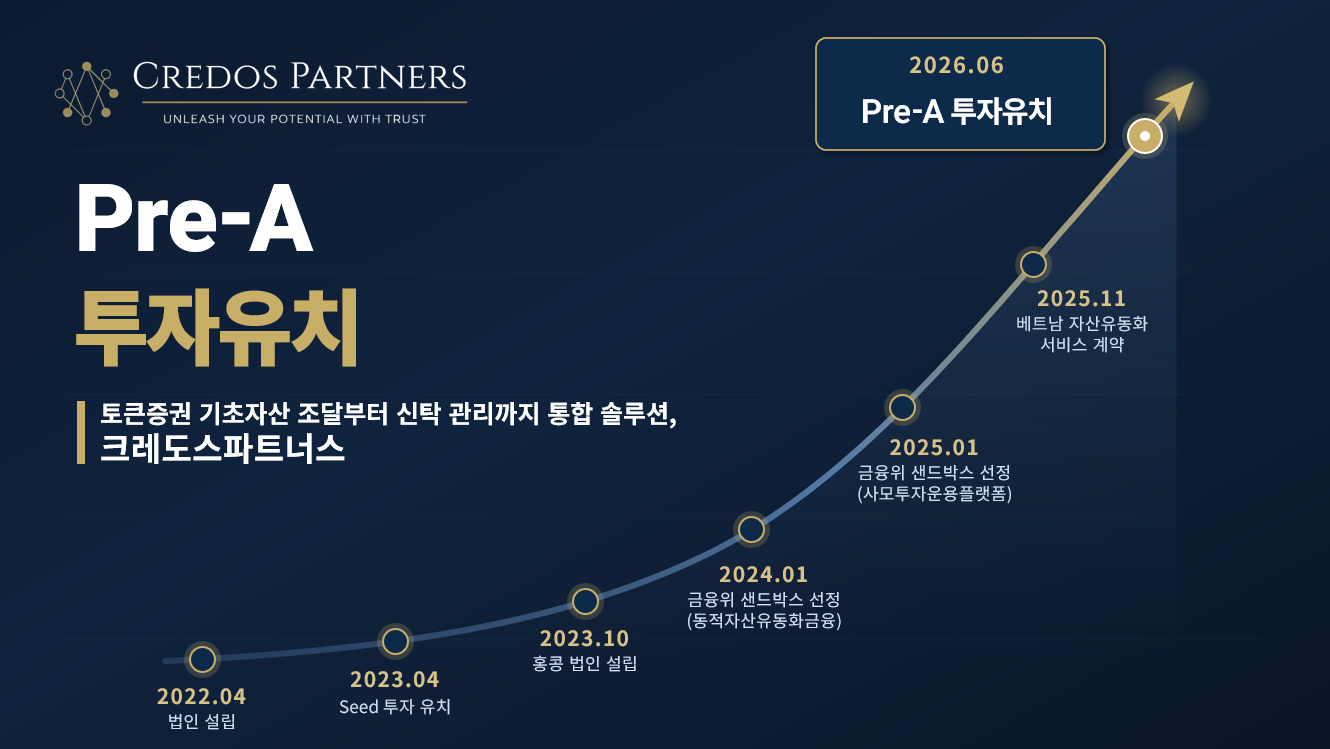
Existing shareholders are also participating in this pre-Series A round, with the entire investment process expected to close next month.
Founded in 2022 by CEO Hayan Lee, who brings over 20 years of experience from multinational banks in Hong Kong, global consulting firms, and IT companies, Credos Partners provides a digital platform for the creation, trading, operation, and trust management of diverse financial products. Security Tokens serve as the underlying technology to efficiently realize this entire process.
In line with recent legislation surrounding the Security Token market, Credos Partners is accelerating its provision of Security Token infrastructure to domestic and international financial institutions. The company has from the outset defined Security Tokens not as a separate product but as a pillar of future financial infrastructure. Rather than viewing token issuance or blockchain technology as an end in itself, Credos Partners focuses on solving inefficiencies that arise in the creation and subsequent operation of the underlying assets to be tokenized.
This strategic direction has translated into tangible results. This year, Credos Partners signed a contract with a Southeast Asian financial institution to build a supply-chain finance platform and is pursuing a similar supply-chain finance project with a domestic institution, targeting launch within the year. Alongside this, the company is advancing the tokenization and sale of foreign-currency bond portfolios for high-net-worth individuals in Singapore, while in Korea it is developing Security Token systems and providing consulting services. In Hong Kong, Credos Partners is preparing a B2B Security Token platform for professional investors through a joint venture. Through these initiatives, the company plans to offer a comprehensive solution that spans the cross-border creation of diverse structured and non-structured assets, and their trading, management, and administration via Credos Partners’ integrated platform.
Juhan Yoon, investment associate at Knet Investment Partners, said, “Following legislation, the Security Token market will move beyond simple issuance platforms, and the core competitive advantage will belong to infrastructure capable of sourcing diverse underlying assets and reliably handling financial institutions’ regulatory, settlement, and ledger-management tasks. Credos Partners stands out because it has a team with structured-finance and cross-border finance experience, and combines asset sourcing, deep understanding of financial-institution workflows, and blockchain- and AI-based operational technology.” He added, “We decided to invest because we see the potential for Credos Partners to grow into a core infrastructure company connecting financial institutions and issuers in the Security Token and real-world asset (RWA) market, which will enter full bloom starting next year.”
CEO Hayan Lee of Credos Partners stated, “Since our founding we have been preparing digital and tokenization solutions for private placements. We will use this investment to expand our Security Token and RWA business both domestically and internationally, with Korea and Hong Kong as our operational hubs.”
This business expansion aligns with the recent institutionalization of Security Tokens. On September 4, the Financial Services Commission held the third meeting of the public–private Security Token consultative body and announced a policy direction to promote tokenization of structured securities—including equities, bonds, and funds—beyond the existing fractional-investment market, drawing on leading overseas examples.
MORE FROM THE POST
- Offline Cashback App Bridge Works Secures Pre-Series A from Laguna Investment
- SureTech Secures Pre-A Funding to Scale AI-Driven Auto Insurance Platform ‘Carsure’
- Dailypay Secures Pre-Series A Funding to Strengthen Growth in Small Business Solutions
- Lemontree Raises $1.8M in Pre-Series A for ‘Firfin’ Allowance Management Service
- AM Management Secures Additional Pre-Series A Funding from Ulsan CCEI
Share

Most Read
- 1
- 2
- 3
- 4
- 5

Leave a Reply