










The number of approved AI medical devices keeps climbing. The FDA alone authorized 91 AI/ML-enabled devices in 2022 and 295 in 2025 — more than triple in three years. The problem is that while the number of companies seeking approval keeps growing, the certification bodies reviewing them haven’t gotten any faster. The queue at the certifier has become as much of a bottleneck as the clinical trial itself in determining how long it takes an AI medical device to reach patients. Scarlet isn’t trying to work around that bottleneck with consulting services — it built itself into the certification body.
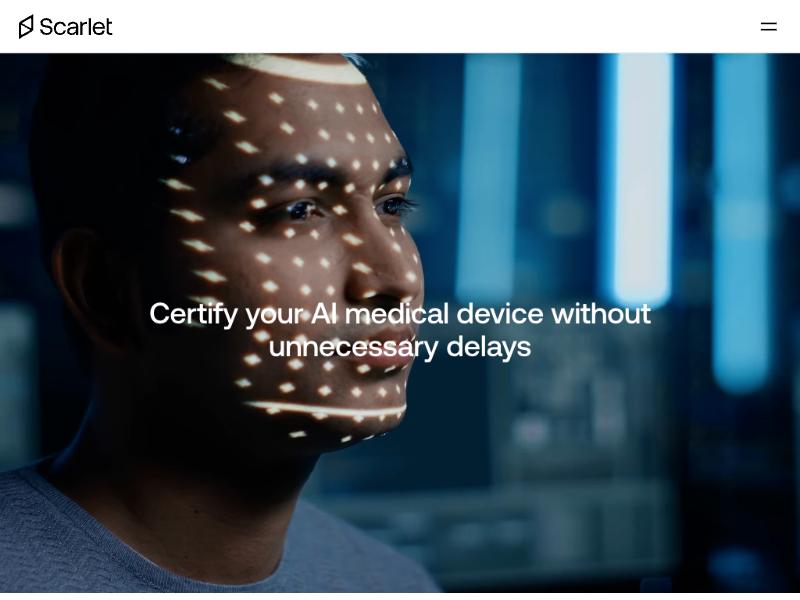
In Europe, a medical device needs sign-off from a “Notified Body” to get certified, a role typically held by large institutional players like BSI, TÜV SÜD and DEKRA. Scarlet spent its first three years negotiating directly with regulators instead of issuing a single certificate. It secured designation as a Notified Body under the EU’s Medical Device Regulation (NB 3022) and as an Approved Body under the UK’s MHRA (AB 8536), issuing its first EU MDR certificate in June 2024. The company says its customers have cut a year or more from certification timelines for new AI-enabled devices and shortened product-update cycles from months to weeks.
Scarlet was co-founded in London in 2021 by CEO James Dewar and CTO Jamie Cox, both of whom previously worked on AI medical devices at Babylon Health. Having lived through months — sometimes years — of delays waiting for their own technology to clear review, they set out to build something better.
Scarlet said it had closed a $50 million Series B led by Headline. Existing investors Kindred Capital, Creandum, Atomico and Entrepreneurs First returned, with Notion Capital joining as a new investor. The round brings the company’s total funding to roughly $75 million. The capital will fund its team of experts and expand its footprint in the US and Asia-Pacific.
Competition splits into two camps. One is traditional Notified Bodies like BSI, TÜV SÜD and DEKRA — credible, but not built specifically for AI medical devices, which Scarlet argues is why they’re slow. The other is regulatory consultancies like Hardian Health, Noze and Lindus Health, which help companies pass a certification body’s review rather than being a certification body themselves. Scarlet’s pitch rests on occupying neither camp — it sits in the gap between the two, holding the regulatory credibility of an official designation while operating at the speed of an AI-native company.
The expansion is likely to intersect with Korea’s own digital therapeutics companies before long. For firms like Beyond Medicine, which won approval from Korea’s Ministry of Food and Drug Safety for its TMJ-disorder digital therapeutic Clickless and has its sights set on global markets, Scarlet’s US and APAC push could offer an alternative path to European certification. For AI medical device exports, the next gate may matter as much as the clinical data itself: which certification body you go through, and how fast it moves.
MORE FROM THE POST
- Heidi Raises $340M for Its AI Care Partner, Now Valued at $900M
- Tandem Health Raises $100M Series B for European Healthcare AI
- Faro Raises $37.3M Series B to Put AI Agents Inside Clinical Development
- Marrow Therapeutics Launches With $173M Series A and B for Bone Marrow-Targeted Genetic Medicines
- Cardiovascular Imaging Startup Raywatt Raises USD 9.9M Series B, Targets 2028 Listing
- Atomico
- BioHealth
- Creandum
- Entrepreneurs First
- funding
- Headline
- HealthCare
- Kindred Capital
- Notion Capital
- Overseas funding
- Scarlet
- seriesB
Share

Most Read
- 1
- 2
- 3
- 4
- 5

Leave a Reply