



- AI
- ·
- Tech Giant
Meta Unveils Muse Wonder and Wonder Full Agent Models







Meta has introduced Muse Wonder and Muse Wonder Full, the models it is calling its most capable to date for personal and professional agentic work. The company said in a research blog post on October 12 that the two models deliver state-of-the-art performance on agentic tasks and mark “a major leap toward personal superintelligence.” Muse Wonder is available immediately through the Meta Model API and Muse Code, while the larger Muse Wonder Full is available today for Muse Code subscribers only. Both models will soon power the consumer agent app Muse, rolling out first to paying subscribers.
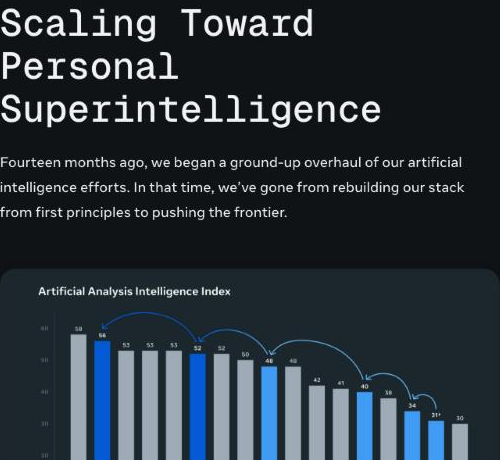
The release caps what Meta describes as a 14-month, ground-up overhaul of its AI organization — a stretch that took the company from rebuilding its model stack from first principles to, in its telling, pushing the frontier. Meta’s earlier Muse Spark model introduced the company’s approach to predictable, rigorous scaling; Muse Wonder and Muse Wonder Full extend that work across both pretraining and reinforcement learning. Where Muse Spark was a general-purpose model built to prove Meta could compete at the frontier again, Muse Wonder is the next step built explicitly for personal and professional agentic work. Both new models were trained at Meta’s gigawatt-scale “Prometheus” data center.
Muse Wonder’s headline features are Active Memory and Active Focus. Active Memory carries context about a user across conversations and surfaces the details relevant to whatever task is at hand, rather than treating each session as a blank slate. Active Focus describes how the model keeps working toward a difficult goal — trying alternative approaches, working through blockers, and adjusting as new information comes in — while checking in with the user before taking consequential actions.
Meta is pitching the models across a wide range of real-world use cases that require specialized knowledge, from parsing a lease to working through an insurance claim or financial and health information. For legal tasks, Meta’s evaluations drew on Harvey‘s Legal Agent Benchmark (LAB), which tests whether a model can work from source documents and detailed instructions to produce usable legal work product. Meta also showcased the models building a playable 3D kitchen game, planning a Saturday run, designing personalized gifts, and laying out a wedding seating chart. On the coding side, the company says both models deliver “frontier” performance on long-running software projects, measured through FocusBench for sustained focus and SWE-Marathon for extended execution.
Rather than lead with raw benchmark scores, Meta framed the release around generalization — guarding against what it called “benchmaxxing,” where two models post similar scores but differ sharply in how well they handle unfamiliar tasks. In a comparison Meta published alongside the release, Muse Wonder Full outperformed the scaling trend set by the earlier Muse Spark 1.3 on tasks outside its post-training focus, a gap the company attributes to a larger, stronger base model carrying training gains over to problems it wasn’t explicitly tuned for. The same post includes an “Artificial Analysis Intelligence Index” comparison chart placing Muse Wonder and Muse Wonder Full near the top of a field that includes current models from rival labs, though Meta did not publish the underlying methodology in the post’s text.
On safety, Meta said it trained the Muse Wonder family to exercise discretion with private information — messages, calendars, and documents a personal agent might touch — and to resist adversarial instructions. Under its Meta Superintelligence Scaling Framework, the company says Muse Wonder carries its strongest safeguards yet against CBRN (chemical, biological, radiological, and nuclear) and cyber misuse, while preserving the model’s ability to help security teams find and fix vulnerabilities in their own systems. Meta called it “our most aligned model to date” and said a fuller safety report, with additional evaluations, is coming soon.
The launch lands as Meta tries to convert an AI strategy reset into real competitive standing. The company has rebuilt itself around a vertically integrated approach centered on its Superintelligence Labs after Llama’s stumbles, and its consumer Muse app hit #1 on app store charts within two weeks of launch last month. That momentum comes against a backdrop where OpenAI, Anthropic, and Google have all been shipping their own agentic models in the same window, making the race to own “personal superintelligence” increasingly crowded — and making Muse Wonder’s actual performance in the wild the more interesting test than any benchmark chart.
MORE FROM THE POST
- Meta Acquires Conductor, the App That Runs AI Coding Agents in Parallel
- Anthropic Launches Always-On Work Agent ‘Claude Duet’
- OpenAI, Anthropic, Google and Meta All Ship New Models — With the Same Catch
- From Llama to Muse: Inside Meta’s Rebuilt, Vertically Integrated AI Strategy
- Thinking Machines Lab Unveils Inkling 2 Small as It Reportedly Nears a $5B Round
Share

Most Read
- 1
- 2
- 3
- 4
- 5

Leave a Reply