





In a war zone where drones fly in large fleets, human operators cannot supervise every vehicle. When electronic warfare cuts off satellite navigation, each machine has to work out where it is and what surrounds it on its own. The EU aims to mobilise €800 billion in defence spending by 2030 and is planning a European Drone Wall to defend its eastern flank, which makes that kind of autonomy more valuable. A Munich startup working on this spatial awareness problem has raised a Series A.
SE3 combines computer vision and AI to turn sensor data into three-dimensional understanding so machines can decide and move on their own. It is developing the technology for environments where systems must keep working when satellite navigation is disrupted, and its immediate market is European defence.
The product is a spatial intelligence software layer for unmanned systems. It connects drones and ground vehicles from different manufacturers and fuses their sensor data into a shared 3D picture of the environment. It then adjusts behaviour, routes and positions for each vehicle in a swarm, and operators can command all functions by voice. The software runs entirely on the edge, so systems keep operating in contested environments.
SE3 also stresses that it is not tied to any one manufacturer’s vehicles. Modular procurement approaches such as MOSA and Germany’s MOSABw programme are making it easier for armed forces to combine systems from different suppliers, and the company sees growing demand for independent software that works across platforms without competing with the vehicles themselves.
In the past two years, SE3 has shipped thousands of systems, and it is working on multiple contracts with Ukraine and Germany’s armed forces, the Bundeswehr. It is an AI partner to defence primes including Rheinmetall and HENSOLDT and to scale-ups such as Auterion and ERC System. Auterion CEO Lorenz Meier said SE3’s spatial intelligence runs on Auterion’s Skynode, so customers get the capability on platforms they already operate, regardless of manufacturer.
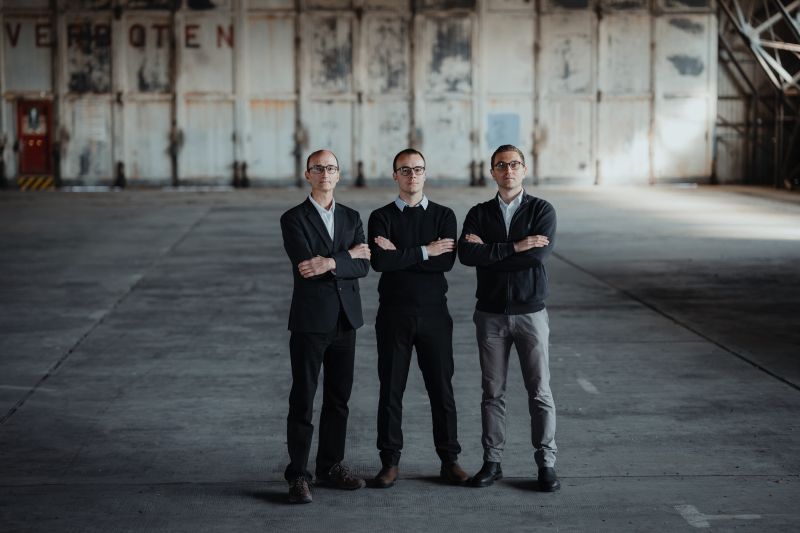
SE3 spun out of the computer vision lab of Professor Daniel Cremers at the Technical University of Munich (TUM). Lukas Köstler is CEO and co-founder, and Simon Klenk is CTO. Both worked on PhDs in computer vision and robotics in that lab. Cremers is chief science officer, holds TUM’s chair for computer vision and AI, and won the Gottfried Wilhelm Leibniz Prize, Germany’s most prestigious research award.
SE3 announced the $30 million Series A on November 12. Accel led the round, with Keen, Lakestar and Seedcamp participating. Accel partner Matt Robinson said a team with talent from one of Europe’s leading research departments is well placed to build spatial AI for autonomous systems, a problem defence primes have found difficult.
The company will use the funds to grow its engineering, commercial and operations teams and fulfil further contracts. It plans to strengthen its presence in Germany and Ukraine, open a UK office and expand across Europe. Defence remains the focus, with robotics, emergency response and other civilian uses to be explored from 2027.
Capital Keeps Flowing to European Defence Startups
European defence startups have been raising large rounds. Helsing, Europe’s largest defence AI company, raised $1.8 billion in a Series E at an $18 billion valuation. Germany’s Stark, a drone maker, raised a €500 million Series C at a €3.5 billion valuation and won German military contracts worth hundreds of millions of euros within two years of its founding.
TEKEVER, a European maker of autonomous unmanned aircraft, raised a $580 million Series D at a $6.4 billion valuation. France’s Harmattan AI became a unicorn less than two years after its founding with a $200 million Series B. UK counter-drone startup Cambridge Aerospace won a UK Ministry of Defence contract for its low-cost drone interceptor and raised a $300 million Series C at a $3.4 billion valuation.
Many of these companies build the airframes or interceptors themselves, while SE3 builds no vehicles and offers software that runs on systems from several manufacturers. In GPS-denied drone navigation, US-based Theseus, a Y Combinator company, is working on similar ground. In the US, Shield AI raised $2 billion at a $12.7 billion valuation and Anduril raised a $5 billion Series H at a $61 billion valuation.
For more on competitors, see here.
MORE FROM THE POST
- Foundry Robotics Raises $100M Series A to Run Autonomous Assembly Factories
- European Defence Acquisition Platform Onodrim Raises $300M Series A at $1.3B Valuation
- Hardware Engineering Platform Nominal Raises $240M Series C at $3B Valuation
- Watney Raises $80M Series A to Put Robots to Work Inside AI Data Centers
- ASI Raises $325M Series C to Orchestrate America’s Critical Infrastructure With AI
Share

Most Read
- 1
- 2
- 3
- 4
- 5

Leave a Reply