


Google Ties Marvell TPU Chip Deal to a $12.2B Equity Warrant


Big tech companies that design their own AI chips still need a design partner. They own the architecture, but physical implementation, verification and the run-up to volume production go to a silicon design house. For the past decade, Google’s TPU program leaned on Broadcom for that role.
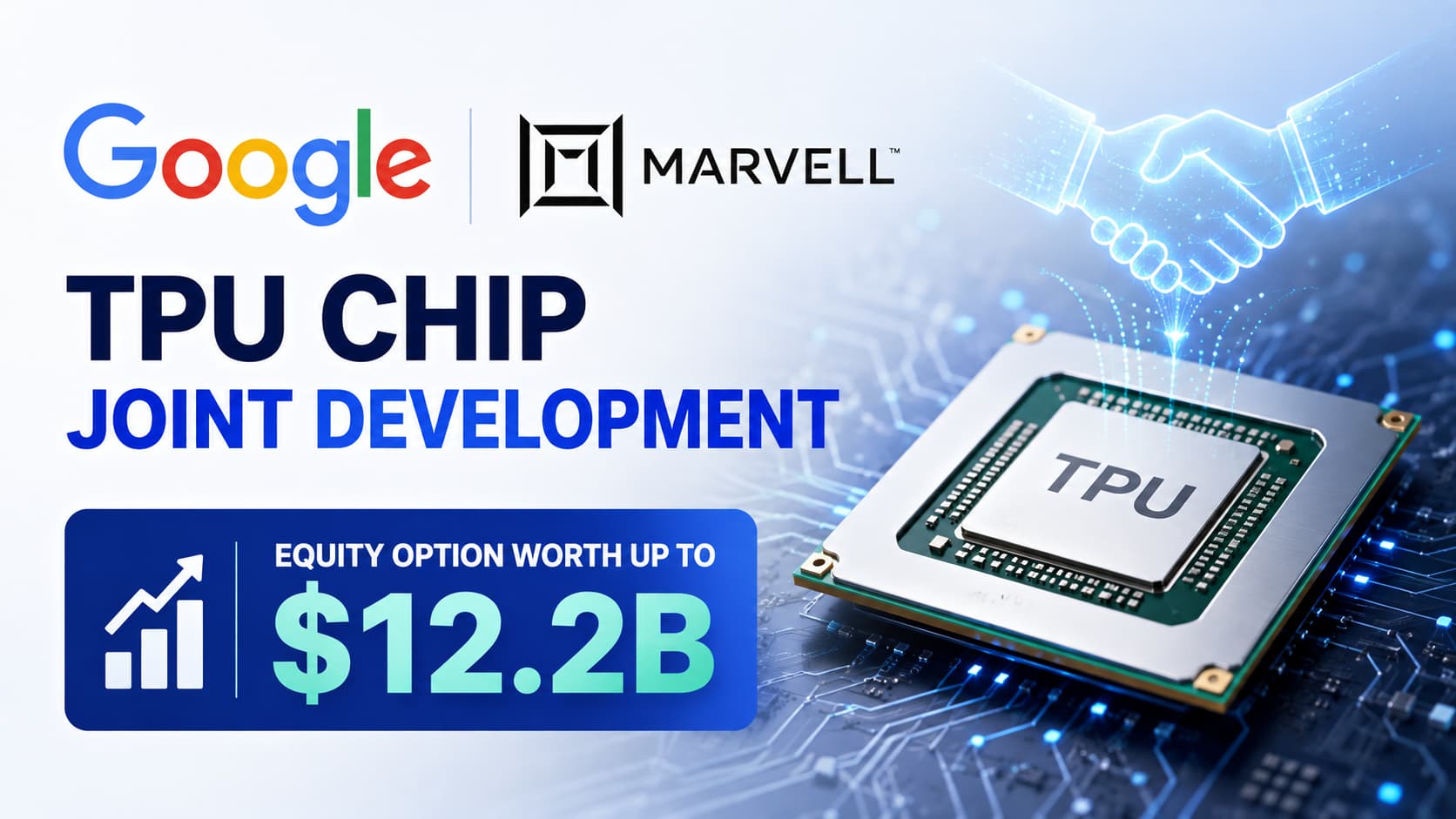
Now Marvell has moved into it. Google agreed to co-develop custom silicon that attaches to the TPU ecosystem — and took its consideration not in cash, but in the right to buy Marvell stock.
The more chips it buys, the more equity it earns
The structure is unusual. Google received warrants for 58,970,907 Marvell shares at an exercise price of $206.58, worth $12.2 billion if fully exercised. The agreement runs through Marvell’s fiscal 2033.
The key is that the rights do not arrive at once. Roughly 1.4 million shares vest in the first year, and the rest unlock in tranches tied to how much silicon Google actually buys — each $500 million in purchases opens the next slice. Hitting every target implies roughly $120 billion in custom-chip sales across the life of the agreement.
Fully exercised, the warrants would make Google Marvell’s fifth-largest shareholder. This is not a conventional strategic investment where cash buys a stake; it is a structure where placing orders earns the right to buy one. Google secures supply, and Marvell gets both revenue and an anchor shareholder.
Not a replacement for Broadcom
The scope covers custom silicon across the TPU ecosystem: AI inference accelerators, storage controllers, network interface controllers, memory interface controllers and near-memory compute. Not the TPU itself so much as the chips that move and store data around it.
The market read it as supply diversification. Marvell rose as much as 14% intraday and closed up around 8%, while Broadcom fell about 5%. But this adds a second supplier rather than displacing the incumbent. Google split its eighth-generation TPU into a training part and an inference part earlier this year, and its Anthropic arrangement covers 3.5 gigawatts of TPU capacity with Broadcom involved. At that volume, one design partner is not enough.
Marvell’s second heavyweight backer
Google is not the first major partner to attach itself to Marvell. In April, Nvidia invested $2 billion in the company and opened up NVLink, a move aimed at cementing its AI factory standard.
So Nvidia and Google now sit alongside each other in the same supplier. The two compete head-on in AI silicon — Nvidia sells general-purpose GPUs, Google builds TPUs precisely to reduce dependence on them. Marvell ends up positioned to take volume from both.
The next phase of in-house silicon
In-house chip programs accelerated this year. OpenAI completed its first inference chip with Broadcom in nine months, and Anthropic has been discussing its first in-house AI chip with Samsung Electronics to reduce Nvidia dependence. In Korea, FuriosaAI is developing its third-generation AI chip with Broadcom.
For the design houses, the customer list keeps growing. Broadcom now serves Google, OpenAI and FuriosaAI at once; Marvell has landed Nvidia and Google. The more companies decide to build their own chips, the clearer it becomes that the reliable money sits with the firms doing the designing.
MatX, founded by engineers who designed Google’s TPUs, raising $500 million for an LLM-specific chip belongs to the same pattern.
MORE FROM THE POST
- Stripe in Talks to Buy AI Model Router OpenRouter for Over $7B
- Etched Raises $700M at $21B Valuation After Jane Street Tested Its Chip
- Multi-Silicon Inference Cloud Gimlet Labs Raises $300M Series B
- AI Inference Optimizer Wafer Raises $40 Million Series A
- NVIDIA Ships Groq 3 LPX, Built on the $20B License It Bought From Its Own Challenger
Share

Most Read
- 1
- 2
- 3
- 4
- 5

Leave a Reply