




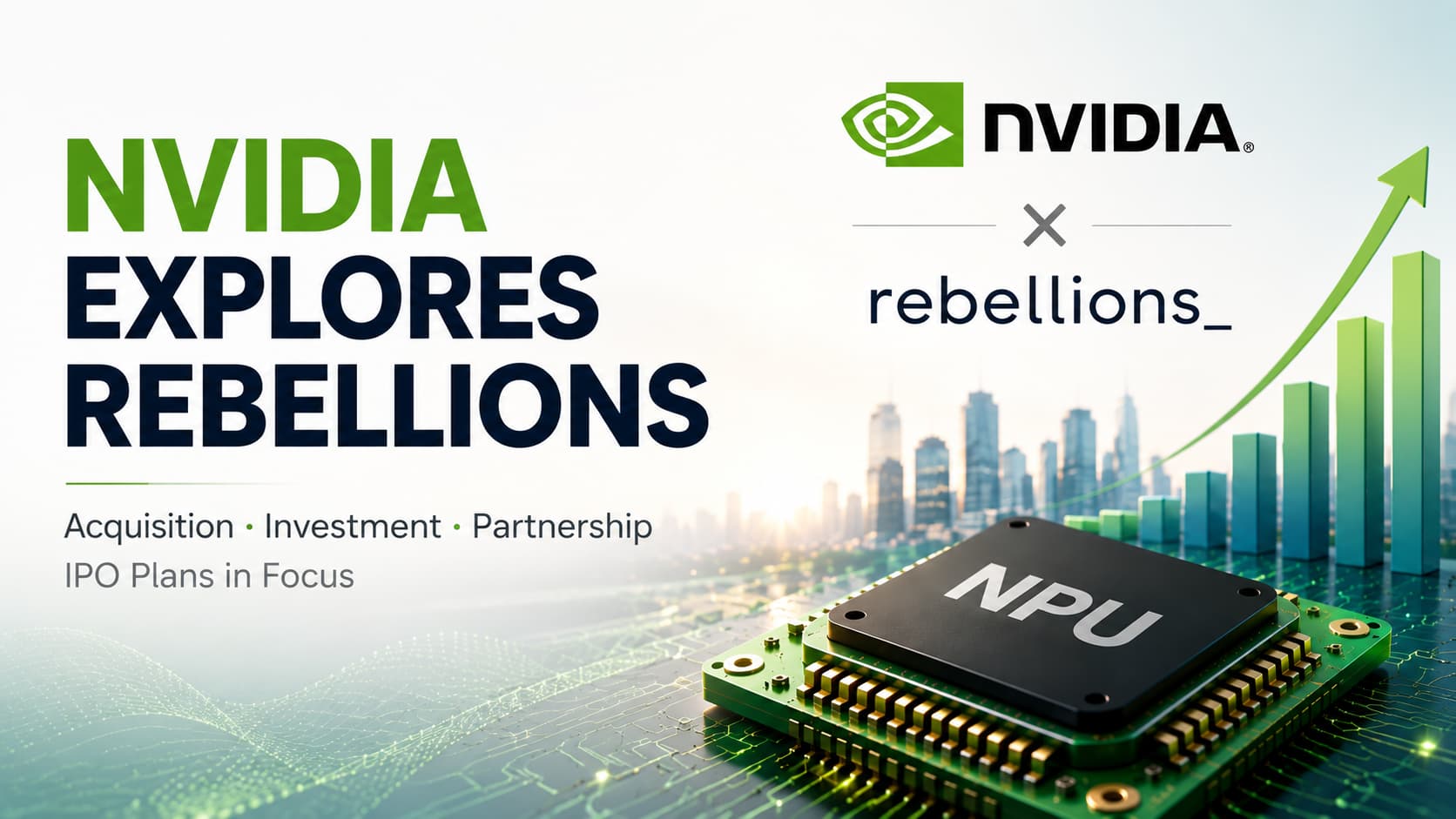
Nvidia has approached Rebellions, the South Korean AI chip designer, to discuss ways of working together. Bloomberg reported on Aug. 21 that the two sides have weighed three options — a technical partnership, an equity investment, or an outright acquisition — while cautioning that the talks are at an early stage and may not lead to a transaction.
Nvidia CEO Jensen Huang met Rebellions co-founder and CEO Sunghyun Park at the company’s Santa Clara headquarters this week, according to the report. Both companies declined to comment.
Founded in 2020, Rebellions designs neural processing units for data centers running AI inference — the work of executing trained models against live traffic, and precisely the segment where Nvidia has been buying up talent and technology. The company has raised roughly $850 million to date, with SK Hynix, Samsung Ventures and Arm among its backers.
The timing is delicate. In March, Rebellions raised $424 million as the first company backed by Korea’s National Growth Fund, at a valuation of 3.4 trillion won, and it is expected to file for preliminary listing review with the Korea Exchange this month. A foreign buyer is, in effect, circling a company the Korean government funded and groomed for a domestic listing.
Precedent suggests an acquisition is not the only possible ending. Late last year Nvidia signed a $20 billion nonexclusive technology licence with the AI inference chip firm Groq and absorbed much of its engineering team, but did not buy the company. Groq kept its cloud business, continued to operate independently, and has since raised $650 million to reposition itself as an inference cloud. A similar structure would not collide head-on with Rebellions’ listing plans.
The government variable
This is not the first time a Korean AI chip designer has drawn a bid from a US tech giant. Meta’s talks to buy Furiosa AI surfaced in February last year, and the roughly $800 million offer was turned down the following month. The reported sticking points were commercial — disagreement over business direction and how the team would be organized after a deal — and founder June Paik concluded the company would grow further on its own chip than on outside capital.
Furiosa AI then scaled on domestic capital instead. That July it raised $123 million in a Series C bridge backed by the Korea Development Bank and the Industrial Bank of Korea, passing a $770 million valuation, and this July the Export-Import Bank of Korea put in 20 billion won as its first direct venture investment.
A legal mechanism does exist. Under Korea’s Industrial Technology Protection Act, a company holding a designated national core technology needs prior approval from the trade minister before a foreign acquisition or investment if the technology was developed with government R&D money; without such funding, it need only file a notification.
The catch is that the mechanism does not obviously bite here. The semiconductor entries on the current national core technology list cover sub-30nm DRAM, 3D NAND, foundry process technology, mobile application processor SoC design, image sensors and display driver ICs. AI chips and NPU design are not listed separately. There is no automatic brake.
The real variable sits with the money rather than the statute. With Furiosa AI the government was a supporter from outside. In Rebellions it is already inside, having put 300 billion won through the National Growth Fund, with the “K-Nvidia No. 1” label attached. Any structure would have to account for that stake and that policy framing. Bloomberg also flagged US antitrust review alongside the position of a Korean government that treats semiconductors as a strategic asset.
Rebellions has been widening its domestic base. In June it acquired the AI optimization firm SqueezeBits and repositioned itself as a full-stack infrastructure company. This month Korea’s science ministry designated its server NPU an innovation product, opening a public procurement track for domestically designed chips. In April it began working with Arm and SK Telecom on inference infrastructure aimed at the sovereign AI market.
MORE FROM THE POST
- Rebellions and SAPEON Merge to Form Rebellions, Pioneering Global AI Growth
- Rebellions and SKT Join Forces to Lead the Global AI Semiconductor Market
- Rebellions Acquires AI Inference Specialist SqueezeBits to Become Full-Stack AI Infrastructure Company
- Nvidia’s $7B Poolside Courtship: License, Hire, Invest — Not Acquire
- Naver and Dunamu Merge to Build AI-Powered Web3 Platform with $6.8 Billion Investment
Share

Most Read
- 1
- 2
- 3
- 4
- 5

Leave a Reply