





Robotics founders and investors broadly agree on one thing: the “ChatGPT moment,” when a general-purpose robot can adapt seamlessly to any environment, hasn’t arrived yet. But companies are betting on that future in very different ways. Tesla and Figure AI are building the body and the “brain” — the AI model — entirely in-house, which means you can’t actually buy their robot today, let alone build something on top of it. Feather Robotics calls itself the “Android of robotics” and is making the opposite bet. The analogy isn’t about the brain — it’s about the hardware being the open standard that anyone can build on, the way Android phones aren’t locked to one maker. In Feather’s version, the body is the standardized layer, and the AI models running on it are the equivalent of apps. Leave the brain open for developers to bring their own AI, and just build the best body money can buy. That bet just attracted fresh funding.
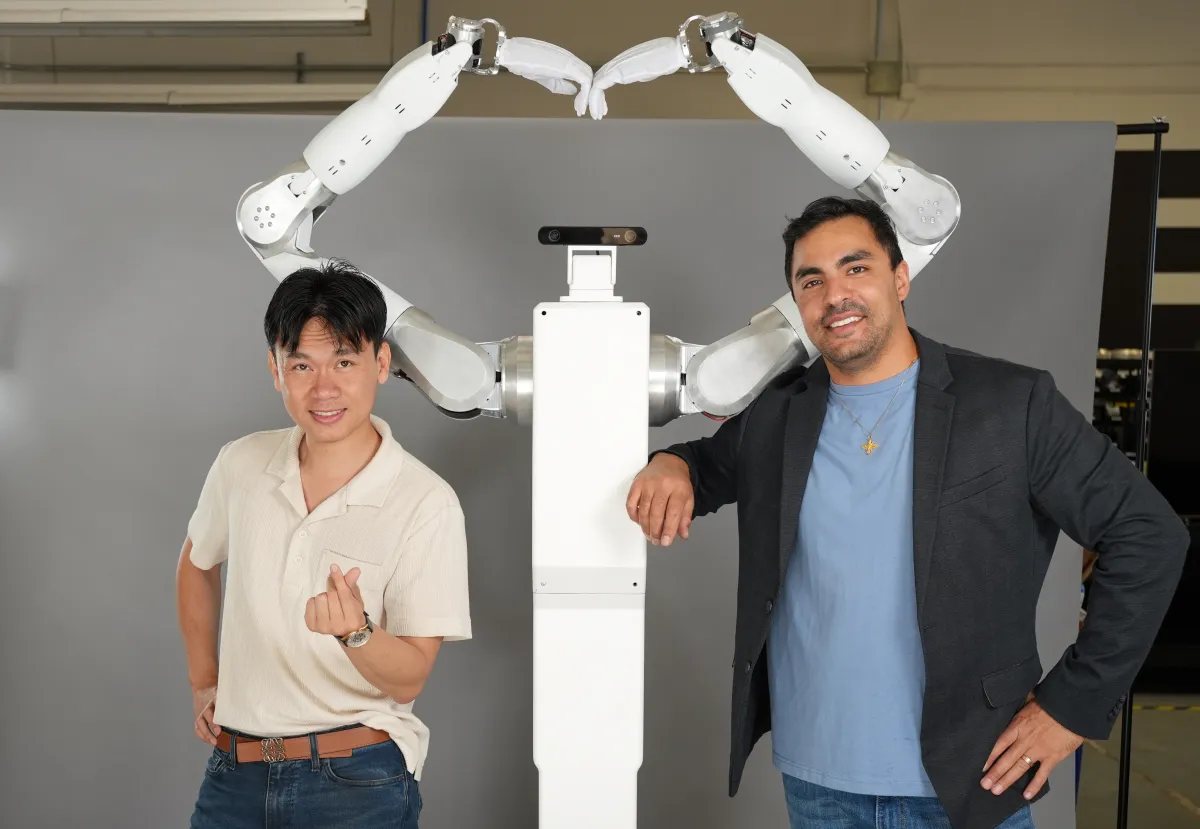
Based in East Palo Alto, California, Feather sells a modular humanoid platform paired with an SDK. Its bimanual robot rides on a wheeled, holonomic base for stability and energy efficiency, runs 10 hours on a charge, and has a 1-meter reach — about 50% longer than the average human arm. It ships today for $29,990, orderable online. “You can’t buy a Tesla robot today and develop on top of it,” CEO Hoa Mai said, pointing to hardware players like Nvidia and Apple, which got their start by shipping something that simply worked and could be deployed, then layered on complexity over time.
That philosophy shows up in how fast Feather moved: a first prototype in two months, a first shipped order in nine — versus 31 months for Figure, which is building both body and brain at once. The trick, the company says, is keeping the system as simple as possible, which cuts down on compounding errors and points of failure.
Mai previously worked at robotics startup Kind Humanoid, which 1X acquired in January 2025. He then teamed up with Parsa Bakhtiari, who led robotics projects at Tesla during the Model 3 production ramp-up while reporting directly to Elon Musk, to found Feather last year.
Feather has raised $7.6 million in pre-seed funding structured as a SAFE. Gradient Ventures, Google’s AI-focused venture fund, led the round, with participation from Builder Capital, Geometry, Virgo VC, and London-listed SEED Innovations. SEED’s earlier $1 million investment, announced in May, converts into equity as part of this round at a $60 million valuation cap. Gradient general partner Darian Shirazi called Feather effectively the only U.S. startup building a modular humanoid platform, and argued the addressable market is large once you factor in what it actually costs to hire, train, and support a $50,000-to-$60,000-a-year laborer.
The traction is already showing up in the numbers: Feather has surpassed $1 million in revenue, with robots deployed at manufacturing and food-service customers, including one manufacturer generating $4 billion a year in revenue.
Feather’s market mixes very different playbooks. Tesla and Figure are building both body and brain in-house, while Chinese rivals are racing on price: Unitree‘s H2 Edu runs about $68,000 and AgiBot‘s G2 about $135,000, while U.S.-based Dexmate‘s wheeled, dual-arm Vega costs $89,999. Feather’s $29,990 undercuts all of them by half to two-thirds. What it doesn’t do is build its own AI model — developers can bring Physical Intelligence, Skild AI, Nvidia, or whatever else they prefer.
MORE FROM THE POST
- SYNCERE Raises $11M Pre-Seed for LUME, a Floor Lamp That Folds Your Laundry
- Fully Autonomous Surgical Robot Maker Aleph Surgical Raises $7.5M Pre-Seed
- Welding AI Maker Path Robotics Raises $300M Series E With NAVER Ventures
- Robot-by-the-Hour Startup Tutor Intelligence Raises $75M Series B
- Foundry Robotics Raises $100M Series A to Run Autonomous Assembly Factories
- Builder Capital
- Feather Robotics
- funding
- Geometry
- Gradient Ventures
- Overseas funding
- physical ai
- pre-seed
- robotics
- SEED Innovations
- Virgo VC
Share

Most Read
- 1
- 2
- 3
- 4
- 5

Leave a Reply