





Skilled welders are hard to find, and shipyards and heavy-equipment plants are sitting on full order books. Traditional industrial robots do not help much here. They follow pre-programmed paths, which makes them a poor fit for welds that differ slightly from one part to the next. Path Robotics, a Columbus, Ohio-based startup, is betting that a robot that can see and decide for itself can fill that gap. On Nov. 10, the company announced a $300 million Series E at a $2.45 billion post-money valuation.
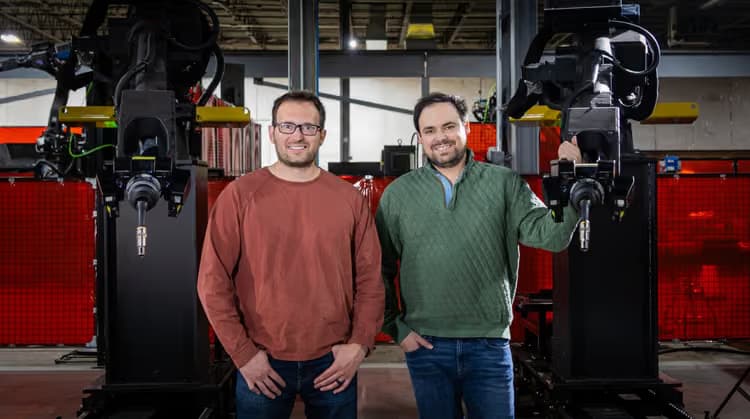
Georgian, an AI-focused growth equity firm, led the round. NAVER Ventures and D. E. Shaw Ventures joined as new investors, and existing backers Addition, Drive Capital, IronArc Ventures, Tiger Global, and Yamaha Motor Ventures also took part. Georgian partner Emily Walsh will join Path’s board.
Giving the robot eyes and judgment
A conventional welding robot has to be taught its path step by step, and a part that sits slightly out of place can ruin the weld. Path’s physical AI welding model, Obsidian, takes that teaching out of the loop. The robot finds the weld joint on its own, plans the sequence and path, welds, and adjusts when conditions change mid-job. The model learns from real-world welding data. For a factory, that means variable welds without reprogramming the robot each time.
The company recently added Rove, a mobile welding system that puts Obsidian on a quadruped robot. Instead of bringing the part to a welding cell, the robot walks to the part. Path says it shows the same model can run on different robot bodies.
ARR up 17x in 18 months, led by shipbuilding and defense
Path says its annual recurring revenue grew 17-fold over the past 18 months, though it did not disclose a dollar figure. The growth has come from shipbuilding and defense, heavy equipment, and energy infrastructure. Customers include HII, the largest U.S. shipbuilder, Lockheed Martin, and the maritime defense company Saronic, along with mid-sized manufacturers such as EK Machine, Millerbernd Manufacturing, TransAmerican Power Products, and TYCROP. Earlier this year, Path announced a $600 million performance-based production agreement with HII to deploy physical AI across U.S. Navy shipbuilding programs. Headcount has grown 97% over the past year, and the company plans to reach 400 employees by year-end.
CEO and co-founder Andy Lonsberry said Path started with welding because it is one of the hardest jobs on the factory floor to automate. “Our goal isn’t to automate one step, but to automate the entire factory,” he said. Founded in 2018, Path has now raised more than $610 million. The new money will go toward scaling the welding business, expanding to tasks before and after welding and to new robot form factors, and training AI models.
Georgian pointed to Path’s proprietary models and its growing base of production data, which it said improves the system with every deployment. Lockheed Martin Ventures called the investment an important milestone for strengthening the U.S. defense industrial base.
Competition: welding specialists and general-purpose robot AI
A handful of newer companies are going after the same problem. Korea’s RB-Ware makes a no-code welding robot and has installed more than 250 units in 16 countries, and NeoArcRobotics is building cutting and welding robots for Korean shipyards. Augmentus raised $11 million to scale physical AI for robotic welding, and China’s LE Robotics raised tens of millions of yuan in a Series A+ round in February. None has raised anything close to Path’s total.
Others are chasing general-purpose robot intelligence rather than one task. Skild AI and Physical Intelligence are building foundation models meant to run on any robot, and defense manufacturer Hadrian raised $1.37 billion in a Series D in August to rebuild U.S. manufacturing capacity. Where those companies bet on a universal model or on the factory itself, Path is trying to perfect the hardest single process first and then extend to the steps around it.
MORE FROM THE POST
- 3D-Printing Construction Robotics Firm ICON Raises $200M Series D
- Physical AI Chipmaker SiMa.ai Raises $150M Series C at $1.45B Valuation
- Lyte Raises $165M Series C to Give Robots a Trustworthy View of the World
- Robot Brain Developer Generalist Raises Another $200M, Two Months After Its $400M Round
- SoftBank-Led Agile Robots Raises $500M Series F at $8.5B Valuation
- Addition
- D. E. Shaw Ventures
- Drive Capital
- funding
- Georgian
- IronArc Ventures
- mega funding
- Naver Ventures
- Overseas funding
- Path Robotics
- physical ai
- robotics
- seriesE
- Tiger Global
- unicorn
- Yamaha Motor Ventures
Share

Most Read
- 1
- 2
- 3
- 4
- 5

Leave a Reply