










European manufacturing once anchored the global industrial economy. Now it’s eroding on three fronts at once. Europe’s share of global manufacturing output has slipped to 15%, while China’s has climbed to 30%. Nearly 40% of EU workers are over 55, and the know-how that keeps factories running retires along with them. As of 2025, European plants were paying more than twice what their US rivals pay for electricity. The obvious fix — physical automation — shows the same gap: China installed 295,000 factory robots in 2024, 54% of the global total, while all of Europe installed just 85,000, or 16%.
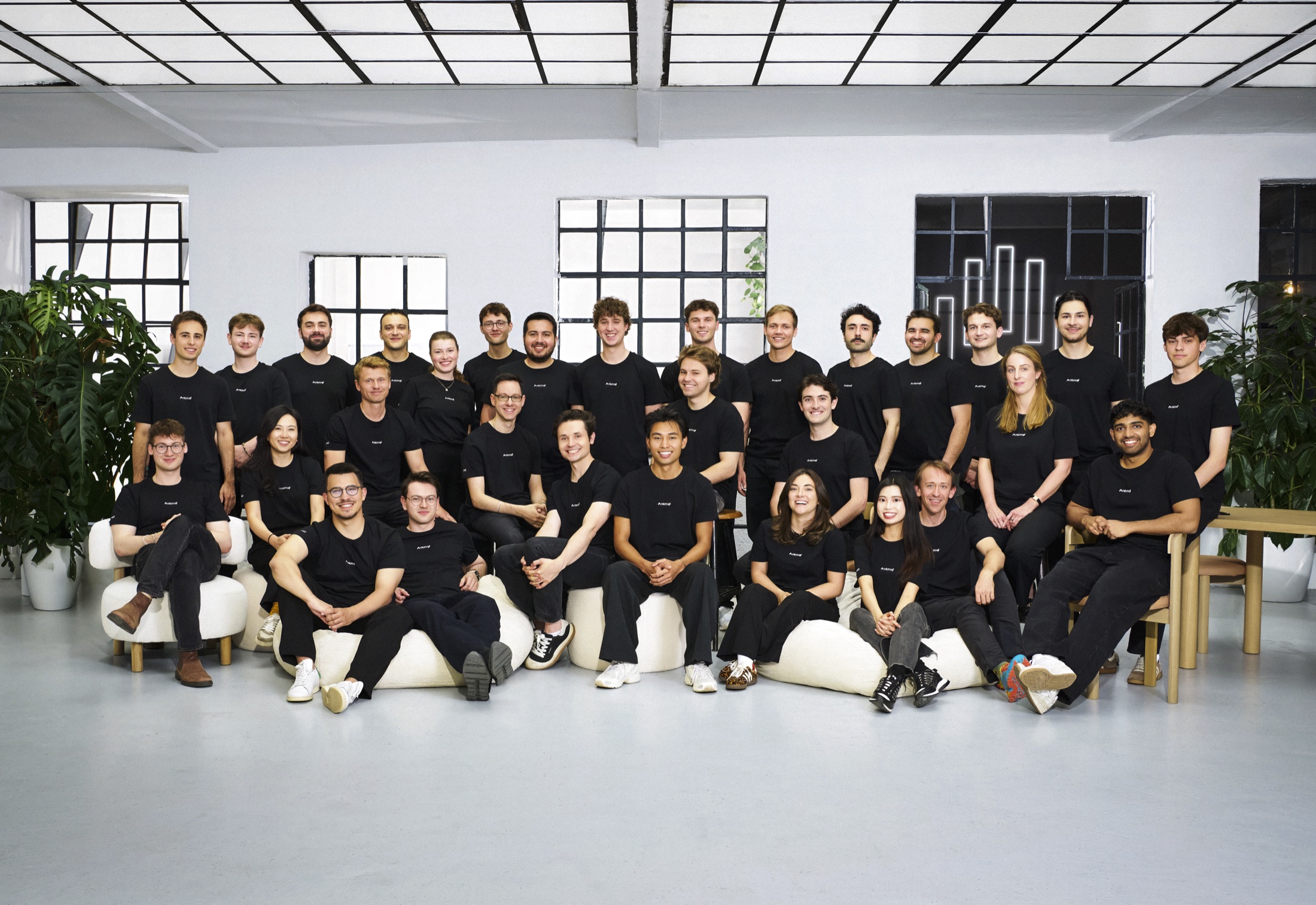
Munich-based microagi is betting it can close that gap without building a single robot itself. The company positions itself purely as a deployment layer: it doesn’t make robots or train foundation models. Its platform, Atlas, captures data inside live production using dedicated recording hardware, multiplies that data through simulation, and fine-tunes the best available model for plant-specific tasks. Forward-deployed engineers and partners including NVIDIA and Unitree then put the robots on the shop floor. “Our job starts after that, on the factory floor,” said CTO Nico Nussbaum. “We put our engineers on site with each customer, and the system learns from their real operations and feeds that back into the next run.”
Earlier this year, microagi also launched Shift, a consumer-facing arm that offers free services — apartment cleaning, private chefs — in exchange for letting workers wear recording gear while they do the job. Reports put Shift’s reach at more than 20,000 participants across 15 countries, feeding the data back into Atlas’s training loop.
CEO and founder Bercan Kilic was an aerodynamicist at Red Bull Racing before starting the company in 2025. Co-founder Yoan Iliev came from Mercedes-AMG Petronas, and co-founder Anton Poletaev is a former Alan Turing Institute researcher. “Industrial Europe has 12 to 18 months to build its robotic edge. We cannot afford to repeat Europe’s hesitation on AI,” Kilic said. The company has since opened a research hub in Zurich, recruiting heavily from ETH Zurich and the Technical University of Munich as well as DeepMind, Apple, and Replit.
microagi said in July that it had raised $55 million in seed funding, which it called the largest seed round in German startup history. Hummingbird Ventures led the round, with Northzone, LocalGlobe, Village Global, and redalpine participating — roughly ten months after the company was founded.
Growth since then has been striking, at least by the company’s own account. Kilic posted on X on October 9 that microagi went “from 0 to $100M ARR in just 6 months after launching Shift.” The claim deserves some caution: Humanoids Daily pointed out that while the company’s own graphic labels the figure “ARR,” its footnote describes it as an “annualized run rate” — an extrapolation from recent results, not $100 million actually earned over six months. microagi hasn’t disclosed the calculation method, how much of that figure is recurring, or the split between its data business and robot deployments. Reporting from TNW puts the reality check in context: only five companies are currently collecting data through the platform, and just one is close to putting robots on an actual production line. Rival Skild AI has made a similar “$100M ARR in record time” claim, but measured from its first commercial deployment rather than a product launch, which makes the two figures hard to compare directly.
Does microagi build its own “robot brain”? By its own account, no. CTO Nico Nussbaum has drawn a clear line: “Our partners build genuinely good robots and models” — the hardware and the foundation models are someone else’s job. Kilic hasn’t named which model makers microagi works with. Muddying that line, a July report on microagi’s Google Cloud and NVIDIA compute partnership described the company both as training “foundation models” on large-scale compute and as a layer sitting “on top of frontier models,” without reconciling the two framings; microagi hasn’t addressed the discrepancy. Companies that do build the actual “robot brains” are a different category — Generalist, a robot foundation model company founded by a DeepMind alum, and Physical Intelligence chief among them — and microagi is closer to a customer of that layer than a competitor to it.
The data-collection business that feeds Shift isn’t unique either. Scale AI, Turing, and Micro1 — which reportedly hit a $4 billion valuation last month — all run similar data-supply businesses for robotics and AI training. microagi’s pitch is that it doesn’t stop at data: by owning the on-site engineering layer as well, it’s trying to vertically integrate a part of the stack that most of its data-focused rivals leave to someone else.
MORE FROM THE POST
- Watney Raises $80M Series A to Put Robots to Work Inside AI Data Centers
- Embo Raises $110M Seed Led by a16z to Build a Robot Brain on World Models
- BrightAI Raises $97 Million to Put Physical AI on Pipes, Poles and Power Lines
- Genesis AI Raises $500M Series A to Build Human-Handed General-Purpose Robots
- Medical Robotics Startup MedInTech Raises USD 25.7M Series C to Expand AI Robotic Endoscopes Into Surgical Robots
Share

Most Read
- 1
- 2
- 3
- 4
- 5

Leave a Reply