










Double Zero is the Korean startup behind Shoty, an AI video production platform aimed first at film and drama sets.
The company is preparing to raise USD 1.14 million (1.5 billion won) in seed funding in Q1 2027.
South Korea’s drama output has nearly halved in three years, from 141 titles in 2022 to a little over 80 in 2025. K-content sells around the world, yet fewer productions are being made at home.
The culprit is cost. Since global OTT platforms entered the market, the average cost per episode has jumped from USD 230,000–300,000 (300–400 million won) to about USD 1.5 million (2 billion won), and top-star salaries have become the market’s standard unit price. According to the Korea Creative Content Agency’s 2025 survey of outsourced-production transactions, performers’ fees are the largest line item, at 32.5% of production costs for broadcasters and 32.7% for production companies. Meanwhile, the broadcast advertising market has shrunk from the USD 3 billion (4 trillion won) range in 2022 to about USD 2.1 billion (2.8 trillion won) in 2025. Global OTT platforms cover the full production budget but cut the producer’s margin to 3–10% and take the IP, so even a hit leaves little for the production company.
The most expensive resource has become the actor’s time. When an actor paid hundreds of millions of won per episode stands on set for a day, dozens of crew members and a full set of equipment are tied up with them. A commercial feature film typically shoots over 50 to 80 days, and a single shooting day can cost tens of millions of won. When the budget runs short, it is the picture that gets cut. Scenes that are too dangerous to shoot, or that clash with an actor’s schedule, are deleted from the script, and the knock-on effect is less work for camera, lighting and art teams.
Double Zero’s AI video production platform Shoty targets this problem head-on. It covers AI video production broadly, including advertising, music videos and short-form content, but it is proving its quality first on film and drama sets, where the demands for detail are highest. Unlike conventional face-swap tools that change only the face, Shoty replaces the body shape, silhouette and movement with those of the lead actor, so scenes that were abandoned as too risky can be shot with a stand-in and restored in post-production. The platform has been used in the post-production of a feature film, passed theatrical-release 4K quality, and cut post-production time by more than 70%. In a comparison against commercial video AI services under identical conditions, it ranked first in six of eight categories.

Double Zero began with ‘No.1 Casting’, a casting platform for background actors. CEO Icheol Park had closed a restaurant business and taken a background-acting part-time job almost by chance. On set he found a casting market run by hand, without a single electronic contract, and he started building the next day. No.1 Casting is already profitable, and the deep understanding of film sets that Park gained along the way became the starting point for Shoty. Double Zero now concentrates its resources on Shoty, and its interviews and investor relations (IR) are built around Shoty rather than casting.

Double Zero is supported by the Pangyo Hub Value-up Package program, run by the Gyeonggi Content Agency’s Pangyo Gyeonggi Culture Creation Hub. The program helps startups explain their services and growth potential in the language investors use.
What problem is Double Zero trying to solve?
The problem we see is not one company’s inconvenience. It is that Korea is losing the capacity to make content. The number of domestic dramas fell from 141 in 2022 to 123 in 2023, to a little over 100 in 2024, and to a little over 80 in 2025, nearly halving in three years. K-content works around the world, but fewer titles are being made at home.
The cause is production cost, and we break it down into four stages. First, unit costs have risen. Since global OTT platforms arrived, the average cost per episode has jumped from USD 230,000–300,000 (300–400 million won) to about USD 1.5 million (2 billion won), and top stars’ fees have become the market’s standard price. Second, costs are not being recovered. The broadcast advertising market has fallen from the USD 3 billion (4 trillion won) range in 2022 to about USD 2.1 billion (2.8 trillion won) in 2025, and terrestrial broadcasters have been in the red for three years running.
Third, even a hit leaves little for the producer. Global OTT platforms pay 100% of the production cost, but they set the margin at 3–10% and take the IP. Fourth, as a result, the most expensive resource has become the actor’s time. When an actor paid hundreds of millions of won per episode stands on set for a day, dozens of crew members and a full set of equipment are tied up for that same day.
So what gets cut when the budget runs short? The picture. Scenes that are too dangerous to shoot, scenes the actor’s schedule can’t accommodate, and scenes that don’t fit the season or location are deleted from the script.
The result shows up in people. When one production collapses, the camera, lighting and art teams lose their work all at once. We didn’t learn about this contraction from the news. We watched it every day in the changing number of assignments on our casting platform.
How did you get from a casting platform to Shoty?
It started with my own experience. After finishing my military service, I ran a restaurant with a friend for about a year, got a little bored, and went looking for a part-time job. I saw a posting for background acting, thought it looked fun, and went to a set. When I got there, contracts were being handled on paper and by hand rather than electronically, and almost nothing was digitized. I interviewed the on-site manager and started building the casting platform the very next day.

Today, eight production companies use Casting for dramas alone, six of them major producers. It is already at a profitable stage of operation, but we see Casting less as a business for squeezing out maximum revenue and more as a foundation for understanding, and expanding into, the film-set ecosystem.
Running Casting meant I kept visiting sets, and I met a lot of cinematographers and editors. They all said the same thing: even when they wanted to make blockbuster-scale content, they ran into limits on the cost and manpower needed for CG and post-production. I judged that AI might be able to take that over, so I started building Shoty, and now the company’s resources are concentrated on it. Without Casting, we would never have run into this problem in the first place.
How exactly does Shoty solve the problem?
We solve for scenes that are hard for actors to shoot. A scene that is too dangerous for the lead, or one that gets pushed back wholesale because of an actor’s schedule, can be shot with a stand-in and then swapped for the lead in post. But that swap has been so expensive and time-consuming that productions ended up giving up the scene or forcing the actor’s schedule to fit.
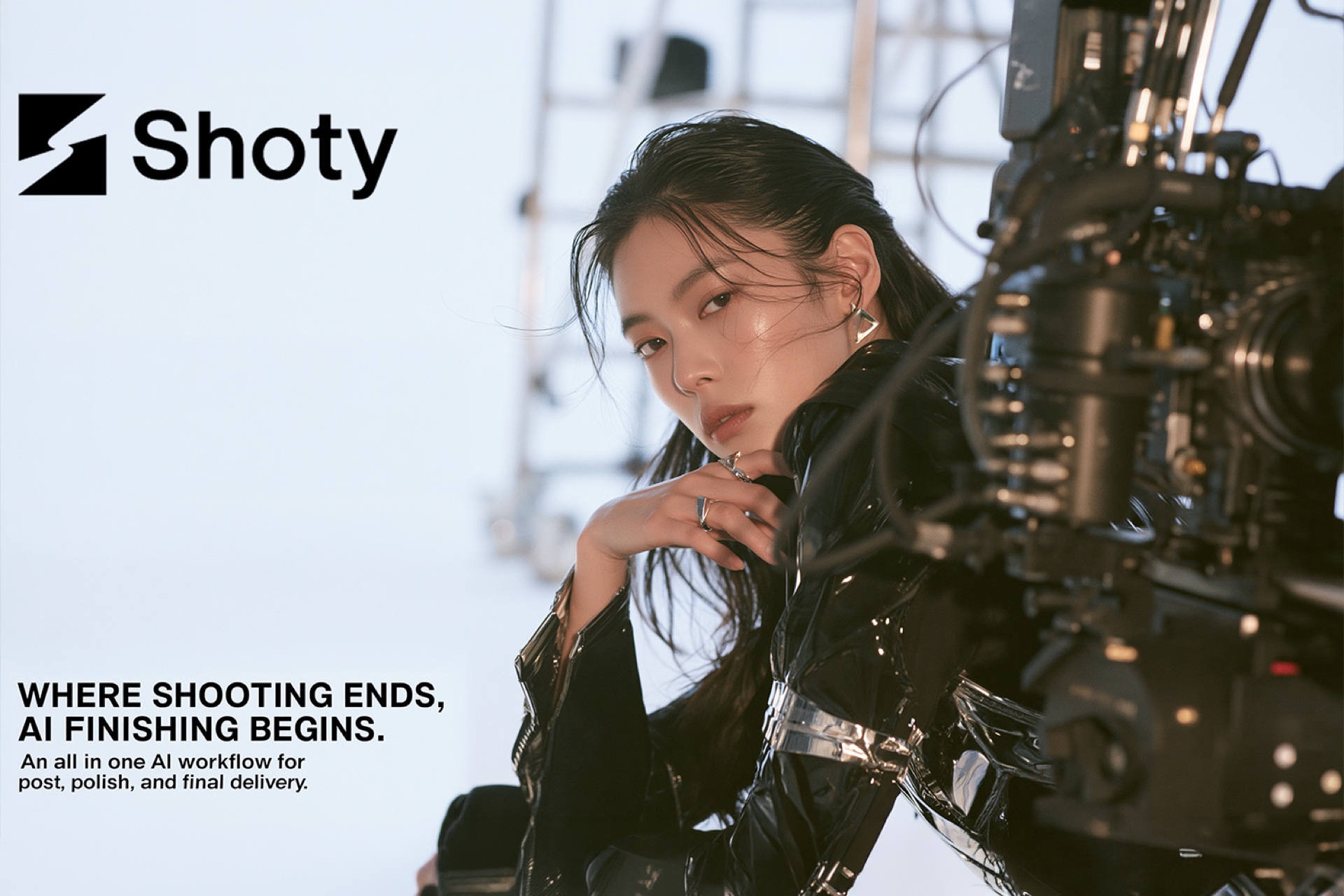
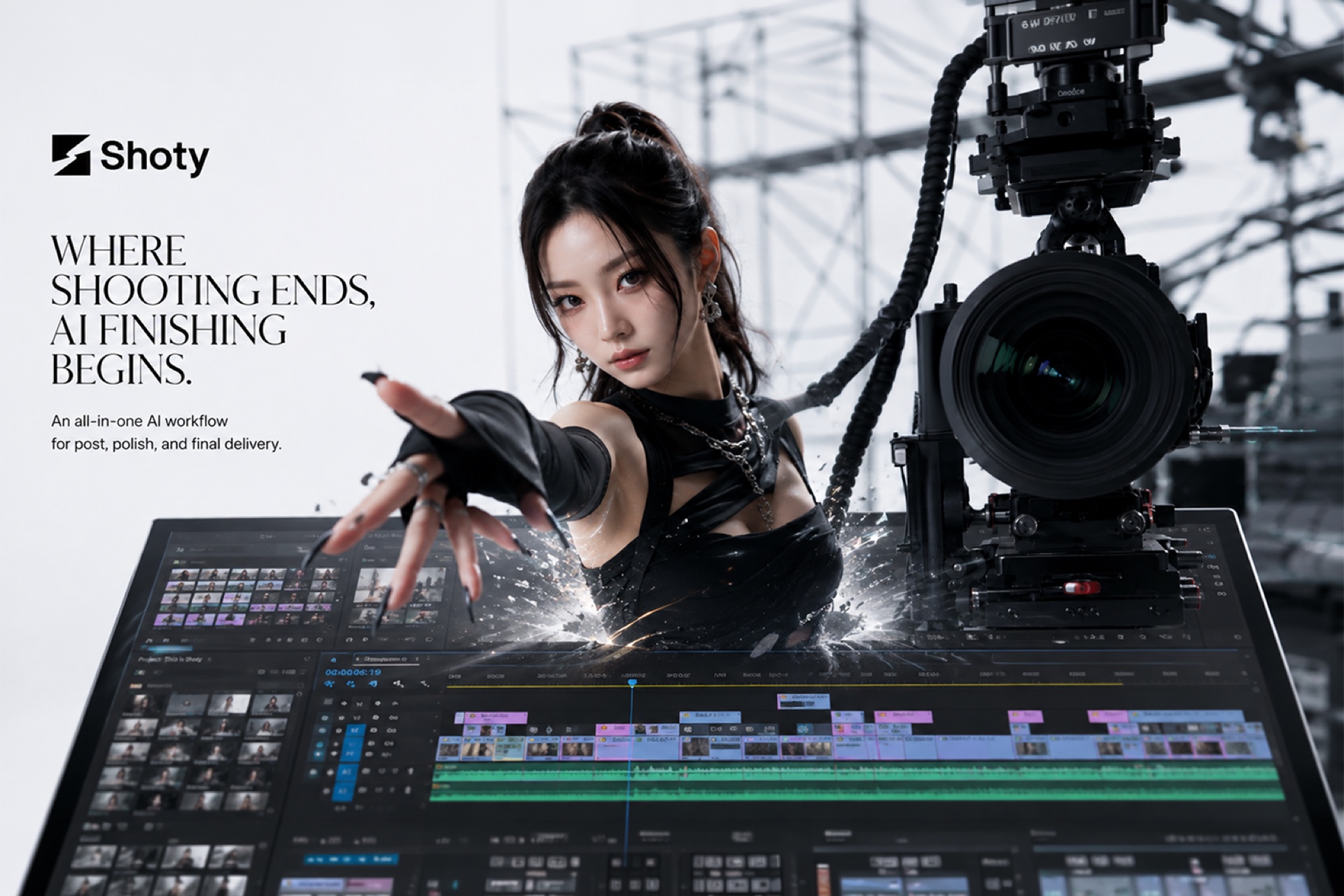
Unlike existing face-swap tools that only replace the face, we change the body shape, silhouette and movement to the lead actor’s. If you change only the face, the shoulder line and build don’t match, and the result is unusable on set. On top of that, unwanted object removal, background replacement, weather and time-of-day changes, and 4K upscaling are all handled in one pass inside the editor.
The benefit goes well beyond saving a few percent of post-production cost. Cut one shooting day and you save the actor’s day and the days of dozens of crew members at the same time. Our product was used in the post-production of a feature film and verified at theatrical-release 4K quality, and it cut post-production time by more than 70%.
What are your competitive and technical advantages over rivals?
First, we don’t just swap faces. Face-swap tools on the market replace only the face region, so the stand-in’s shoulder line, build and gait remain. They can fool you in a close-up, but they can’t be used for a full shot. We built our product to change body shape, silhouette and movement together, because that is what produces results you can actually use on set.
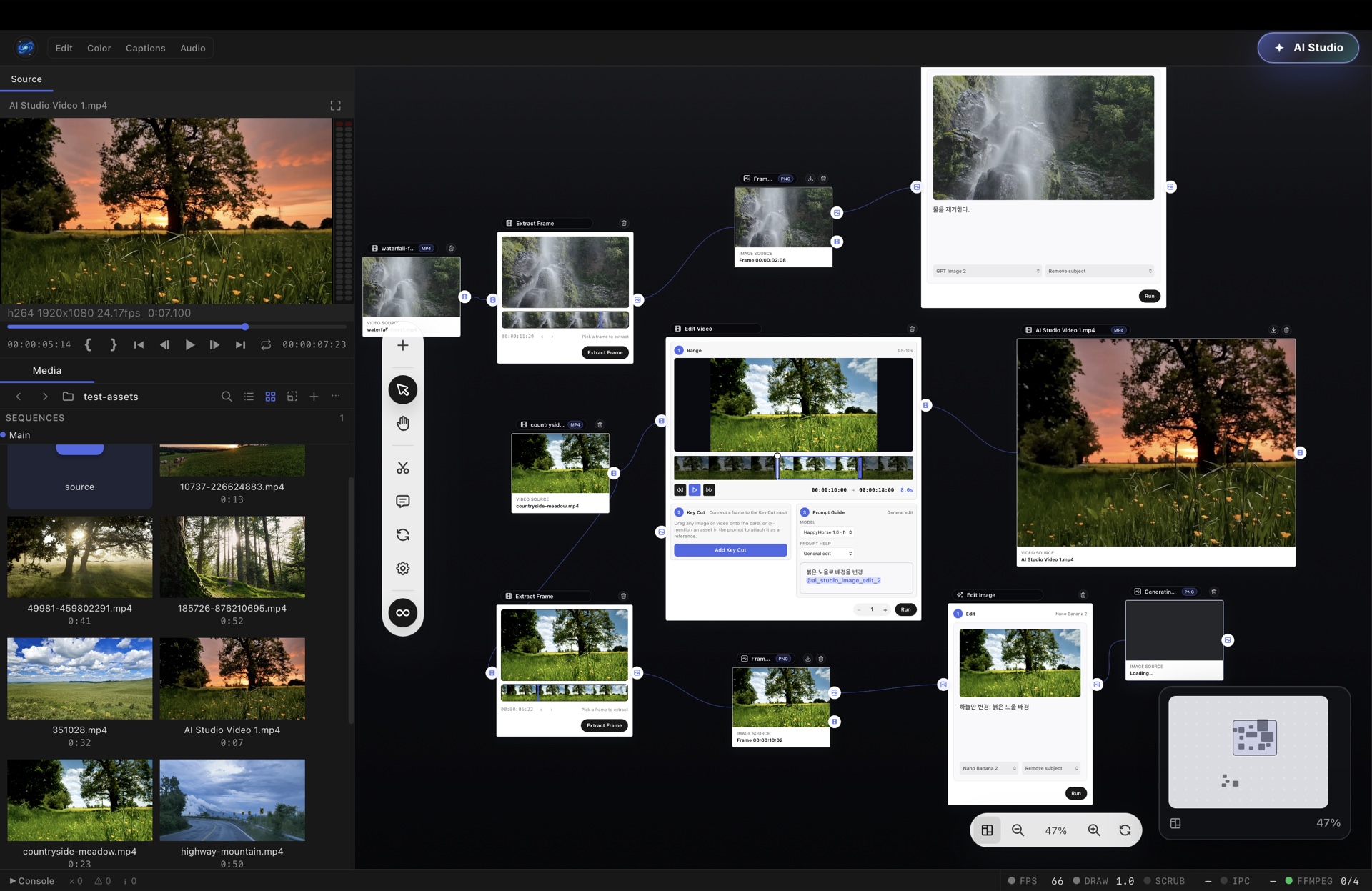
Second, editing and AI live on one screen. Today, people edit in an editing program, generate in an AI tool and composite in yet another app, shuttling files back and forth. Shoty puts AI processing, and an AI assistant director that understands the project, on top of an editor that includes a timeline, color grading, audio and export.
Third, we respect on-set standards. The product was used in the post-production of a feature film, passed theatrical-release 4K quality, and plugs directly into existing mastering pipelines. In measured comparisons against commercial video AI services under identical conditions, we ranked first in six of eight categories, and we include the two where we trailed in our materials as well.
There are overseas services with strengths in video generation, but we believe most are tools focused on general-purpose video generation and are not specialized for production sites. We differ in that we positioned ourselves as a production-specialized tool from the start.
Fourth, we are a company that came out of the field. The set data and the network of directors and producers we have built over several years of running a casting platform can’t be copied the way a feature can. When we decide what to build, we ask the set, not the boardroom.
What products do you offer today, and what is their status?
We have two products. The one we are concentrating on now is Shoty, the AI video platform. In a single timeline it handles swapping footage shot with a stand-in for the lead actor, removing unwanted objects, replacing backgrounds and weather, and 4K upscaling. It was used in the post-production of a feature film and has been verified at theatrical 4K quality.
The foundation is the casting platform No.1 Casting, which consists of an app for performers, an app for managers, an admin web console and a settlement system, and has been in commercial operation since 2024. It supports recruitment and interview management, QR-code clock-in and clock-out, electronic contracts, automatic generation of shooting logs and inspection forms, and performer-fee settlement and tax-reporting data. Both the performer and manager apps are officially available on the App Store and Google Play.
In one line: Casting runs stably and profitably and supplies our on-set network, while Shoty is going into real commercial productions and has just entered the commercialization stage. It is the service we are putting the most weight behind.
Who is your target market and core customer?
Our core customer is the production company, not the talent agency. We confirmed this after meeting more than 100 major agencies, post-production studios and production companies: agencies don’t choose post-production vendors directly. The contract is the director’s and the production company’s call. So our primary customers are film and drama production companies and post-production studios, followed by teams making advertising, music videos and short-form content.
Shoty covers AI video in general, including ads, music videos and short-form content. We go after film and drama first because it is the most demanding market, where even 1–2% of the frame’s detail has to pass, so once we are validated there, it is easy to expand to other video. It is also a large market with a wide range of genres, and above all it is where shoots get blocked most often by actor schedules and dangerous scenes.
The unit our customers feel is the shooting day. A commercial feature shoots over 50 to 80 days, and each day costs tens of millions of won. If we cut one day, or let a production shoot with a stand-in instead of the lead and solve it in post, the math works out on the spot. We are targeting 120 domestic production companies initially, and the background-acting market that Casting belongs to is worth about USD 38 million (50 billion won) a year.
But the market we really care about is the one that doesn’t show up in today’s statistics. If scenes abandoned as too dangerous, and projects shelved because of schedule conflicts, come back to life, the market itself grows. We see ourselves not as dividing up existing production budgets but as reviving demand that had disappeared.
What is your business model?
Both products are centered on B2B and use a mix of subscription and usage-based pricing. For Casting, the basics are a per-match fee and a monthly subscription for casting-management agencies. It is already profitable, but we run it as a base for expanding the film-set ecosystem rather than to maximize revenue. Casting agencies use it in real operations today, and the platform has processed more than USD 8.4 million (11 billion won) in cumulative performer-fee settlements.
What we are putting our weight behind now is Shoty. It combines team subscriptions at the production-company and agency level with project-based billing for heavy workloads such as high-resolution rendering and bulk version generation. We also offer a subscription plan for individual creators. We began converting to paid plans in July 2026 and are only now starting to build revenue. In the two months of July and August, new revenue came to USD 50,000.
What have you achieved so far?
The casting platform has 13,263 registered members, 82,737 cumulative performer assignments and a 95% role-fill rate. Eight production companies use our platform for dramas alone, six of them major producers. These metrics are published in real time at No.1 Casting.com, and cumulative performer fees settled have passed USD 8.4 million (11 billion won). It is a service that runs every day on real drama and film sets.
Shoty began paid conversion in July 2026 and earned USD 50,000 in new revenue in July and August. It was used in the post-production of a feature film and verified at theatrical 4K quality. In measured comparisons against commercial video AI services, it ranked first in six of eight categories. We have filed 12 patents in video AI.
On the public-support side, we were selected for the 16th cohort of the Youth Startup Academy, the Gyeonggi Content Agency’s Early-Growth Scale-up Package, the Pangyo Hub Value-up Package and the Gyeonggi AI Membership, and we reached the finals of the Ministry of Science and ICT and NIPA AI Championship. We also take part in NVIDIA Inception, Google Cloud, the OpenAI startup program and the Alibaba Cloud partner program.
I also count our industry network as an achievement. We are in talks about collaboration with a leading Korean post-production studio, and Director Dongha Oh of Mosaic Film, who won four awards at a Hollywood AI film festival, works with us as both an adviser and a customer.
What does your team look like, and what makes it competitive?
The biggest feature of our team is that people who know the set and people who build the technology sit at the same table.
I am the founder who built and operates the casting platform myself, running a service with about 13,000 members and 82,000 assignments. I studied business administration and software, and I am currently going through the 16th cohort of the Youth Startup Academy. Our CTO majored in computer science and leads AI algorithms and full-stack development. He has won the grand prize (President’s Award) at the KAIST AI Hackathon, the grand prize (Minister’s Award) at the Ministry of National Defense cyber hackathon, and awards in four tracks at ETH San Francisco.
Our head of AI video comes from the set. He has directed three music videos for singers, had Korea’s first AI hybrid short film shown at SIGGRAPH, directed brand videos and led Unreal-based XR projects. His role is to make sure our product has features that the field actually uses, not features developers imagined. Our AI model development is handled by a team member who was a researcher at Seoul National University’s AI institute.
The team also came together because of the set. After watching scenes get erased on set because of budgets, we concluded that this is a problem to be solved with the cost of making, not with an app, and people who agreed with that idea gathered. Even now we get feedback from sets every day and keep up a pace of adding and fixing multiple features a day.
What kind of support are you getting from the Gyeonggi Content Agency (Pangyo Hub)?
We were selected for the Gyeonggi Content Agency’s Early-Growth Scale-up Package (southern region) with a Shoty project and carried it out, and then were selected for the 2026 Pangyo Hub Value-up Package.
The Scale-up Package was decisive at the stage of building the product. We concentrated the project funds we received on product development and our test environment, and that let us take Shoty from a prototype to a level where it could be used in the post-production of a feature film. It was the support that got an early-stage company over its hardest stretch.
The Pangyo Hub Value-up Package helped at the stage of explaining ourselves. We reworked materials that had explained us in technical terms into the language of the market and customers. Out of that process came two conclusions: that our customer is the production company, not the agency, and that our message should shift from cost savings to volume and speed. The fact that it is an organization specialized in the content industry also mattered. At general startup-support organizations, you spend all your time explaining what the video post-production process is. Here we could skip that conversation and go straight to the next topic.
Why should investors keep an eye on Double Zero?
We are preparing a seed round targeting Q1 2027. We currently operate as a sole proprietorship, and we plan to convert to a corporation alongside the fundraising.
Let me give investors three reasons to watch us. First, we are a company that started on the set. Through the casting platform we got inside film sets first and built real transactions there: 13,263 members, 82,737 assignments and USD 8.4 million (11 billion won) in settlements. On the back of that understanding, we are now widening our capabilities to AI video production as a whole. We didn’t pick this problem from behind a desk.
Second, we are already in real productions. We were used in the post-production of a feature film and verified at theatrical 4K quality. We are producing deliverable results, not demos. Third, money is moving through the business. Casting is already run profitably, and Shoty also began paid conversion this July and is building revenue.
What we really want to talk about is the goal. Right now, making a single frame costs so much that when you work it out on a calculator, only safe projects survive. When the cost of making comes down, the math changes, and when the math changes, the range of works that can be attempted widens.
Because our first business was a casting platform that sends people to sets, we have no interest in a picture where AI replaces people. We believe that more productions mean more shoots, and more shoots mean more jobs on set. We are a company that makes production more efficient, and we hope that efficiency adds up to an environment in which bigger and more diverse works come out of Korea.
MORE FROM THE POST
- [Korean Startup Interview] StudioMetaK: From Virtual Humans to an Original-IP Entertech Company
- [Korean Startup Interview] Sodalive: Turning Finished Webtoon Characters into AI Creators
- [Korean Startup Interview] Soft Story: Selling Korean Dubbing to the World in “Reverse Localization”
- [Korean Startup Interview] Ludens: FanDoor Brings Unity-Level Interactive 3D to the Web
- [Korean Startup Interview] Studio AIM: A Mid-Form OTT Where AI Creators Get Paid
Share

Most Read
- 1
- 2
- 3
- 4
- 5

Leave a Reply