


- AI
- ·
- Tech Giant
Jensen Huang’s Exit: From the Allegations to the Money Behind AI Infrastructure


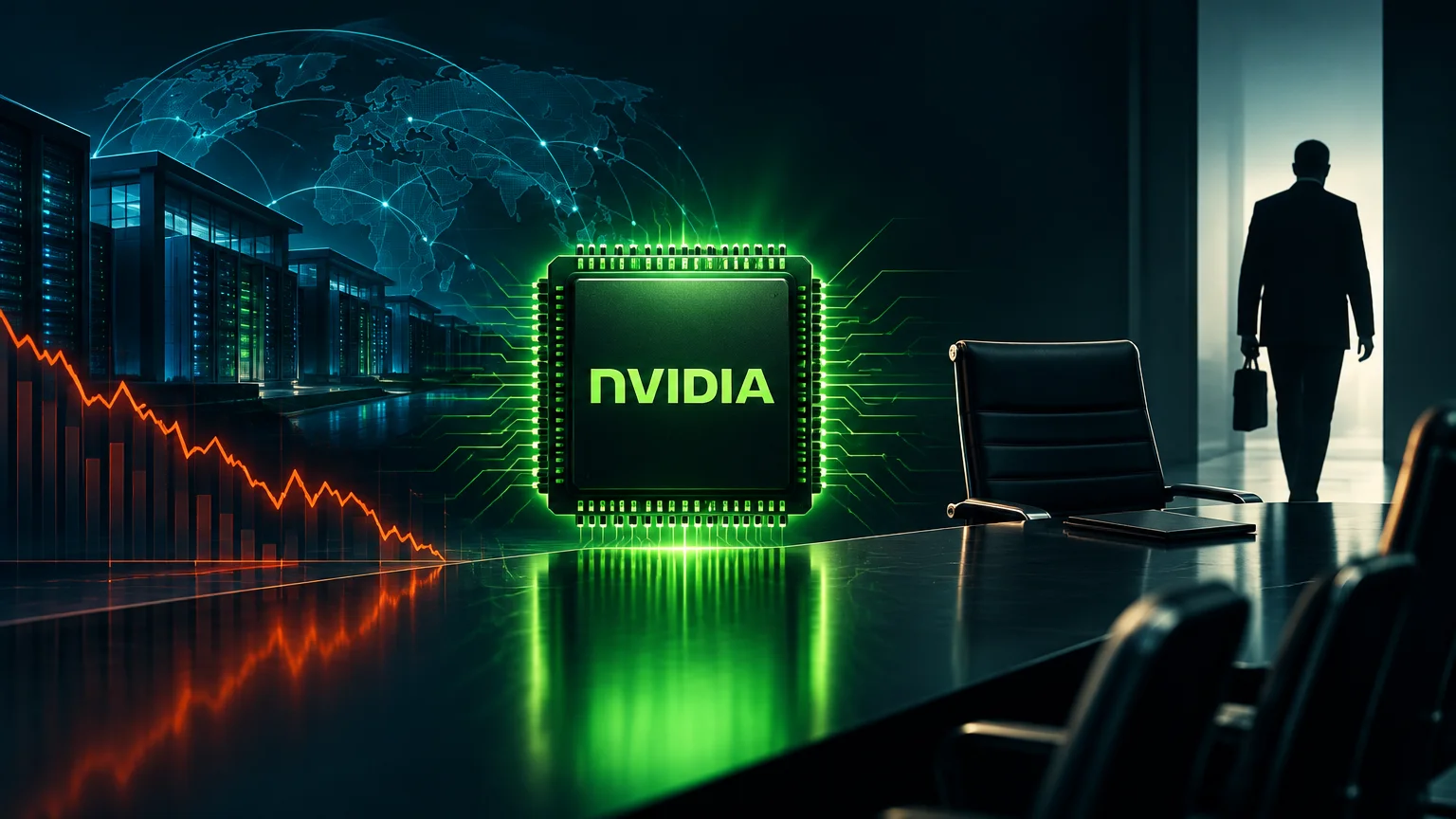
Jensen Huang’s resignation is a scandal about one executive, and it also puts Nvidia’s export-control exposure, its governance and the money funding AI infrastructure to the test at the same time. Nvidia said on Nov. 12 that Huang had resigned as president, CEO and director, effective immediately. It gave no reason. The central question is whether Nvidia will keep propping up the credit of the neoclouds it has backed with investments and purchase commitments. If that support wavers, their funding could get harder. But their financing is already shifting toward customer contracts, so whether the risk spreads is not yet clear. This piece, current as of Nov. 15, works through three threads: the allegations, export controls and the funding lines.
What is confirmed and what is only reported
The filing confirms little. Huang left all three roles at once, and CFO Colette Kress is interim CEO while keeping her finance job. Harvey Jones, a venture investor and former Synopsys CEO, became the company’s first-ever board chair, and the board is weighing internal and external candidates. The stock fell more than 13% at the open, pushing market value below $4 trillion, then closed down 4.3%.
The allegations rest on reporting. The New York Times and others reported that U.S. intelligence judged Alice Huang, a former executive at Singapore-based Megaspeed, to be linked to Chinese intelligence. China denies it, and Megaspeed is an Nvidia chip customer. On Nov. 8, Nvidia said an independent inquiry would examine whether Huang had been targeted by a foreign intelligence service, adding that it had no reason to believe national security or company secrets were compromised. The board was reported to have retained Wachtell, Lipton, Rosen and Katz and former acting U.S. Attorney Joon Kim, and Huang was reported to have apologized to staff for being unfaithful to his wife.
On Nov. 11, The Times, citing five Nvidia employees, reported that Huang had also had a relationship with Kimberly Powell, the healthcare vice president who reports to him. Nvidia, Huang and Powell have not confirmed it, and Powell pulled out of a scheduled Milken Institute event. Reuters reported the same day that the board was discussing whether to remove him. On Nov. 12, Reuters cited anonymous sources in reporting a relationship with another employee, who has not been identified. Nothing reported establishes that Huang knowingly helped Beijing. The inquiry’s findings, any FBI investigation and whether Megaspeed broke export controls remain open.
Export controls, the other front
The case reaches beyond one executive because Megaspeed, where Alice Huang worked, is an Nvidia partner in Southeast Asia and sits at the center of export-control allegations. CBS News reported that U.S. investigators believe she used industry contacts and shell companies to gain access to 240,000 chips barred from export to China. NBC News reported that Megaspeed denies illegally moving chips, says it is cooperating with a Commerce Department inspection and has hired a U.S. law firm to review its compliance. Singapore has been examining Megaspeed and its controllers since February 2025 over possible false declarations about server purchases and their final destinations. Accounts differ on whether Alice Huang herself was investigated. CNBC reported that Singapore’s home ministry said no such investigation of her was conducted, while CBS reported that Singapore held her passport for about eight months.
In Washington, the export policy itself is now in question. On Nov. 12, Sen. Ron Wyden and Rep. Richard Neal, the top Democrats on the Senate Finance and House Ways and Means committees, wrote to Commerce Secretary Howard Lutnick to open an inquiry into how exports of H200 chips to China were approved. The letter said Commerce appears to have lacked due diligence in vetting Chinese buyers, and said that taking a cut of the sales through a tariff looks like an unconstitutional export tax. It also asked whether $26 million in Nvidia donations to Trump-related projects influenced the arrangement, and cited reports that Commerce suspended its review of Megaspeed. These are allegations, not findings.
Markets and politicians moved too. CNBC reported that informal trade in Nvidia chips inside China paused and that Alibaba’s Hong Kong shares fell about 7% after reports about Megaspeed’s customers. House Foreign Affairs Chair Brian Mast said Huang agreed to testify before Thanksgiving, and Senate Banking Chair Tim Scott asked for testimony on Dec. 3. President Donald Trump said Huang told him he had no idea he was involved with an intelligence operative. PBS reported that some analysts think the episode could fuel calls for tougher export controls on China and raise trade tensions.
The credit Nvidia has been propping up
The news landed hard because of the financial web Nvidia has built with its customers. Nvidia invests in AI infrastructure companies or buys their capacity, and those companies spend the money on Nvidia chips. Critics call it circular financing.
CoreWeave is the clearest case. Nvidia invested $2 billion in the company in January. Reports based on CoreWeave’s filings say Nvidia also agreed to buy any capacity CoreWeave cannot sell to others through April 13, 2032, under an order with an initial value of $6.3 billion. In effect, Nvidia does not just sell the chips and hold equity; it carries part of CoreWeave’s demand risk.
Korea’s Financial News reported that Nvidia supplied 12% of the $16.8 billion Nebius raised from January to September, and 60% of Nscale’s $3.36 billion in financing commitments. It cited a Bloomberg estimate of at least $750 billion in announced or discussed AI deals involving Nvidia. Wowtale could not verify those figures in filings, but they suggest that dependence on Nvidia varies by company.
How independent customer revenue is from Nvidia’s money cannot be settled from the filings. CoreWeave’s 10-Q shows that two anonymous customers accounted for 30% and 24% of third-quarter revenue. That is more spread out than a year earlier, when one customer made up 67%. But the customers’ names and funding sources are not disclosed, and the company says the labels can refer to different customers in different periods. Nebius is reported to rely heavily on contracts with Microsoft and Meta, but it has not disclosed their share of revenue.
If the support wavers, where it binds first
Neoclouds spend far more than they earn, and they spend it first. CoreWeave’s 2026 capital spending of $37 billion to $39 billion is about 2.9 times its revenue guidance of $13.0 billion to $13.3 billion. Nebius expects to spend about $27 billion this year against revenue at the low end of $3.0 billion to $3.4 billion, roughly nine times. Next year the gap narrows to about 3.4 times, with spending of $40 billion to $45 billion against revenue of $12 billion to $13 billion. Wowtale calculated these ratios from the companies’ own guidance.
The gap is filled with debt and prepayments. CoreWeave’s 10-Q shows total debt rose from about $21.4 billion at the end of last year to about $46.9 billion at the end of September, and third-quarter interest expense was $846 million, about 2.7 times a year earlier. CNBC reported that some of its bonds yield more than 16% and that it does not plan to issue more unsecured parent-level bonds at current rates.
The question follows from there. If lenders and investors find part of their comfort in Nvidia’s willingness to help, that willingness being doubted pushes funding costs up. Higher costs delay construction and revenue recognition while the larger interest bill stays. Korea’s Financial News reported concern that this path could shrink AI investment and spread to banks and private credit. That is market concern, not established fact. No source forecast a chain-reaction collapse.
Why it is too early to say
First, demand is real. CoreWeave’s revenue rose 168% and Nebius’s 571%, though Nebius’s included about $325 million of one-time revenue. CoreWeave’s backlog grew from $104 billion in June to $132.5 billion, and its 10-Q says 36% will be recognized within 24 months. According to a transcript of its earnings call, management said more than 75% of committed capital spending is tied to investment-grade and enterprise customers.
Second, the funding is moving. Nebius said prepayments on contracts signed in the third quarter covered more than 100% of related capital spending, up from 50% to 60% in the second. It plans to fund 75% to 85% of 2027 spending with prepayments and asset-backed financing tied to investment-grade customer contracts, and in July it raised $775 million that way for the first time. Credit then rests on the customer’s ability to pay, not on Nvidia’s willingness to help. Some companies would survive a weaker Nvidia backstop and some would not.
Third, the sell-off began before the scandal. According to CNBC, Nvidia’s market value was already down about $2 trillion from its Oct. 6 peak, and CoreWeave’s stock had fallen more than 40% in the month before its earnings as rising rates pushed lenders out. Nebius’s 16.8% drop on Nov. 12 came the same day it trimmed guidance to the low end and unveiled its 2027 spending plan, and CoreWeave fell 6.9%. Nothing reported so far shows Nvidia cutting investments or guarantees because of the resignation.
There are warning signs too. Nebius said annualized run-rate revenue more than doubled in three months, from $3.0 billion to $6.4 billion, and then said it will stop reporting the metric; remaining performance obligations over the same period grew 3%. CoreWeave’s net loss widened to $709 million from $110 million a year earlier. Both companies’ spending rises along with their revenue, so growth alone does not shrink the risk.
Who decides
Nvidia’s circular financing was strategy approved by a board that had worked with Huang for a long time. The Next Web reported that directors have served about 15 years on average, nearly twice the S&P 500 norm, and that none is a current or former S&P 500 CEO or has a national-security background. That board must now handle a founder’s absence, its own inquiry and a CEO search at once.
Interim CEO Kress has been CFO since September 2013, which means she was finance chief throughout the period in which Nvidia built a system of investments and purchase commitments that support its customers. One reading is that, in the short run, the structure is more likely to continue than to change suddenly. Another is that a permanent CEO and a board that tightens financial oversight could scale back circular deals. Both are interpretation. CNBC reported that analysts float Ian Buck, Bryan Catanzaro, Michael Kagan and Bill Dally alongside Kress as internal candidates, and President Trump suggested Tim Cook on social media.
The Korean angle
Nvidia’s money reaches Korean AI companies too. Wowtale has covered NVIDIA’s plan to invest in Korean AI startups Motif, Upstage and RLWRLD, NAVER’s $1 billion raise from NVIDIA and NVIDIA’s $10 billion European tour. Nvidia building a place for itself as supplier and shareholder uses the same grammar as at CoreWeave and Nebius. What differs is the scale, and whether there are substitute customer contracts to lean on.
What to watch on Nov. 17
The first test is the earnings report on Nov. 17, 1:20 p.m. Pacific, which is 6:20 a.m. in Korea on Nov. 18. It is the first guidance under interim leadership, and analysts are watching succession, distribution channels and export-rule compliance, CNBC said. Through the lens of this analysis, the key question is how Nvidia discloses and describes its customer-support commitments, guarantees and investment holdings. Congressional testimony has been floated for before Thanksgiving or Dec. 3, and no date has been given for a permanent CEO or for the findings of the board’s inquiry.
MORE FROM THE POST
- Meta Launches $35B Stock Offerings Despite $82B in Cash, Testing How Far AI Capex Can Stretch
- NVIDIA Ships Groq 3 LPX, Built on the $20B License It Bought From Its Own Challenger
- Volta Announces $10B AI Infrastructure Deal, Reportedly With Anthropic
- NVIDIA Plans Investments in Korean AI Startups Motif, Upstage and RLWRLD
- Generative Media Inference Platform fal Raises $1.3B Series F
Share

Most Read
- 1
- 2
- 3
- 4
- 5

Leave a Reply