





Every company running AI agents builds up a record of how its work actually gets done: each tool call, failure and correction. Almost all of it is thrown away, so the next run starts from the same general-purpose model, repeats the same errors and carries the same cost. Remanence, which wants to turn that record into AI models a company owns, came out of stealth with a $30 million seed round co-led by FirstMark Capital and EQT Ventures.
From discarded execution data to training environments
Remanence plugs into a company’s existing AI models and turns their execution traces into tailored training environments, then post-trains open-weight models on them with reinforcement learning. Open-weight models are those whose trained weights are published so anyone can download and adapt them. The platform covers four steps: analyzing traces to find where an agent fails, synthesizing new tasks and verifiers in a sandbox that mirrors the customer’s application, long-horizon reinforcement learning, and inference. It can run fully managed or in the customer’s own cloud. As new traces accumulate, the model is retrained and keeps improving on accuracy, cost and latency, the company says.
Ownership is the pitch. Each customer ends up with a specialized model of its own, keeps the model weights, and can keep its data inside its own infrastructure. The company claims a post-trained open-weight model can match frontier models on a customer’s tasks at a fraction of the cost. It says it works with customers in legal, customer support and enterprise software across Europe and the US, but names none of them.
A founding team from H Company
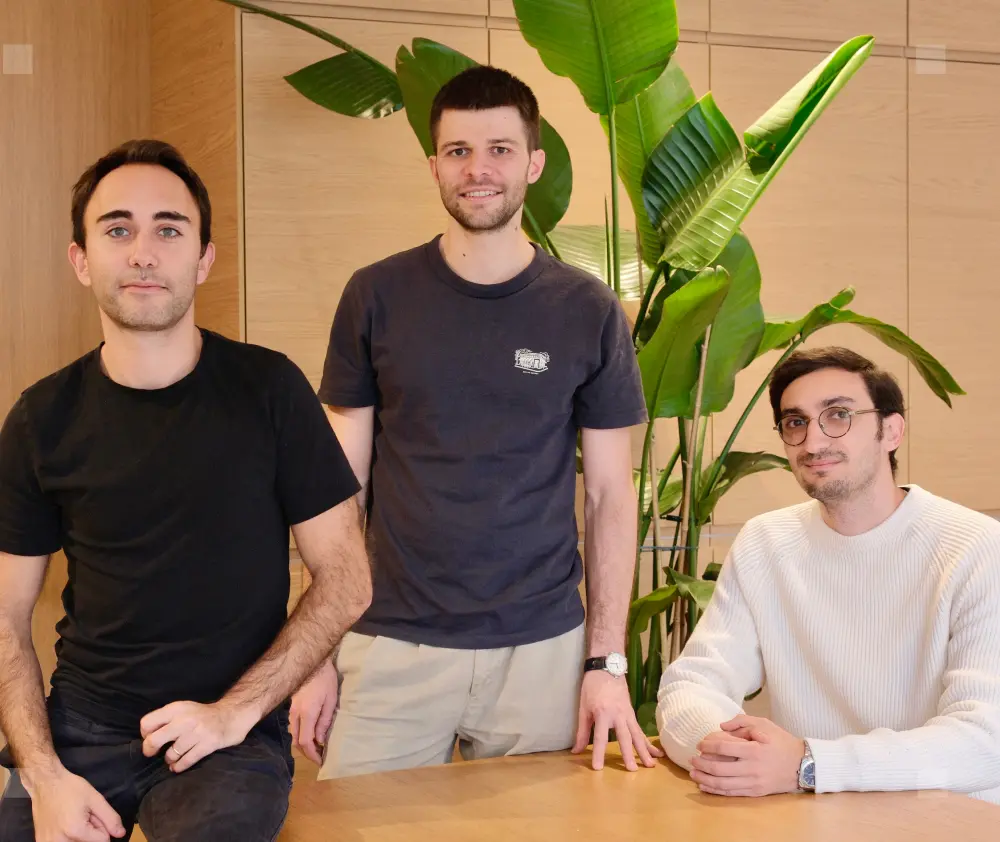
The founders are CEO Pierre-Louis Cedoz, Hamza Benchekroun and Axel Moyal. They previously worked together at H Company, France’s computer-use AI lab, where they say they led the post-training of the open-weight Holo models and set the state of the art on computer-use benchmarks. The team also includes people from Google DeepMind, Meta and InstaDeep. The company notes that long-horizon reinforcement learning post-training and environment generation have mostly happened inside frontier labs, and says it wants to bring that work to the enterprises where it can matter most. Cedoz said AI companies spend more on intelligence every quarter and own none of it.
Zero Prime Ventures, Emblem, Drysdale Ventures, Global Founders Capital and Yellow joined the round. Angels include Datadog co-founder and CEO Olivier Pomel, Mirakl co-founder and CEO Philippe Corrot, Pigment co-founder Romain Niccoli, Synthesia co-founders Victor Riparbelli and Steffen Tjerrild, and Mehdi Ghissassi of AI71. The announcement does not give a valuation.
The money will fund research and compute infrastructure, including a dedicated GPU cluster, along with work on its reinforcement learning environments, evaluation systems and post-training. It is hiring researchers and engineers in Paris, London and San Francisco.
Competitors: the open-weight post-training race
Remanence is going after the market for replacing expensive closed general-purpose model APIs with open-weight models post-trained for a specific company. Rivals differ in how they get training data and which part of the pipeline they focus on.
The most advanced is Applied Compute, founded by former OpenAI researchers. It retrains open-weight models with reinforcement learning on a customer’s data and ways of working, embeds engineers with customers and then runs the models on its own cloud. It recently raised $350 million at a $3.25 billion valuation.
Trajectory raised a $45 million Series A led by Sequoia at a $300 million valuation. Companies pick an open-source model and connect the platform to their service, and it gathers feedback on how the model performed on real work and retrains it. Experts such as lawyers and doctors define what good looks like, and that judgment feeds model improvement. Harvey, Rogo, Decagon, Mercor and Nvidia are customers. Its data comes from service feedback that carries expert judgment.
New York’s Plurai raised a $13 million seed led by Team8. It starts from simulation: it clones a customer’s agent into a sandbox as a digital twin, sends in thousands of simulated users to surface failures before launch, then uses the same simulation data to post-train small language models for each agent. Those models can stand in for costly frontier models or act as guardrails that check the agent’s actions.
Remanence says it differs by synthesizing training environments from the execution traces of agents already in production and tying long-horizon reinforcement learning and inference into one loop. Where Applied Compute leans on embedded engineers and customer data, Trajectory on expert feedback and Plurai on simulation, it starts from what production agents have already done. But it names no customers and gives no performance figures, and its cost and quality claims are the company’s own. With Applied Compute already heavily funded and new entrants arriving, the race is heating up quickly.
MORE FROM THE POST
- Fragment Launches With $56M to Have AI Agents Resolve Procurement Exceptions at Large Manufacturers
- Model ML Raises $250M at $1.5B Valuation for Personal AI Agents in Finance
- AI-Native CRM Dreamteam Raises $53 Million in Seed and Series A Funding
- LangChain Raises $300M Series C at a $3B Valuation Led by CapitalG
- Plurai Raises $13M Seed to Stress-Test AI Agents Before Launch
- agentic AI
- AI
- Drysdale Ventures
- Emblem
- enterprise AI
- EQT Ventures
- FirstMark Capital
- funding
- Global Founders Capital
- Overseas funding
- Remanence
- seed
- Yellow
- Zero Prime Ventures
Share

Most Read
- 1
- 2
- 3
- 4
- 5

Leave a Reply