


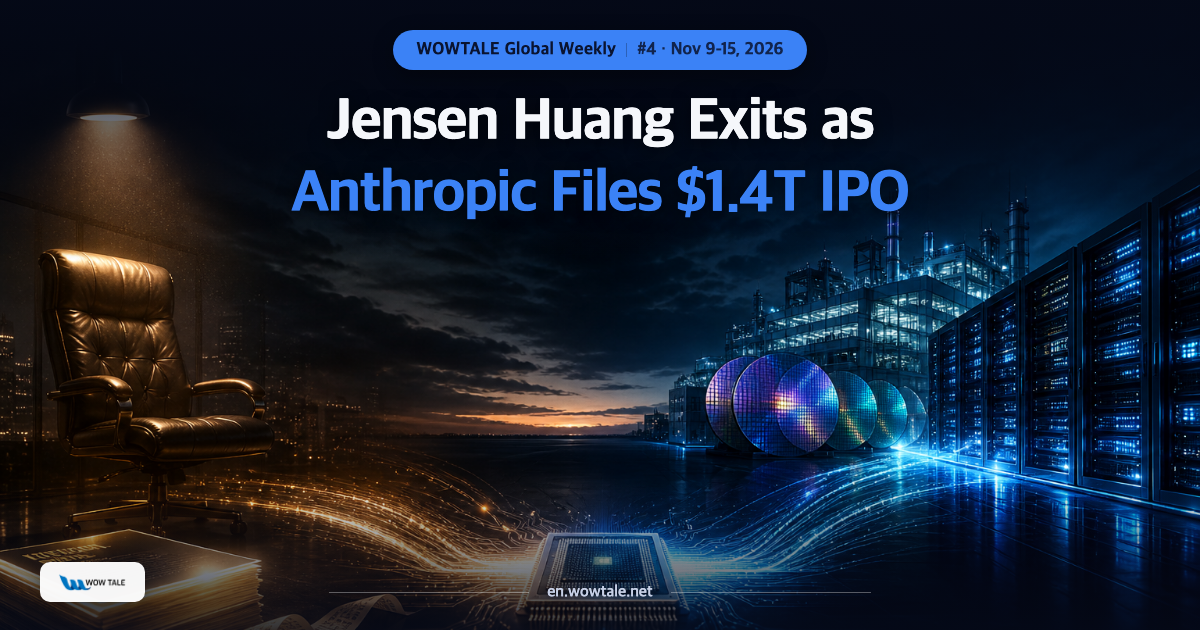
[WOWTALE Global Weekly #4] Jensen Huang Exits as Anthropic Files a Record IPO, TSMC Buys Into Both Labs


by WOW TALE · Nov 9 – Nov 15, 2026
Nvidia CEO Jensen Huang resigned on November 12, and three days later Anthropic filed an amended S-1 that could value the company at up to $1.4 trillion. TSMC said it will invest up to $1 billion directly in Anthropic and OpenAI, taking equity in the customers that keep its fabs full. Meta’s acquisition of Conductor and Sequoia Capital’s decision to close its London office and wind down two programs point the same direction: capital at the top of the AI stack is being restructured, not just raised.
Daily global coverage at WOWTALE English → | 한국어로 보기: Wowtale.net →
LEAD STORY
Nvidia’s Leadership Vacuum Meets Anthropic’s Record IPO and TSMC’s Equity Play
Nvidia CEO Jensen Huang resigned on November 12. A rundown of what’s confirmed traces the allegations, export-control fallout, governance questions, and what the leadership change could mean for the neocloud financing behind CoreWeave and Nebius. Three days later, Anthropic filed a second amended S-1 setting a price range of $70 to $78 a share — a valuation of roughly $916 billion to $1.02 trillion on basic shares, and up to $1.4 trillion fully diluted. Nine-month revenue came in at $33.24 billion against a $104 billion net loss. TSMC, meanwhile, said it will invest up to $1 billion in Anthropic and OpenAI — a foundry buying equity in the customers it supplies, rather than just taking their orders.
Meta’s acquisition of Conductor, the app that runs AI coding agents in parallel, and Sequoia Capital’s decision to close its London office, end two programs and raise roughly $10 billion in a fresh fund round out the picture. A CEO exit, a record-breaking IPO, a foundry’s equity stake in its own customers, a selective acquisition and a VC’s retrenchment look unrelated, but all five reflect the same thing: capital at the top of the AI stack is being restructured, not just deployed.
Mega-Funding Keeps Spreading Across the AI Stack
AI evals and post-training company Mercor raised a $750 million Series D at a $20 billion valuation, as enterprises increasingly pay to grade and refine model outputs rather than just run them. Fractile, which is building memory hardware to break AI inference’s memory bottleneck, raised $720 million, while AI revenue agent Rox raised a $100 million Series B at a $1.3 billion valuation to automate enterprise sales pipelines. Agent engineering platform LangChain raised a $300 million Series C at a $3 billion valuation led by CapitalG, with more than 7,000 organizations now using its LangSmith tooling. Grid-adjacent AI infrastructure startup Taurus raised $500 million to deploy modular power-and-compute units that plug directly into spare grid capacity, sidestepping the years-long wait for new power contracts. Mirendil, a frontier lab founded by Anthropic alumni, raised a $1 billion Series A to build agents that carry out AI research themselves rather than just assist human researchers.
Evals, memory, sales agents, agent tooling, grid power and automated research are different layers of the same stack, but the pattern holds: capital keeps spreading outward from the models themselves into the infrastructure and tooling layers around them.
Physical AI Moves From the Lab to the Job Site
SoftBank-led Agile Robots raised $500 million at an $8.5 billion valuation to expand its humanoid and industrial robotics business. Path Robotics, a welding-focused physical AI company with Naver Ventures among its backers, raised a $300 million Series E led by Georgian, with annual recurring revenue up 17x in 18 months as its welding robots move from pilot lines into full production runs. Google DeepMind, meanwhile, unveiled Gemini Robotics 2.5, which drove an Apptronik Apollo 2 humanoid to a reported 96% success rate sorting parts on live Mercedes-Benz production lines.
Humanoids, welding robots and a general-purpose robotics model look like different businesses, but physical AI investment and capability keep moving past the lab and into deployed, revenue-generating work on actual job sites.
AI Expands Into Biology, and a16z Bets the Field Gets Bigger
Google DeepMind unveiled AlphaGenome 2, a model that predicts how individual DNA variants behave in specific human cell types and finds nearly twice as many expression-changing variants as its predecessor — a step toward using AI to explain the genome, not just sequence it. Separately, a16z argued that AI will make pharma even bigger by raising the odds of drug-development success and cutting the time it takes, a thesis AlphaGenome 2’s own numbers help substantiate. Vascular-surgery robotics startup Mosaic exited stealth with a $47 million seed round, and SRTD Biotech raised a €31.5 million seed for mRNA drugs engineered to switch on only inside diseased cells.
Genomics, pharma economics, surgical robotics and mRNA engineering are different corners of biotech, but all four moved this week on the same premise: AI doesn’t just speed up biology, it changes what’s economically viable to build.
Enterprise AI Spend Concentrates, and Google Bets on Wearables
Spend-management platform Ramp’s research arm, Menlo Ventures, found that enterprise AI spending has reached $176.8 billion annually, with 69% going to frontier labs. Google, meanwhile, unveiled Gemini-powered smart glasses built with Samsung, Gentle Monster and Warby Parker, opening pre-orders in Korea and the US ahead of a December 10 launch — a sign the next platform fight for generative AI is moving from phones and browsers onto something people wear all day. Microsoft, for its part, opens Ignite 2026 on November 17, where it plans to lay out its AI agent strategy for roughly 300 partners alongside new cloud and security initiatives.
Spending concentration, a bet on wearable hardware and a platform vendor’s own agent push are a different kind of signal than this week’s megadeals — a look at where the AI industry’s structure is actually shifting underneath the headlines.
Also This Week
- Coframe Raises $25M Series A for Self-Improving Websites · AI
- Imprint Raises $130M at a $1.9B Valuation for Co-Branded Cards · Fintech
- Nominal Raises $240M Series C for Hardware Engineering AI · AI
- Plurai Raises $13M Seed to Simulate Users Before Agent Launch · AI
- Edelbyte Raises $70M Seed and Series A, Founded by Microsoft Veterans · AI
- Onodrim Raises $300M Series A for European Defense Acquisitions · Defense
- Graphon Labs Raises $35M Series A for AI Agent Memory · AI
- Mavria Raises $130M to Date to Build AI Data Centers in a Factory · AI Infra
- Google DeepMind’s Gemini Robotics 2.5 Hits 96% Success in a Mercedes-Benz Factory Pilot · Physical AI
- Microsoft Opens Ignite 2026, Nov 17–20, With an AI Agent Strategy in Focus · Enterprise AI
What We’re Seeing
- Jensen Huang’s resignation, Anthropic’s up-to-$1.4T IPO filing and TSMC’s direct equity stake in its own customers all landed within days of each other — capital at the top of the AI stack is being restructured, not just raised.
- Mercor, Fractile, Rox, LangChain, Taurus and Mirendil show mega-funding spreading from the model layer into evals, memory, agents, grid power and automated research.
- Path Robotics, Agile Robots and Google DeepMind’s Gemini Robotics 2.5 show physical AI moving past demos and into deployed, revenue-generating work.
- AlphaGenome 2, a16z’s pharma thesis, Mosaic and SRTD Biotech show AI and biotech converging well beyond drug discovery alone.
- Menlo Ventures’ $176.8B enterprise AI spend figure, Google’s Gemini smart glasses and Microsoft’s Ignite 2026 agent push are structural signals distinct from this week’s funding headlines.
This Week in Korea
Nvidia invested directly in Korean AI startups Motif, Upstage and RLWRLD, while Rebellions partnered with SKT on sovereign NPU infrastructure and Samsung and LG adopted Nvidia technology — five separate Nvidia relationships in a single week, landing just as Nvidia’s own CEO stepped down. See Korean Startup Weekly News #144 for the full domestic picture.
WOWTALE Global Weekly is a weekly roundup of international startup and tech trends.
MORE FROM THE POST
- [WOWTALE Global Weekly #3] AI Usage Soars, Prices Fall — and M&A Keeps Taking Over
- [WOWTALE Global Weekly #2] Thrive and DoorDash Headline a Week of Megadeals
- [WOWTALE Global Weekly #1] AI Megarounds Sweep Every Sector as Flapping Airplanes Raises $1B With No Product Yet
- [Korean Startup Weekly News #144] NVIDIA Backs Five Korean AI Companies in a Single Week
- [Korean Startup Weekly News #143] Korean-Founded MISS A Hits $760M Valuation in US Beauty
Share

Most Read
- 1
- 2
- 3
- 4
- 5

Leave a Reply