










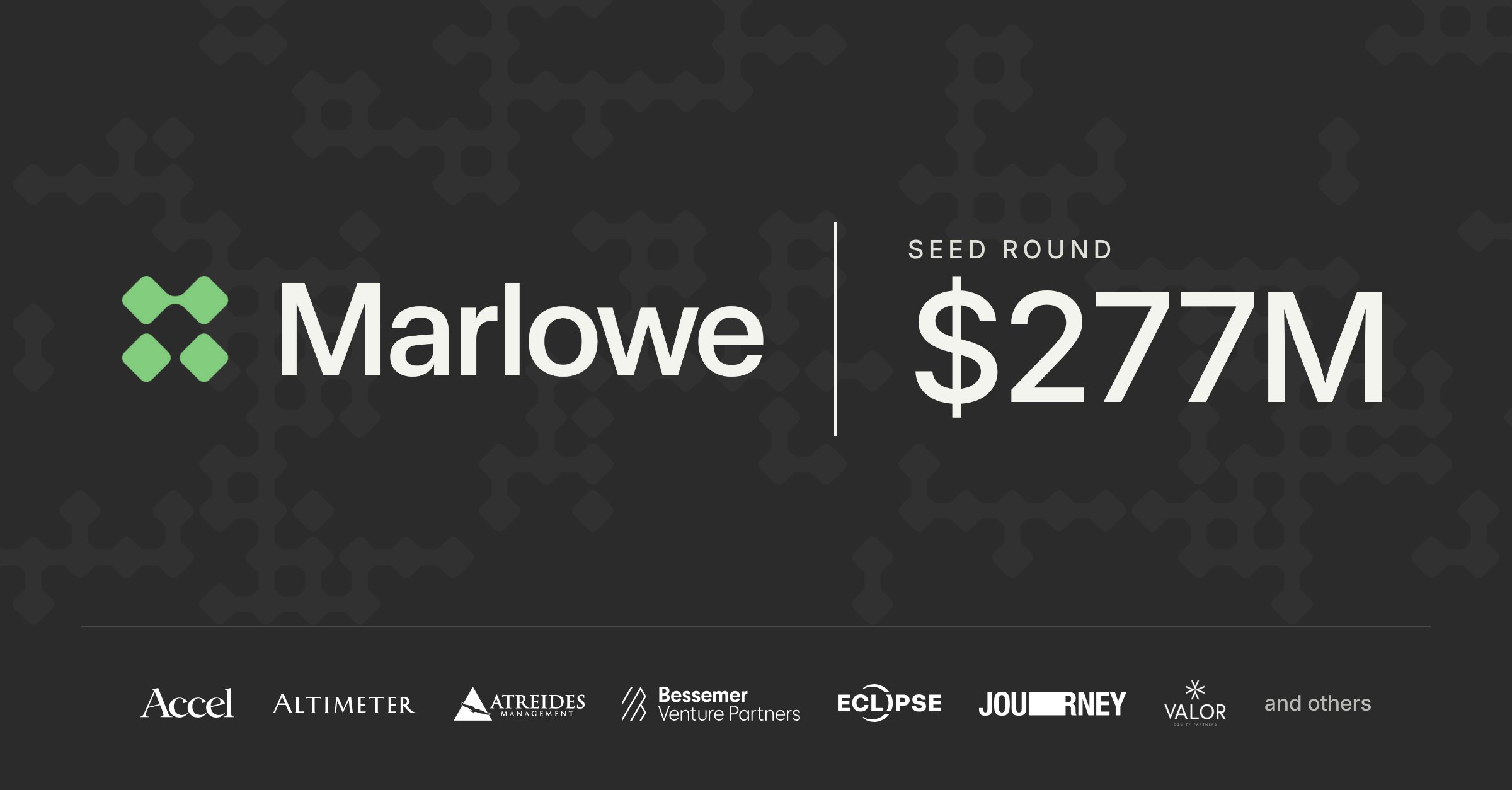
Marlowe, which plans to build inference-only data centers from a mix of AI chips rather than leaning on NVIDIA GPUs alone, has raised a $277 million seed round. Accel led the round. It is rare for a company founded in May to raise that much at the seed stage. Its first data center goes live in December.
Inference is the stage where a trained AI model actually answers a user. A coding agent refactoring a codebase, a voice assistant replying in under a second and an analyst asking a model to summarize a 500-page filing are all inference. As use spreads quickly, demand has outrun supply, pushing up costs and capping usage. By the company’s account, data center construction costs are up 40% since 2020, and some projects have been delayed or canceled as financing, permits and power hold them back.
Marlowe argues that stacking up more of the same compute is not the answer. Running training and inference on one general-purpose system is like owning only SUVs for transportation, it says, when a bike, sedan, train or jet is often the better choice. Relying on a single chipmaker also leaves the whole industry with one supply-chain point of failure. AMD, Google, Broadcom, Cerebras, Etched and others are building new chips to cut the cost of inference, but a chip alone cannot produce tokens, the units of text an AI generates. Without a system around it, a new chip can fall short of its design.
So Marlowe designs and operates everything together, from chip choice to the data center, network, cloud and the workload running on top. It calls this a multi-silicon AI factory. It matches each job to the right chip and squeezes small gains out of every layer, from power allocation and operating software to the inference engine and model routing. Double-digit percentage gains per layer add up to a 2-3x advantage in performance and cost, the company says. Its customers are AI application and platform companies, and it embeds engineers with them to tune their workloads for alternative silicon.
Partners are already on board. Vamsi Boppana, AMD’s senior vice president of AI, said AMD will deploy its rack-scale Helios system with Marlowe next year. Rob Wachen, co-founder and president of Etched, said the two will stand up their first inference clusters together this year. Etched is the inference-chip company Wowtale reported in August had raised $700 million at a $21 billion valuation. Marlowe says it is working with several other chipmakers too.
Dan Lewis, the CEO, and Kutta Srinivasan, the CTO, lead a team drawn from AWS, Cerebras, Deutsche Bank, Goldman Sachs, Google, KKR, Lambda, LinkedIn, Meta, Microsoft, NVIDIA, Oracle and SambaNova. They have worked across AI infrastructure, hardware-software co-design, data center buildouts and GPU financing. The company was founded in collaboration with Eclipse founder Lior Susan, DriveNets CEO Ido Susan and Stanford professor Chris Ré. Lior Susan is executive chairman, Ido Susan sits on the board as an operating member and Ré is a founding advisor. Ré was also involved with Together AI and Factory.
Accel’s Christine Esserman and Ivan Zhou said Marlowe has assembled a rare full-stack team with experience at Microsoft, LinkedIn, Meta and elsewhere, spanning hardware-software co-design, data center buildouts, supply chain and financing. Its focus on quality, reliability and efficiency from day one is central to their conviction, they said.
Bessemer Venture Partners, Altimeter Capital, Atreides, Eclipse, Journey and Valor Equity Partners, among others, also joined the round. Angels include Box CEO Aaron Levie, Uber CEO Dara Khosrowshahi, Palo Alto Networks CEO Nikesh Arora and Dropbox CEO Drew Houston. Yash Patil, the Applied Compute CEO Wowtale covered in the Palo Alto Networks deal, is an angel as well. The company did not disclose a valuation.
Competition: money is gathering outside NVIDIA
The closest company Wowtale has covered is Gimlet Labs. Its multi-silicon inference cloud splits inference into stages and hands each to whichever of GPUs or inference chips suits it best. It raised a $300 million Series B led by a16z in September at a $3 billion valuation. Where Gimlet binds chips together mostly in software, Marlowe builds and runs the data centers itself. General Compute is a neocloud that buys inference chips from Cerebras, SambaNova and Positron AI, installs them in leased data centers and operates them. It closed a $100 million Series A in October. TensorWave, an AI cloud that runs only AMD chips, raised a $350 million Series B in June.
More broadly, neoclouds such as CoreWeave and Lambda, which buy GPUs in bulk and rent them out, are the incumbents, and Cerebras went public in an IPO that raised $5.5 billion. In inference services, Together AI raised $800 million and Fireworks AI $1.5 billion.
Marlowe’s first data center is not yet open, though, and it has not named customers or disclosed revenue.
MORE FROM THE POST
- Fractile Raises $720M Series C to Break the AI Inference Memory Bottleneck
- Generative Media Inference Platform fal Raises $1.3B Series F
- Neocloud General Compute Raises $100M Series A as CoreWeave Sell-Off Spooks Sector
- AI Inference Infrastructure Startup Modal Raises $750M Series D
- Heterogeneous-Chip Platform Infinigence AI Raises RMB 2.3B Series C
Share

Most Read
- 1
- 2
- 3
- 4
- 5

Leave a Reply