





AI compute demand is pressing against terrestrial limits — power, cooling water, and land are all running short. That is why putting data centers in orbit, where sunlight is continuous and heat radiates into vacuum, has moved from science fiction to a fundable thesis in barely two years.
The bottleneck now is not the technology but the rocket seat. SpaceX is winding down its workhorse Falcon 9 by 2028 in favor of the still-unproven Starship. Blue Origin’s New Glenn and ULA’s Vulcan are not yet flying on a regular cadence, and Rocket Lab’s Neutron remains on the pad. For anyone planning a constellation, securing launch capacity has itself become a cost center and a competitive edge.
Starcloud is the furthest along in this market. Founded in January 2024 as Lumen Orbit and a graduate of Y Combinator’s Summer 2024 batch, the company flew its first satellite, Starcloud-1, last November, putting the first NVIDIA H100 GPU into orbit. On that spacecraft it trained the first AI model in space, ran a version of Google’s Gemini in orbit, and demonstrated high-powered inference and fine-tuning on flight hardware.
The company is working toward a constellation of 88,000 satellites and 20 gigawatts of orbital compute. Production lines for its next-generation Starcloud-3 spacecraft are being stood up at a new 100,000-square-foot facility in Woodinville, Washington.
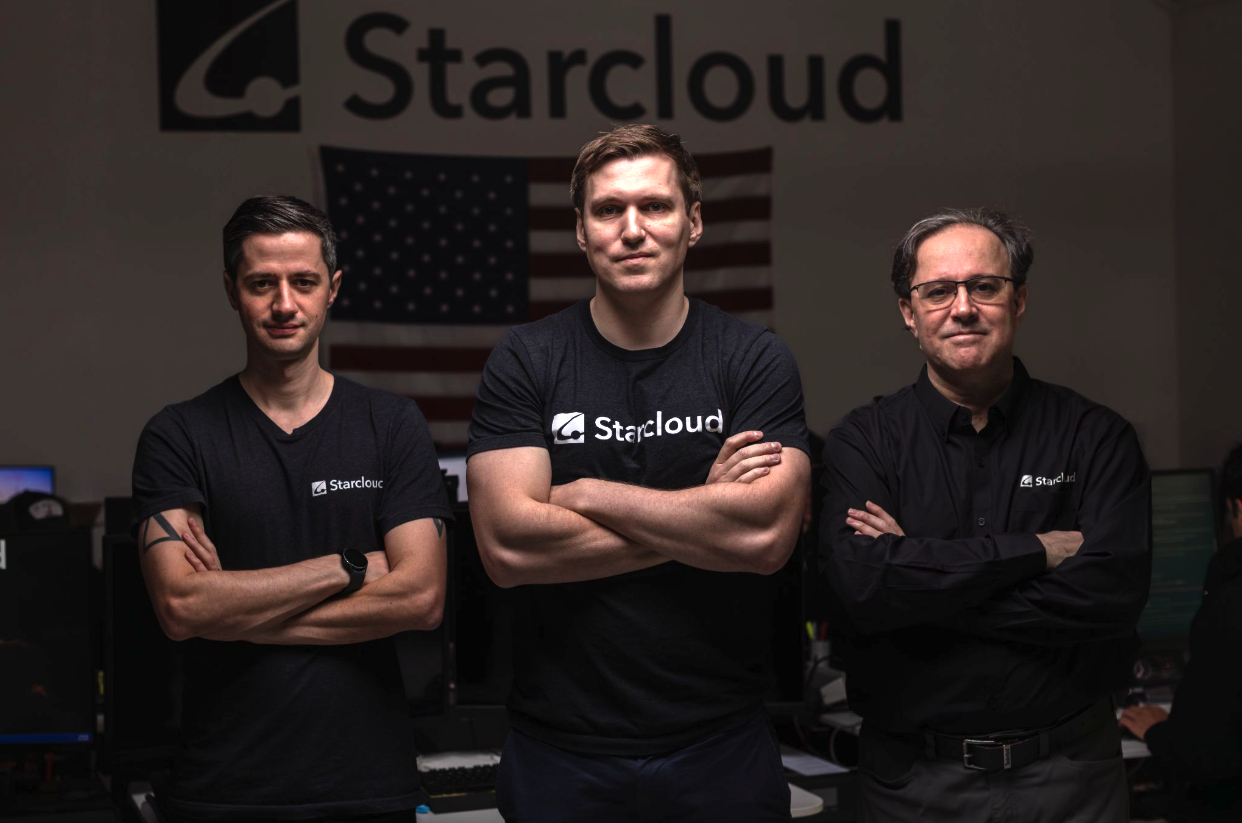
Three founders lead the company. CEO Philip Johnston came from McKinsey and previously co-founded the digital brand aggregator Opontia; he studied applied mathematics at Nottingham and holds an MBA from Wharton and an MPA from Harvard. Chief Engineer Adi Oltean worked on Starlink’s spacecraft-to-spacecraft tracking beams at SpaceX after two decades at Microsoft running large production GPU clusters. CTO Ezra Feilden came from Airbus Defence and Space.
Starcloud announced a $250 million Series A extension at a $2.3 billion post-money valuation. Manhattan West led the round. Existing backers Benchmark, EQT, Soma Capital, NFX, and 776 followed on, while NVIDIA, Cisco Investments, Cedar Capital, Goanna Capital, and Standard Capital came in as new investors.
The pace is the striking part. Five months ago, in March, the company raised $170 million at a $1.1 billion valuation — becoming the fastest unicorn in Y Combinator history — and that figure has now more than doubled. Total capital raised since founding stands at $450 million.
The new money funds three things: manufacturing capacity, joint engineering work with NVIDIA, and procurement of future launch allocation. Johnston said the company put the first H100 in orbit last November and that this capital lets it build the infrastructure to send many more of NVIDIA’s most advanced GPUs to space.
NVIDIA’s arrival on the cap table follows work already under way. Since March the two companies have been collaborating on NVIDIA’s Space-1 Vera Rubin Module, built for an environment where cooling depends on large radiators and components must survive radiation exposure. Starcloud’s satellites are expected to serve as an early flight platform for that space-rated hardware.
Cisco joined as a new investor, bringing networking, optical, and AI infrastructure expertise. Cisco Investments said it wants to carry its long-standing work in secure data center infrastructure into the emerging world of orbital data centers. At Manhattan West, Ken Abdalla and Lauren Selig led the deal, with Selig joining as a board observer.
Competitors
Orbital data centers went from a fringe idea to a field crowded with both startups and hyperscalers in about a year.
Cowboy Space, which renamed itself from Aetherflux, closed a $275 million Series B in May at a roughly $2 billion valuation. Led by Robinhood co-founder Baiju Bhatt, it differs from Starcloud in aiming to build its own launch vehicles and vertically integrate the whole stack.
Sophia Space raised a $10 million seed in February. Orbital picked up a $5 million pre-seed led by a16z speedrun in June to build low-Earth-orbit AI data center satellites, with an eventual target of more than 100,000 spacecraft.
The hyperscalers are moving too. Google unveiled Project Suncatcher last November — a constellation of solar-powered satellites carrying its own TPUs — and plans two prototype launches by early 2027. SpaceX, meanwhile, merged with xAI on an explicit premise of running AI in space.
MORE FROM THE POST
Share

Most Read
- 1
- 2
- 3
- 4
- 5

Leave a Reply