










Packing thousands of GPUs into an AI datacenter is only half the problem; connecting them fast enough is the other half. Copper has been hitting its limits on both bandwidth and power as AI clusters scale, and the industry is turning to optics instead. Dell’Oro Group forecasts that cumulative spending on datacenter switches for AI back-end networks will approach $1 trillion over the next five years (2026-2030), with scale-up networking accounting for more than half of that market by 2030.
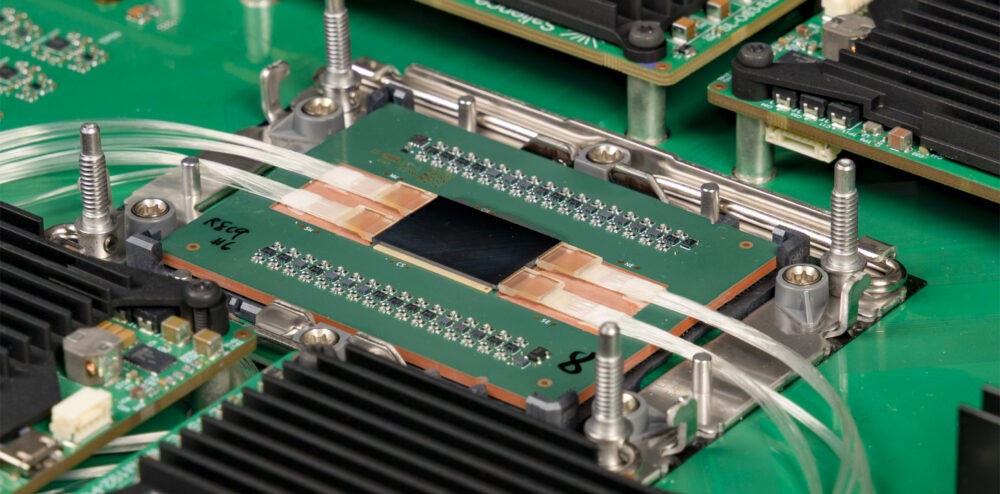
Oxford, England-based Salience Labs builds optical circuit switching (OCS) chips aimed squarely at that bottleneck. Think of it as a light-based patch panel between GPU racks: instead of physically re-cabling servers, the company’s switches reroute light paths in software to regroup which racks talk to which. Its fully integrated, all-optical switch architecture is designed to connect thousands of GPUs across multiple racks for scale-up networking. Last month, the company demoed a 64-port all-optical photonic switch at ECOC 2026 — an industry first for silicon photonics OCS, according to the company. The new funding will support follow-on 128- and 256-port versions. Salience’s technology draws on more than a decade of research out of the University of Oxford and the University of Münster.
CEO and co-founder Vaysh Kewada started the company in 2021. “OCS will play a critical role in AI datacenter networking,” Kewada said. “As customers roll out optical links in their datacenters, high-performance optical switches are needed to deliver the token economics that workloads demand. Salience Labs has demonstrated a market-leading technology: a fully integrated on-chip solution that scales well to high-volume manufacturing.”
Salience Labs said it closed a $125 million Series B after demand came in above its target, led by Bullhound Capital, whose Principal Callum Stewart is joining the board. New investors AMD Ventures, Intel Capital, SBI Group, Hudson River Trading, and the British Business Bank joined the round, with continued backing from existing shareholders Applied Ventures LLC, Oxford Science Enterprises, Cambridge Innovation Capital, and Silicon Catalyst Ventures. The funds will go toward speeding up OCS deployment, scaling volume manufacturing, and opening a second Silicon Valley office — alongside continued manufacturing partnerships with Keysight Technologies and Tower Semiconductor.
“The investor base and customer relationships Salience Labs has developed really speak to the capability of the leadership,” said Bullhound’s Callum Stewart. AMD Ventures Director Patrick Rundell noted that “AI infrastructure is increasingly being designed at rack scale, where networking has a direct impact on system performance, efficiency and economics.” Intel Capital Managing Director Srini Ananth said Salience “stands out through its integrated silicon photonics architecture and proprietary optical amplification.”
Salience isn’t the only one trying to replace copper with light, though rivals are attacking different parts of the problem. Its closest head-to-head competitor is iPronics, which builds the same kind of rack-to-rack optical circuit switch — and, coincidentally, closed its own $125 million Series B just last month, bringing its total funding to $177 million with NVIDIA joining as a new investor. That overlap means the two companies are solving the same problem the same way. Ayar Labs takes a different approach: instead of a switch that reroutes connections between racks, its co-packaged optics (CPO) design puts an optical chip right next to the GPU or switch ASIC, converting electrical signals to light the moment they leave the chip to cut losses at that one junction — a different point in the stack than what Salience or iPronics address. Ayar Labs has raised $650 million to date. Celestial AI went further still, building a “Photonic Fabric” that carries optical signals to any point on a chip, not just its edge, aimed at the bottleneck between memory and compute rather than rack-to-rack networking — but the company was pulled out of the independent-startup race entirely when Marvell Technology acquired it for $3.25 billion this past February.
MORE FROM THE POST
- Fractile Raises $720M Series C to Break the AI Inference Memory Bottleneck
- Marlowe Raises $277M Seed Led by Accel to Build Multi-Silicon AI Factories for Inference
- Genesis AI Raises $500M Series A to Build Human-Handed General-Purpose Robots
- Quantum Error-Reduction Software Maker Q-CTRL Raises $290 Million Series C
- Graphon Labs Raises $35M Series A to Give AI Agents Long-Term Memory
- AI
- AI Infra
- AMD Ventures
- Applied Ventures
- British Business Bank
- Bullhound Capital
- Cambridge Innovation Capital
- Hudson River Trading
- Intel Capital
- Oxford Science Enterprises
- Salience Labs
- SBI Group
- Silicon Catalyst Ventures
Share

Most Read
- 1
- 2
- 3
- 4
- 5

Leave a Reply