


- AI
- ·
- Tech Giant
Nvidia Q3 Revenue Doubles to $115.8B, but Q4 Margins Are the Swing Factor


Nvidia’s latest quarterly report, its first since CEO Jensen Huang’s resignation, left little to question on demand. The market’s attention has shifted to a gross margin expected to bottom in the fourth quarter, the commitments and guarantees Nvidia is taking on, and who will lead the company next.
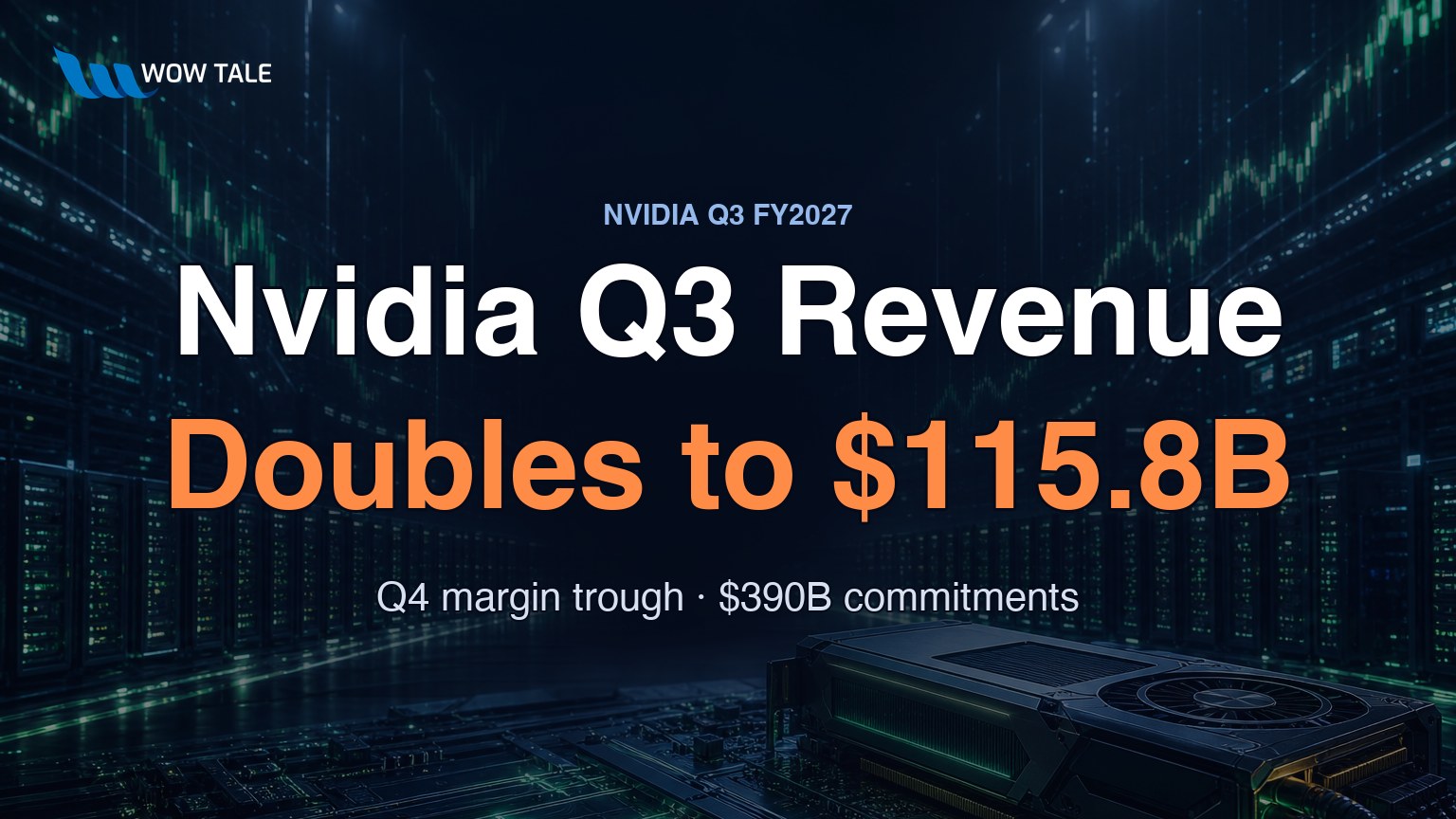
Nvidia reported fiscal 2027 third-quarter results on November 17 for the quarter ended October 25. Revenue was $115.8 billion, up 103% from a year earlier and 20% from the prior quarter. That beat the company’s own $108.0 billion guidance from August by about 7% and consensus of roughly $109.1 billion by about 6%. Non-GAAP diluted EPS was $2.68 against an expected $2.47, and Nvidia guided fourth-quarter revenue to $130.0 billion, plus or minus 3%.
Demand: new clouds and enterprises are leading growth
Data center revenue was $107.6 billion, up 110% year over year and 93% of the total. Hyperscale revenue was $60.1 billion, up 23% from the prior quarter but only about 71% from a year ago, while AI clouds, industrial and enterprise customers contributed $47.5 billion, up 195% year over year. Neoclouds, sovereign AI and enterprise demand are now the faster-growing leg.
Frontier labs are a growing share too. Interim CEO and CFO Colette Kress said frontier AI labs such as OpenAI and Anthropic are expected to account for about 15% of data center revenue this year, according to SiliconANGLE. Some commentators read that as these labs moving beyond renting cloud capacity and starting to build their own data centers.
Three direct customers accounted for 14%, 11% and 11% of revenue, or 36% combined. The filing does not name them and says they were mostly in the Compute & Networking segment. In the first quarter three customers represented 21%, 17% and 16%, and in the second quarter one represented 16%. Direct customers are often system builders or distributors that assemble servers for end users, so these figures cannot be read directly as the share of any one cloud or AI lab. Separately, the filing says one AI research and deployment company generated meaningful revenue indirectly by buying cloud services from Nvidia’s customers.
New products did the lifting. Nvidia said Vera Rubin ramped faster than any prior product and added nearly $20 billion in revenue sequentially. According to press reports, Kress also said physical AI revenue nearly tripled year over year and is on track to exceed $25 billion this year.
Guidance: revenue keeps rising, margin troughs in Q4
The $130.0 billion fourth-quarter guide implies 12% sequential growth, but the quarter includes an extra week. Normalized to 13 weeks, the figure is roughly $120.7 billion, or about 4% sequential growth by Wowtale’s calculation. The midpoint still sits above the roughly $125 billion consensus.
Margin is the bigger variable. GAAP gross margin was 74.8% in the third quarter, and the fourth-quarter guide of 71% to 72% sits 3.4 points lower at the midpoint. Nvidia said the early Rubin ramp already trimmed third-quarter margin slightly. According to press reports, Kress called the fourth quarter the low point and expects margin to recover to 72% to 73% in fiscal 2028. Operating expenses are guided to about $11.0 billion, up from $9.2 billion, which was already 57% higher than a year earlier.
China is excluded: the guide assumes no data center compute revenue from the country. Nvidia shipped $2.4 billion of Hopper products to China in the third quarter, but Kress reportedly said shipments have now stopped.
Commitments and guarantees: the risk Nvidia is taking on
The most notable part of the filing is how deeply Nvidia has become entwined with its supply chain and its customers’ financing, beyond selling chips. Each item means something different.
- Supply commitments of $390 billion (up from $279 billion): parts and capacity Nvidia has promised to buy, mostly multi-year memory contracts. They lock in volume, but the money goes out even if demand softens.
- Cloud and data center lease commitments of $102 billion (up from $74 billion), plus $32 billion in neocloud agreements: contracts, not yet commenced, under which Nvidia will rent computing capacity and facilities from cloud and data center operators over the long term.
- Equity investment commitments of $20 billion: planned investments in frontier labs, infrastructure financiers and private companies. The filing does not name the investees.
Together these make $518 billion in future commitments. Guarantees come on top. Maximum gross exposure is $118.0 billion, of which $105 billion is credit support for SB Energy’s Ohio campus, which will host Nvidia infrastructure under 20-year leases to OpenAI. A guarantee is a promise that Nvidia will cover a data center operator’s debt or lease payments if it cannot. Kress said guarantees take effect only after the customer has secured land, power, construction and financing, and do not apply if a facility is delayed or falls through. No payments have been made so far. According to press reports, private neoclouds with below-investment-grade credit must show real customer demand, known as offtake, before they buy chips.
The structure matters because Nvidia’s investments and guarantees expand customers’ ability to buy its chips, which is exactly what the “circular financing” debate is about. On Wall Street, some compare it to vendor financing in the dot-com bubble, while others see a strategy that builds a competitive moat. Kress said Nvidia will rigorously evaluate future investments, commitments and guarantees, though some commentators note that is an interim CEO’s stance that a permanent CEO could change.
Earnings quality: $65.3 billion in net income, less in cash
GAAP net income was $65.3 billion, up 105% and including $1.8 billion in net equity-investment gains. Free cash flow was $43.8 billion, about 67% of net income. Receivables rose to $81.0 billion and days sales outstanding from 60 to 64, which Nvidia tied to Rubin shipment timing and extended terms for some large customers. Inventory rose from $31.6 billion to $39.7 billion. Fast growth ties up working capital first. Even so, shareholder returns hit a record $28.1 billion, and $227.3 billion of buyback authorization remains.
Leadership gap and the market’s view
Huang resigned as president, CEO and director on November 12, effective immediately. The filing did not give a reason, and Kress is serving as interim CEO while remaining CFO. Board chair Harvey Jones has reportedly said the board does not intend to reinstate Huang, and the company is considering internal and external candidates. Kress called it “business as usual” and raised her fiscal 2028 revenue growth expectation to about 75% from 70% in August. Shares, down 24% in November before the report to their lowest since July 2025, rose about 3.6% after hours, from $155.46 to $161.04.
Wall Street is split between demand and leadership. Jefferies kept a Buy with a $250 target, down from $300, saying demand still outruns supply. Piper Sandler raised its earnings estimates but cut its target to $230 from $300 on CEO uncertainty. HSBC kept a Hold with a $170 target, saying the stock may not re-rate until a permanent CEO is named, and Summit Insights downgraded to Hold, citing the roadmap beyond Vera Rubin and expected custom-ASIC share gains in 2027. TipRanks shows a Moderate Buy consensus of 26 Buy, 13 Hold and 1 Sell with an average target of about $231.
Korea and what to watch
Because the rise in supply commitments is mostly memory, Korean suppliers are directly exposed. According to local reports, SK Hynix rose about 5% and Samsung Electronics about 4% in Seoul on November 18, and Samsung Electro-Mechanics gained about 7% after Nvidia reportedly signed new substrate and advanced-packaging contracts with it. Contract sizes were not disclosed. The KOSPI recovered the 5,100 level.
Kress said the acquisition of Hugging Face, agreed in September at about $12.9 billion, is on track. Three things to watch: whether fourth-quarter margin is truly the trough, how quickly the $390 billion of supply commitments turns into revenue, and how a new CEO handles commitments and guarantees.
For the wider AI infrastructure competitive landscape, see here.
MORE FROM THE POST
- Jensen Huang’s Exit: From the Allegations to the Money Behind AI Infrastructure
- Meta Launches $35B Stock Offerings Despite $82B in Cash, Testing How Far AI Capex Can Stretch
- NVIDIA Ships Groq 3 LPX, Built on the $20B License It Bought From Its Own Challenger
- NVIDIA Plans Investments in Korean AI Startups Motif, Upstage and RLWRLD
- Generative Media Inference Platform fal Raises $1.3B Series F
Share

Most Read
- 1
- 2
- 3
- 4
- 5

Leave a Reply