



Stripe in Talks to Buy AI Model Router OpenRouter for Over $7B


Developers no longer commit to a single model. Claude handles the code, Gemini reads the image, an open-weight model runs the cheap bulk work. The friction is that every model comes with its own API shape and its own pricing scheme, so switching means rewriting code, and understanding where the money went means checking each provider separately.
OpenRouter removes that friction. One API reaches more than 400 models, and the platform picks where a request should go based on the task and the budget. Models from OpenAI, Anthropic, Google and Meta all sit behind the same endpoint. Eight million developers use it, and it moves roughly 25 trillion tokens a week.
$1.3 billion in May, $7 billion now
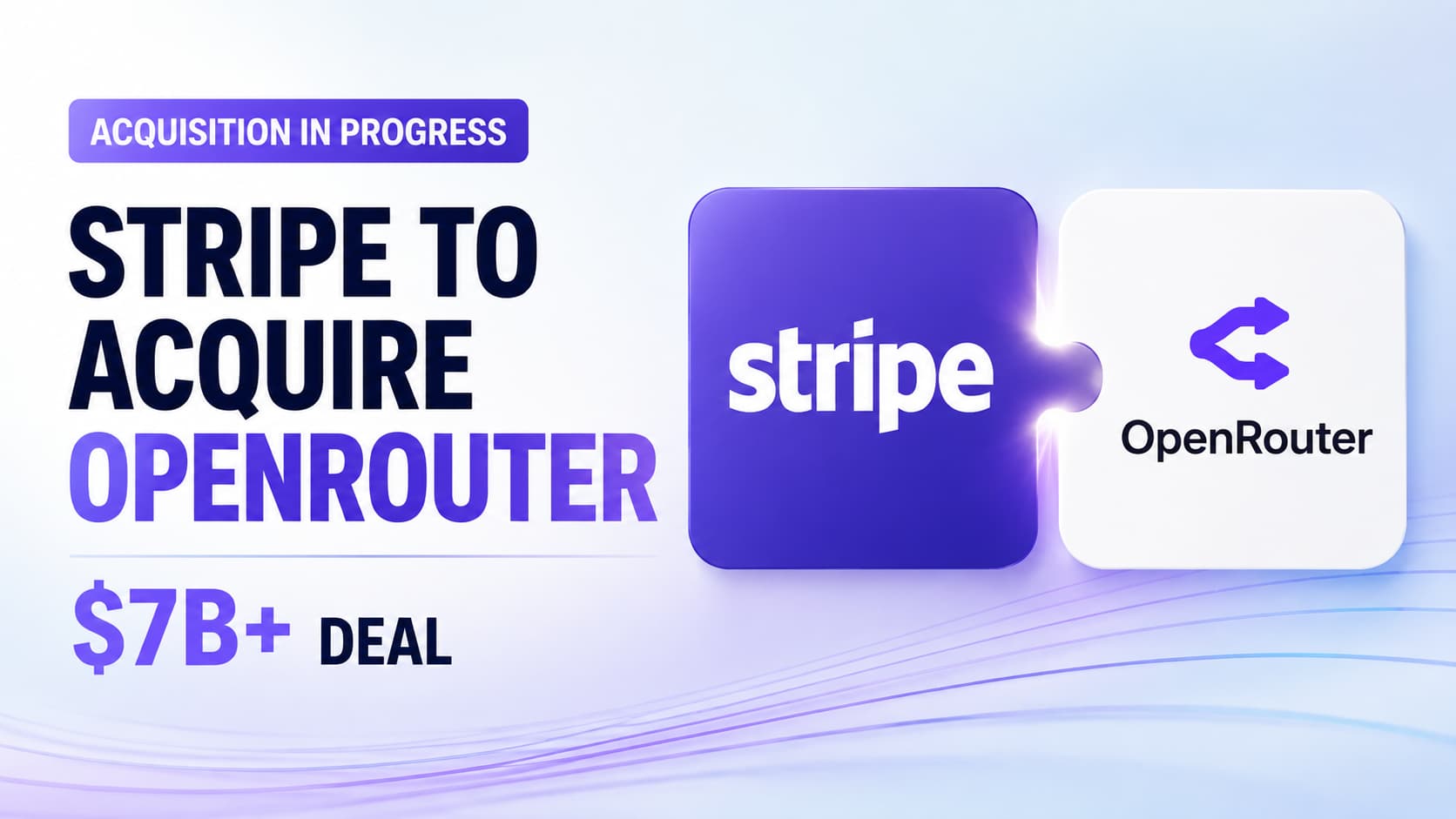
Bloomberg reported that Stripe has agreed to buy OpenRouter for more than $7 billion. The Wall Street Journal had earlier reported that the two sides were discussing a figure closer to $10 billion.
Neither company has confirmed it. Stripe said it does not comment on rumors or speculation, and OpenRouter did not respond. Reports also note the final price could still move, so this remains a deal without an official announcement.
The price is the striking part. Only three months ago, in May, OpenRouter raised a $113 million Series B led by CapitalG at a $1.3 billion valuation, having taken roughly $150 million in total to that point. At $7 billion, that is 5.4 times its worth in three months. Menlo Ventures and Nvidia also joined that round.
The company was founded in 2023 in New York by Alex Atallah, Chris Clark and Louis Vichy. Atallah was part of the founding team at NFT marketplace OpenSea, where he served as CTO. He recently described the company as “Stripe for AI” — and not long after, reports emerged that Stripe wanted to buy it.
The missing piece was only ever one
Reading this as a payments company moving into AI captures half the story. Line up what Stripe has acquired over the past year and the intent becomes legible.
It starts with Metronome, announced last December and closed in January for roughly $1 billion. Metronome is a usage-based billing platform, and OpenAI, Anthropic, Databricks and Nvidia all use it to meter tokens and GPU-seconds into invoices. Stripe took the billing layer for AI companies outright.
On top of that it bought stablecoin infrastructure firm Bridge for $1.1 billion, then added wallet technology Privy and payment orchestration company Orum. Tempo, the payments-specific blockchain Stripe built with Paradigm, launched mainnet in March and includes a protocol that lets software and AI agents settle payments on their own. Stripe’s declaration in May that agents would become transacting parties in their own right belongs to the same arc.
Billing sat with Metronome, settlement with Bridge and Tempo, agent payments with Tempo. The one blank left was the point where tokens are actually consumed. Hold the gateway that model calls pass through, and you can meter spend at its source, then layer billing and settlement on top of it. That is exactly where OpenRouter sits.
Stripe was valued at $159 billion in February and processes about $1.9 trillion a year. At $7 billion, this would be the largest acquisition the company has ever made.
Why OpenRouter would sell
The seller has its own arithmetic. Routing is a structurally thin-margin business: you pay providers at cost and add a fee on top, so at scale your leverage with those providers determines your economics.
The bigger variable is that OpenAI and Google have begun routing inside their own models. When the companies that own the models absorb that work, the middle layer has to justify its existence. Holding 25 trillion tokens a week is as strong a negotiating position as this business is likely to get.
Others reaching for the same layer
Attempts to own a layer above the models are coming from several directions.
Selling inference cheaper and faster is the play at Fireworks AI and Groq. Groq in particular signed a $20 billion licensing deal with Nvidia, dropped its chip business for an inference cloud, and restarted this month with a $350 million Series A. Unlike OpenRouter, which brokers across providers, these companies run the models on their own infrastructure.
On the payments side, agent-native infrastructure startups keep appearing, aiming at the stretch where an agent spends money on its own behalf. If Stripe absorbs OpenRouter, the barrier to entry in that market rises a step.
Meanwhile the largest AI companies are buying infrastructure layers directly. OpenAI recently acquired presentation startup NextSlide, and SpaceX closed its $60 billion purchase of Cursor. Those who own the models are buying applications; those who own payments are buying metering.
MORE FROM THE POST
- Multi-Silicon Inference Cloud Gimlet Labs Raises $300M Series B
- Google Ties Marvell TPU Chip Deal to a $12.2B Equity Warrant
- Rillet Achieves Unicorn Status With $100M Series C Funding
- Etched Raises $700M at $21B Valuation After Jane Street Tested Its Chip
- Naver and Dunamu Merge to Build AI-Powered Web3 Platform with $6.8 Billion Investment
Share

Most Read
- 1
- 2
- 3
- 4
- 5

Leave a Reply